
By James Morris, GlobeScan
The landscape of corporate sustainability is undergoing a profound transformation. For decades, the intellectual and regulatory center of gravity for environmental, social, and governance (ESG) standards was firmly rooted in Western markets, particularly North America and Europe. However, a new report published by GlobeScan and BSR signals a historic shift: the monopoly of Western influence is fracturing, giving way to a multi-polar environment where sustainability leadership is increasingly being defined in Asia-Pacific, the European Union, and emerging markets.
As sustainability professionals at the world’s largest corporations navigate a landscape characterized by tighter budgets, intense regulatory scrutiny, and a narrowing focus on compliance-driven outcomes, the fundamental question arises: Who is setting the agenda for the future?
Main Facts: A Pivot Toward Regional Diversity
Recent research conducted in the spring of 2026, surveying 124 sustainability experts from firms with over $1 billion in annual revenue, paints a clear picture of an industry in transition. The era of "global standardization" led primarily by U.S.-centric models is receding. In its place, we are seeing a fragmented but dynamic ecosystem where regional influence is becoming the primary driver of corporate strategy.
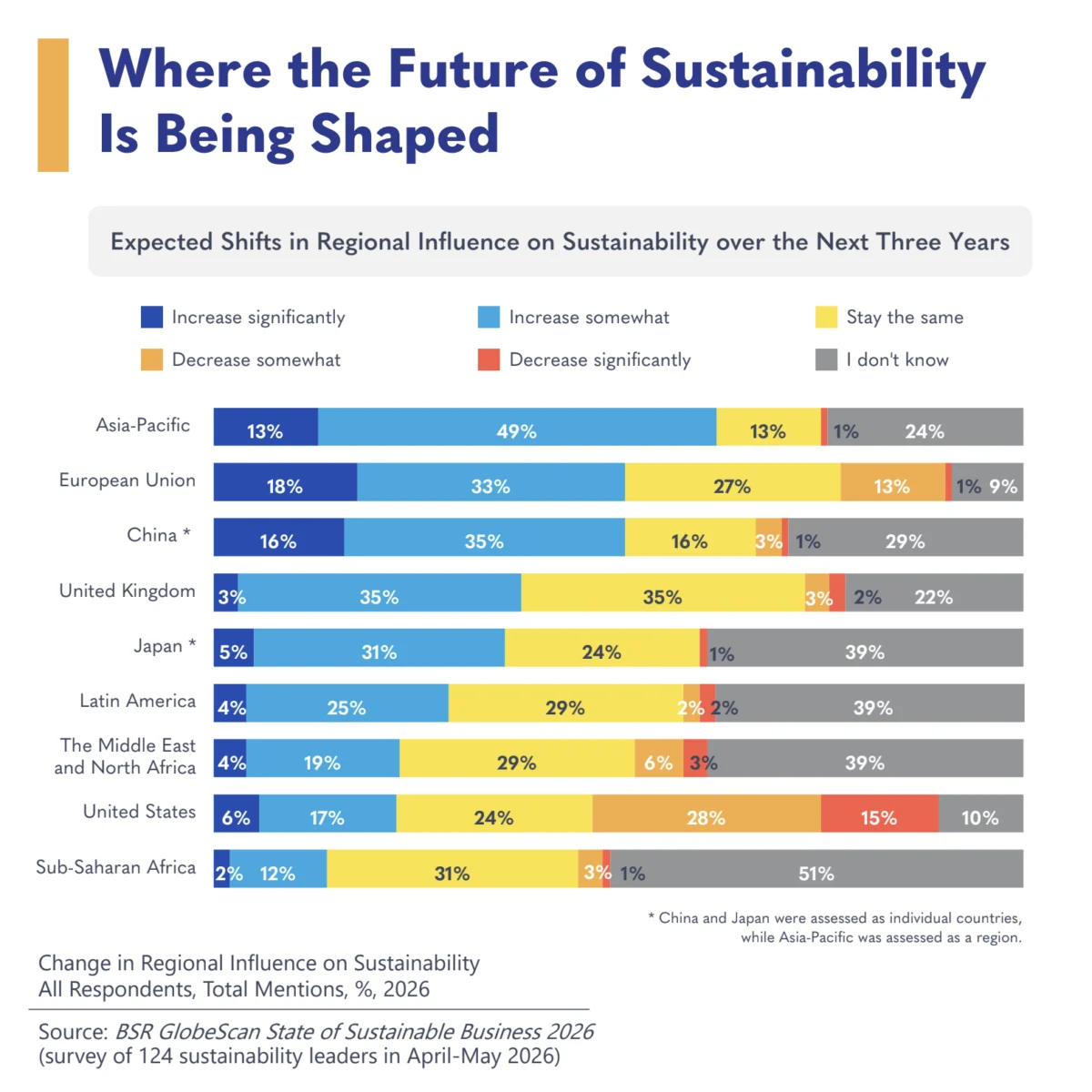
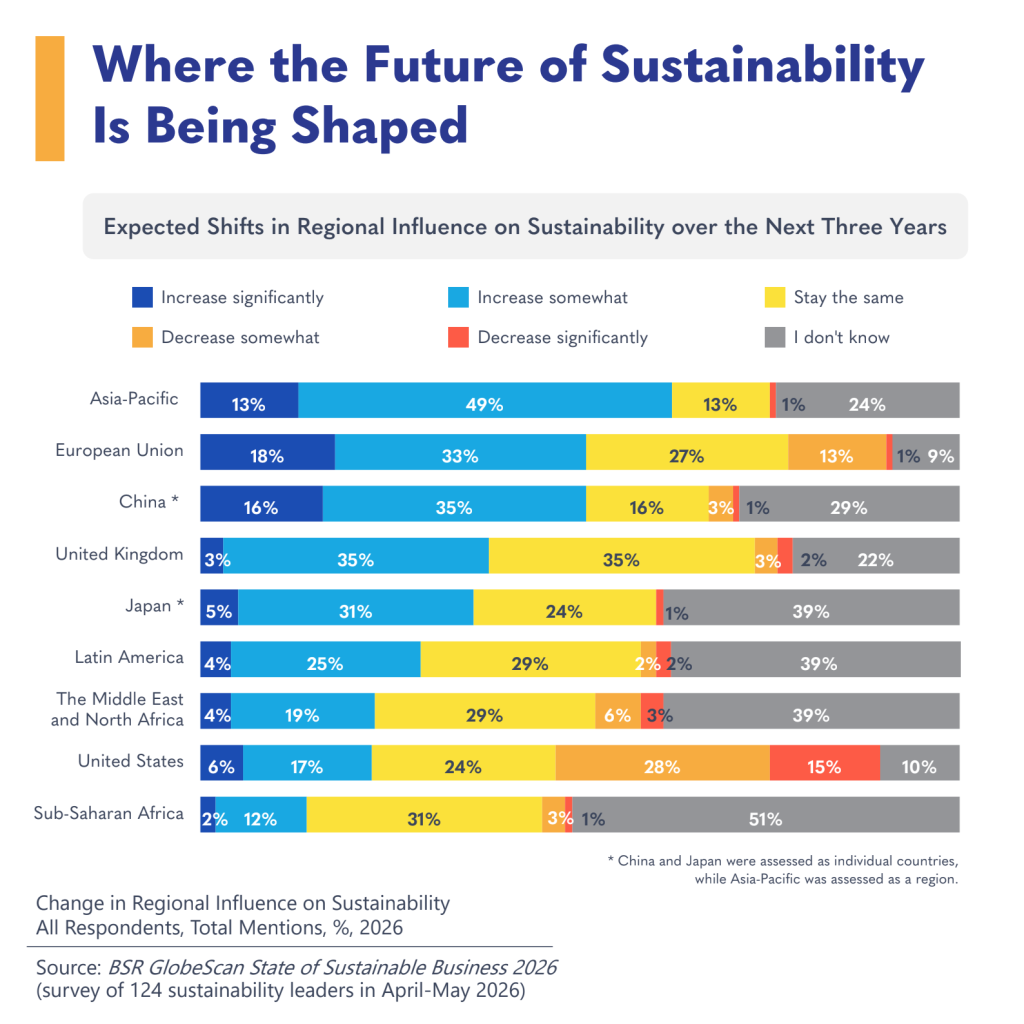
The most striking finding is the ascent of the Asia-Pacific (APAC) region. Nearly two-thirds of sustainability leaders surveyed expect APAC’s influence to grow significantly over the next three years. This is not merely a reflection of manufacturing scale; it is an acknowledgement of the region’s growing role in standard-setting, policy innovation, and the scaling of green technologies.
Conversely, the data reveals a marked decline in expectations for the United States. Only 23 percent of respondents believe the U.S. will gain influence in shaping sustainability priorities, while 43 percent anticipate a decline. This represents a significant psychological and strategic shift, as global companies begin to view the U.S. not as the primary architect of future sustainability norms, but as a market that is increasingly out of step with global trends.
Chronology of Change: From Voluntary to Mandatory
To understand how we reached this inflection point, we must look at the evolution of the corporate sustainability mandate over the last five years:

- 2021–2022: The Peak of Voluntary Ambition. The immediate post-pandemic era was marked by a surge in "Net Zero" commitments. Companies vied for the most ambitious targets, often driven by investor pressure and a booming market for green bonds. The focus was on broad, aspirational goals.
- 2023–2024: The Reality Check. As macroeconomic headwinds—inflation, energy crises, and supply chain fragility—took hold, the "sustainability-first" mentality faced a reality check. Resources became tighter, and the "ESG backlash" in certain political spheres, particularly in the U.S., forced firms to move from bold pledges to defensive posture.
- 2025: The Regulatory Tsunami. With the implementation of directives like the EU’s Corporate Sustainability Reporting Directive (CSRD), the focus shifted abruptly from "marketing and aspiration" to "compliance and transparency." This was the death knell for vague sustainability claims.
- 2026: The Regional Realignment. As of this year, the focus has narrowed. Companies are now optimizing for specific regulatory environments. Sustainability is no longer a monolithic global program; it is a localized, high-stakes operational necessity.
Supporting Data: Mapping the Shifting Influence
The quantitative data provided by GlobeScan and BSR provides a roadmap of this shifting power dynamic. When respondents were asked to project the evolution of regional influence over the next 36 months, the results were definitive:
| Region | Expected Influence Growth | Expected Influence Decline |
|---|---|---|
| Asia-Pacific | 64% | 12% |
| European Union | 58% | 15% |
| China | 52% | 18% |
| Latin America | 38% | 22% |
| Middle East & N. Africa | 35% | 25% |
| United States | 23% | 43% |
These figures suggest a "great rebalancing." The European Union continues to hold the gold standard for regulatory rigor, cementing its role as a global rule-maker. Meanwhile, China’s aggressive pursuit of green tech and the rapid development of local carbon markets are positioning it as a mandatory stop for any global organization looking to manage its Scope 3 emissions.
The emergence of Latin America and the MENA region—while currently lower in absolute terms—marks a shift in corporate attention toward these regions as critical hubs for the "S" (social) and "G" (governance) components of sustainability, specifically regarding human rights in supply chains and the transition to renewable energy.
Official Perspectives: The Professional Consensus
Sustainability practitioners currently find themselves in a "compliance trap." With budgets under pressure, departments are being asked to do more with less.
"We are seeing a move away from the ‘North Star’ model of sustainability," says one senior executive from a Fortune 500 company who participated in the survey. "Previously, we had a global strategy that we imposed on all regions. Now, we are being forced to adopt a modular approach. If you aren’t compliant in the EU, you lose market access. If you aren’t aligned with China’s green manufacturing standards, you lose your competitive edge in the supply chain. The U.S. is becoming less relevant in terms of setting the standard, even if it remains a key consumption market."
This professional consensus highlights a shift from "values-based sustainability" to "value-chain sustainability." Professionals are no longer tasked with championing corporate purpose; they are tasked with risk mitigation and ensuring that the company’s operational footprint complies with an increasingly fragmented web of regional requirements.
Implications for Global Strategy
The findings of this report carry profound implications for how global corporations must structure their sustainability functions in the coming decade.
1. The Death of the One-Size-Fits-All Approach
Global sustainability departments must decentralize. The strategy that works for a firm in Brussels will likely fail in Shenzhen or São Paulo. Companies must empower regional heads to interpret local regulations and sustainability expectations, creating a "federated" model of governance rather than a centralized, top-down structure.
2. Prioritization as a Survival Skill
With resources tightening, "doing everything" is no longer an option. The data shows that firms are narrowing their focus. This is a positive development, as it forces companies to abandon "greenwashing" initiatives that lack depth. By focusing on the most material issues—be it decarbonization in the supply chain or circular economy practices in manufacturing—companies can achieve deeper, more measurable impact.
3. Regulatory Fluency is the New Competitive Advantage
The ability to navigate regional regulations is becoming the primary differentiator between market leaders and laggards. Firms that invest in "regulatory intelligence"—the ability to anticipate and adapt to shifting standards in APAC, the EU, and beyond—will outperform those that wait for the U.S. to set the trend.
4. Acknowledging the "U.S. Disconnect"
For U.S.-headquartered companies, the risk of isolation is real. By focusing exclusively on the domestic political landscape, these firms risk ignoring the global standards that are rapidly becoming the new "rules of the road" for international trade. The challenge for these organizations will be to reconcile their domestic strategies with a global reality that is moving in a different direction.
Conclusion: A New Era of Pragmatism
The research from GlobeScan and BSR serves as a wake-up call. The era of sustainability as an abstract, globalized ideal is over. We have entered an era of sustainability as a pragmatic, regionalized, and highly regulated operational reality.
As the world’s influence centers shift toward Asia and Europe, and as emerging markets begin to dictate the terms of trade, global corporations must adapt. The companies that succeed will be those that can synthesize these disparate regional signals into a strategy that is simultaneously coherent at the board level and hyper-relevant on the ground.
The future of sustainability is no longer being shaped in a single boardroom in New York or London. It is being shaped in the industrial hubs of the Asia-Pacific, in the legislative chambers of the European Union, and in the resource-rich corridors of the Global South. For those willing to listen, the signals are clear: the world is changing, and the sustainability agenda is changing with it.