The era of Artificial Intelligence (AI) in telecommunications has officially transitioned from experimental trials to tangible, commercial network applications. In 2026, leading operators are leveraging AI to achieve unprecedented levels of efficiency, driving down energy consumption, automating complex network operations, optimizing spectrum utilization, and significantly reducing operating costs. The results are no longer theoretical; they are quantifiable, demonstrating a clear return on investment for AI adoption.
The AI Imperative: A New Dawn for Network Operations
For years, the telecommunications industry has been exploring the potential of AI to address the ever-increasing demands of a data-driven world. Now, in 2026, this potential is being realized. The inherent complexity of modern 5G networks, coupled with the relentless growth in data traffic, has created an urgent need for intelligent automation and optimization. AI is emerging as the critical enabler, moving beyond simple data analysis to actively manage and enhance network performance.
The benefits are far-reaching. Operators are reporting substantial reductions in energy consumption, a critical factor given rising energy prices and increasing environmental consciousness. Network operations, traditionally a labor-intensive and reactive process, are becoming proactive and automated, freeing up human capital for more strategic tasks. Furthermore, AI’s ability to unlock greater efficiency from existing spectrum resources is paramount in an era where spectrum acquisition is increasingly challenging and expensive.
This shift signifies a fundamental change in how telecommunications networks are managed and operated. The focus is moving from merely keeping the lights on to actively optimizing every aspect of the network for maximum performance, efficiency, and cost-effectiveness. The following groundbreaking projects highlight the measurable impact of AI across the global telecom landscape in 2026.
Leading Telecom AI Projects in 2026: A Snapshot of Progress
The landscape of AI in telecommunications is rapidly evolving, with operators worldwide demonstrating impressive gains. These initiatives showcase the diverse applications of AI, from core network optimization to customer service enhancements and internal operational efficiencies.
Deutsche Telekom: Pioneering Energy Efficiency in the 5G Core
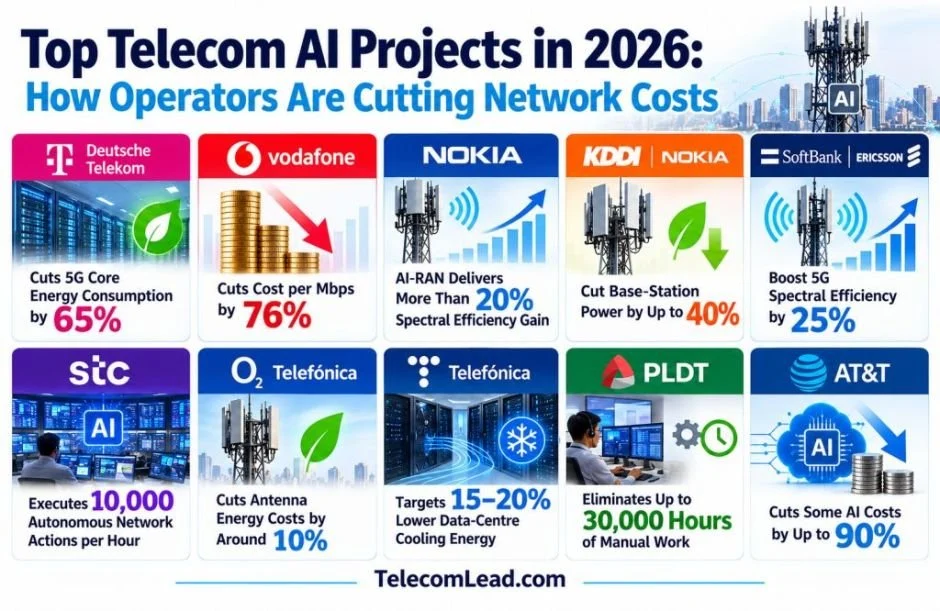
Deutsche Telekom stands at the forefront of energy conservation, having achieved a remarkable up to 65 percent reduction in 5G core energy consumption. This groundbreaking achievement, dubbed "Full Stack Energy Efficiency," is a testament to a holistic approach that dynamically adjusts computing and network resources based on real-time demand. Instead of maintaining a constant high level of infrastructure activity, Deutsche Telekom’s system intelligently scales resources up or down as needed, embodying the principle of "Zero Bits, Zero Watts."
The technology, developed in collaboration with industry giants like Lenovo, HPE, AMD, and Mavenir, initially focused on demand-driven resource control and hardware/software optimization. However, the next crucial step involves integrating AI algorithms. These AI-powered solutions will proactively predict traffic demand, enabling the network to activate resources in anticipation of increased usage, further solidifying energy savings. For telecom operators, such significant reductions in power consumption translate directly into lower operational expenditure (OpEx), a vital consideration in a competitive market. This project underscores the growing importance of sustainability within the telecommunications sector.
Vodafone: A Comprehensive AI-Driven Efficiency Program
Vodafone has emerged as a leading example of AI’s broad impact, showcasing significant improvements across its operations. Their Fiscal Year 2026 results reveal that Generative AI (GenAI)-based Zero Touch Operations have achieved over 70 percent automated resolution of network issues. This level of automation not only streamlines problem-solving but also contributes to a substantial 76 percent reduction in cost per Megabit per second (Mbps) through centralized international network management.
Beyond network operations, Vodafone’s AI initiative extends to customer service and software development. Their GenAI customer assistant, SuperTOBi, boasts over 70 percent end-to-end resolution rates, while AI-powered customer-value management has slashed campaign analysis time by an impressive 85 percent. Furthermore, more than 5,000 developers are utilizing GenAI coding tools, leading to a 12 percent productivity improvement across the software development lifecycle. These multifaceted applications demonstrate Vodafone’s strategic commitment to leveraging AI for holistic business transformation.
Nokia AI-RAN: Enhancing Spectrum Efficiency for Future Growth
In a sector where spectrum is a finite and invaluable resource, Nokia’s AI-RAN (Radio Access Network) technology is poised to become strategically critical. The company reports that its AI-powered radio innovations have demonstrated over 20 percent improvement in spectral efficiency. By integrating Nokia’s RAN software with NVIDIA’s Aerial platform, AI processing is brought closer to the radio network, enabling more intelligent and responsive resource allocation.
This AI-RAN program involves a growing consortium of global operators, including A1 Group, Chunghwa Telecom, du, e&, Mobily, stc, TPG Telecom, and Zain Saudi Arabia. While a 20 percent spectral efficiency gain doesn’t magically create more spectrum, it allows operators to carry significantly more traffic over their existing spectrum holdings. This capability is crucial for enhancing network capacity without the immediate need for costly spectrum acquisition or extensive cell-site expansion. Nokia is ambitiously targeting approximately 50 percent spectral efficiency gains by 2027 and over 100 percent by 2028, setting aggressive benchmarks for the future of radio access.
KDDI and Nokia: Revolutionizing Base Station Power Consumption
A collaborative effort between KDDI Research and Nokia Bell Labs has yielded impressive results in reducing base station energy consumption. Their Intelligent 4D Resource Optimization Technology has demonstrated up to approximately 40 percent lower power consumption while maintaining equivalent throughput. This innovative technology simultaneously manages four critical radio resources: time, frequency, space, and transmission power.
The March 2026 proof of concept not only achieved significant power savings but also demonstrated the potential for up to four times the throughput without an increase in power consumption compared to existing 5G base-station equipment. This dynamic coordination of network resources, rather than optimizing individual parameters in isolation, offers a powerful pathway to increase network capacity without a corresponding rise in energy expenditure. This project highlights the sophisticated ways AI can optimize the physical infrastructure of mobile networks.
SoftBank and Ericsson: Real-World Spectral Efficiency Gains
SoftBank and Ericsson have taken AI integration a step further by testing AI directly within a live, commercial 5G network in Japan. The results are compelling: Ericsson’s AI-native Scheduler for Link Adaptation has delivered up to 25 percent higher spectral efficiency and 50 percent higher downlink user throughput. Across evaluated locations, average spectral efficiency and downlink throughput saw an improvement of approximately 10 percent.
The significance of this trial lies in its execution on a commercial network, providing a realistic assessment of AI’s capabilities beyond laboratory settings. For operators, consistently extracting more traffic capacity from existing spectrum is a critical strategy for managing mobile data growth and deferring the need for additional infrastructure investments. This project provides concrete evidence of AI’s ability to enhance the economic viability of existing spectrum assets.
Automation Takes Center Stage: Streamlining Network Operations
The drive towards autonomous networks is accelerating, with AI playing a pivotal role in automating complex tasks and decision-making processes.
stc: Executing Thousands of Autonomous Network Actions Hourly
Saudi operator stc is a prime example of AI driving network operations towards unprecedented levels of autonomy. Utilizing Nokia’s MantaRay AutoPilot, stc’s network is performing approximately 10,000 autonomous corrective actions every hour. This level of automated intervention is crucial for maintaining network stability and performance in real-time.
The deployment has already yielded significant benefits, including a 30 percent increase in cell utilization and an average 10 percent improvement in downlink throughput. Furthermore, AI-powered RAN energy management has independently achieved an average 6 percent reduction in energy consumption without compromising key network performance indicators (KPIs). At this scale of autonomous action, manual intervention becomes entirely impractical, making AI an indispensable operating mechanism for detecting, analyzing, and rectifying network issues automatically.
O2 Telefonica Germany: Enhancing Network Operations and Energy Management
O2 Telefonica Germany is strategically combining AI-based network operations with energy management solutions. Their Network Operations Agent (NOA) empowers engineers by facilitating faster incident analysis, root cause identification, troubleshooting, and information retrieval. This intelligent assistance streamlines the resolution process for network engineers.
Complementing these operational efficiencies, AI-supported energy-saving functions dynamically adapt frequency bands and network capacity in response to fluctuating traffic demand. These integrated measures are reportedly reducing electricity costs across their antenna network by around 10 percent. O2 Telefonica’s broader Autonomous Network Journey aims for Level 4 autonomous network operations by 2030, a vision that hinges on AI’s ability to handle numerous operational processes autonomously within defined policy frameworks.
Telefonica Germany: Driving Data Centre Energy Efficiency with AI
Telefonica Germany, in partnership with EkkoSense, is implementing a sophisticated AI-driven approach to improve thermal management in data centers and technical infrastructure sites. By deploying IoT sensors, advanced analytics, and a real-time 3D digital twin, they are gaining unprecedented visibility into operational conditions. Initial evaluations suggest a promising 15-20 percent reduction in cooling-system energy consumption.
This AI digital-twin project continuously monitors equipment and thermal conditions, actively identifying inefficiencies that can be addressed. The financial benefits extend beyond immediate electricity savings, as enhanced visibility into infrastructure capacity can help avoid unnecessary capital expenditures. Proactive maintenance is also bolstered by predictive alerts, enabling timely interventions. Telefonica plans to progressively roll out this technology to its highest energy-consuming sites, prioritizing impactful energy conservation efforts.
Beyond the Network: AI’s Impact on Productivity and Cost Management
The transformative power of AI is not confined to the network infrastructure itself; it is also revolutionizing back-office operations and addressing the rising costs associated with AI deployment.
PLDT: Eliminating Thousands of Hours of Manual Work with Agentic AI
Philippine operator PLDT is demonstrating how AI can generate significant savings beyond the traditional network domain. Through a collaboration with UiPath, PLDT has deployed agentic AI across critical areas such as knowledge retrieval, customer engagement, and risk assessment.
Their KAI knowledge agent is a prime example, transforming information searches that previously took up to five days into contextual responses delivered in mere seconds. UiPath estimates that KAI eliminates an astonishing 25,000 to 30,000 hours of manual work annually, equivalent to the productivity capacity of approximately 12 full-time employees.
Further enhancing productivity, PLDT’s Ellie digital assistant provides customer responses up to 80 percent faster, generating an additional 18,000 to 25,000 hours of annual productivity capacity. The ERICA risk-intelligence agent has also dramatically reduced manual risk assessment efforts by an impressive 97-99 percent. This deployment highlights the strategic advantage operators gain by extending AI into knowledge management, customer operations, and enterprise workflows.
AT&T: Optimizing AI Costs with Intelligent Routing
As AI adoption scales, the cost of running these sophisticated models becomes a significant consideration. AT&T is proactively addressing this challenge with its intelligent AI Gateway. Processing an average of 45 billion AI tokens daily, AT&T’s gateway evaluates a multitude of factors – including cost, speed, and expected output quality – before selecting the most appropriate AI model for each task.
This intelligent routing strategy has led to reductions in some AI costs by as much as 90 percent, generating millions of dollars in savings. The US operator is also investing in developing telecom-specific AI models, such as its OTel 2.0 model, which has been post-trained using extensive datasets on advanced hardware. AT&T’s AI Gateway strategy underscores a crucial emerging challenge for the telecom industry: optimizing not only the benefits derived from AI but also the significant costs associated with its operation.
Implications and the Future of Telecom AI
The leading telecom AI projects of 2026 clearly point to three primary areas of financial impact: energy efficiency, network capacity, and automation. The measurable improvements in energy per bit, cost per Mbps, spectrum efficiency, network automation, and employee productivity are setting new competitive benchmarks.
While some of these results are still in the trial or initial evaluation phases, the overarching trend is undeniable. The telecommunications industry is embracing AI not as a futuristic concept but as a practical, indispensable tool for driving operational excellence and financial performance. The journey towards fully autonomous networks and AI-native operations is well underway, promising a more efficient, sustainable, and cost-effective future for telecommunications. The competitive advantage in the coming years will undoubtedly belong to those operators who can most effectively harness the power of artificial intelligence.