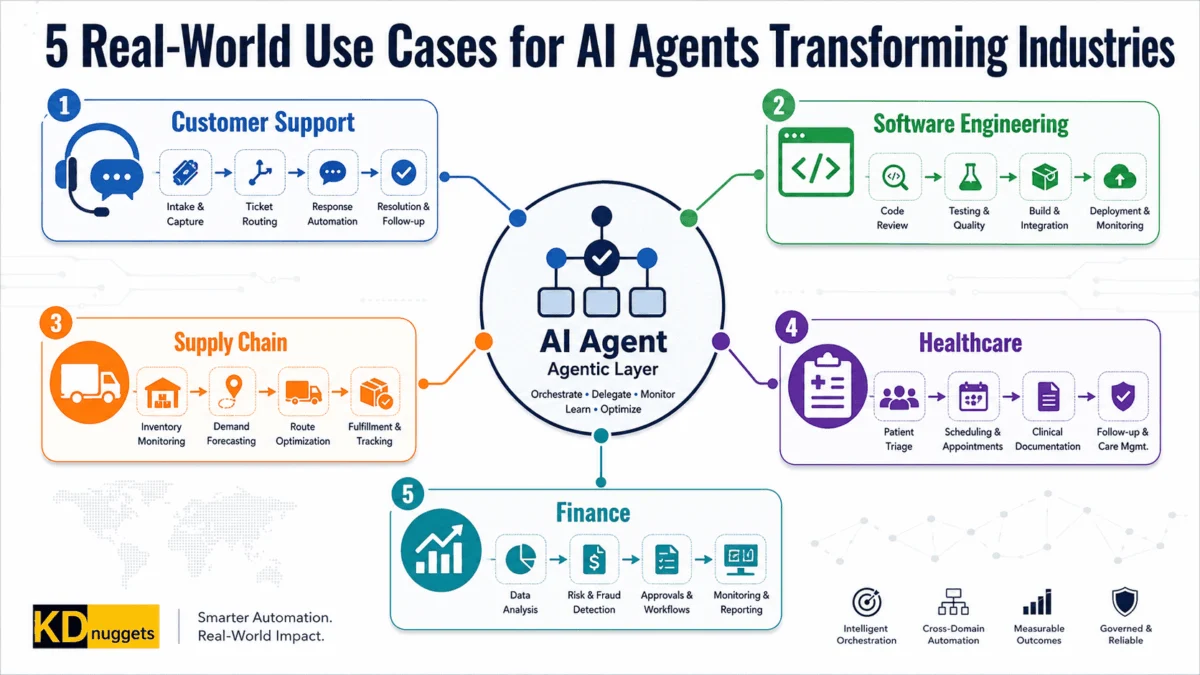
The year 2026 marks a watershed moment in the history of artificial intelligence. We have officially exited the "Chatbot Era"—a period defined by passive, prompt-dependent systems—and entered the era of Agentic AI. Unlike their predecessors, which served primarily as sophisticated text generators, autonomous agents act as digital employees capable of planning, executing, and adapting to multi-step workflows across disparate software ecosystems.
These agents do not merely suggest answers; they navigate CRM databases, execute code, negotiate logistics, and conduct financial forensic investigations without the need for constant human intervention. As businesses worldwide scramble to integrate these systems, the enterprise landscape is undergoing a fundamental transformation in labor, efficiency, and decision-making.
The Chronology of Evolution: From Chatbots to Agents
To understand the current state of agentic AI, one must look at the rapid progression of the technology over the last 36 months.
- 2023: The Generative Inflection Point: The world was captivated by Large Language Models (LLMs) that could write essays and debug basic code. However, these systems were "stateless"—they had no memory of external tools and required human prompts for every individual action.
- 2024: The Tool-Use Breakthrough: Developers began "hooking" LLMs into APIs. This allowed models to search the web or query databases, but the systems remained fragile, often failing when a sequence of tasks deviated from the expected path.
- 2025: The Rise of Reasoning Models: With the advent of advanced reasoning architectures, AI began to "think" before acting. Agents gained the ability to backtrack, correct their own errors, and maintain long-term goal alignment.
- 2026: Enterprise Production: AI agents are now standard in high-stakes environments. They are no longer experimental toys; they are essential infrastructure, managing supply chains, healthcare records, and cybersecurity protocols in real-time.
Five Pillars of Transformation: Real-World Use Cases
The shift toward agentic AI is not uniform; it is concentrated in sectors where high-volume, repetitive, and time-sensitive execution is the norm.
1. The Autonomous Customer Support Lifecycle
The modern customer experience is omnichannel, spanning email, WhatsApp, and live web portals. Traditional chatbots often failed because they operated in silos. Today’s AI agents serve as "orchestrators," integrated deeply into CRMs like Salesforce or Zendesk.
- The Workflow: When a customer requests a refund for a lost shipment, an agent doesn’t just reply with a template. It verifies the tracking status via a logistics API, checks the user’s account history, processes the credit, and sends a personalized notification—all without human oversight.
- Strategic Shift: This allows human support staff to pivot away from low-value "ticket clearing" and focus on high-empathy, relationship-driven conflict resolution.
2. Software Engineering: The "Agentic Developer"
Perhaps the most dramatic shift is occurring in the software development lifecycle (SDLC). Autonomous coding agents—such as those utilizing frameworks like SWE-agent—can now take a high-level Jira ticket, perform a deep search of a massive codebase, implement the necessary code, write unit tests to ensure stability, and submit a formal pull request for a senior engineer to review.
- Implications: The role of the developer is evolving from "writer of code" to "architect of systems." By delegating the boilerplate and bug-fixing phases to agents, human engineers are freed to focus on high-level architectural design and system security.
3. Supply Chain Resilience in an Unstable World
Global logistics is currently a fragile web of port delays, geopolitical shifts, and raw material scarcity. Multi-agent systems (MAS) are now the backbone of modern supply chain management.
- Operational Execution: By utilizing multi-agent reinforcement learning (MARL), these systems can negotiate with suppliers, re-route cargo in response to weather patterns, and adjust inventory orders based on real-time market demand. What once took a team of logistics managers days to resolve now happens in seconds as agents autonomously communicate across the value chain.
4. Clinical Triage: Reclaiming Physician Time
Healthcare faces a systemic crisis of administrative burnout. Studies indicate that for every hour of patient care, physicians often spend two hours on documentation. AI agents are bridging this gap by handling the "administrative layer" of medicine.
- The Application: These agents securely aggregate patient vitals, synthesize notes from multiple visits, ensure billing codes are accurate, and manage appointment scheduling. By offloading this burden, the "human touch" in medicine is being preserved, as physicians spend more time with patients and less time staring at EHR (Electronic Health Record) interfaces.
5. Financial Forensics and Fraud Detection
The arms race between financial institutions and sophisticated fraud syndicates has reached a breaking point. Rule-based systems have historically been too rigid, leading to massive volumes of "false positives" that bury compliance teams.
- Contextual Intelligence: AI agents now perform deep, contextual investigations into flagged transactions. They can correlate cross-platform data—identifying patterns that span across credit cards, bank accounts, and digital wallets—to determine if an anomaly is genuine fraud or a legitimate customer action.
Supporting Data and Industry Implications
The economic data surrounding this transition is compelling. Early reports from enterprise sectors indicate that companies adopting autonomous agents report an average 30–40% increase in workflow throughput within the first six months.
However, the transition is not without friction. As agents assume control over execution, the "Human-in-the-Loop" (HITL) model is being redefined. In 2026, the human role is increasingly focused on:
- Exception Handling: Managing the 5% of cases that fall outside the agent’s logic.
- System Oversight: Auditing agent decisions to ensure compliance and ethical alignment.
- Strategy Formulation: Defining the high-level goals that the agents will then execute.
Expert Perspective: A Note from Vinod Chugani
Vinod Chugani, a leading educator in the AI space, emphasizes that this shift is not about "replacing" professionals, but about augmenting their capability. "The transition from generative AI to agentic AI marks the moment when technology moves from answering questions to actively doing the work," Chugani notes. "We are moving into a future where the division of labor between human and machine is clearly defined: the machine handles the high-volume, rule-bound execution, while the human assumes the mantle of strategic decision-maker."
Chugani’s pedagogical approach—bridging the gap between theory and practical application—is becoming essential for professionals trying to navigate this landscape. For those looking to build their own agents, the path involves moving beyond simple prompt engineering toward mastering frameworks like LangChain and understanding the nuances of multi-agent orchestration.
The Road Ahead
As we look toward the remainder of the decade, the integration of agentic AI is expected to accelerate. The competitive advantage will belong to those organizations that can successfully build and maintain an ecosystem where AI agents and human workers operate in tandem.
The technology is ready, the frameworks are open-source, and the business case is proven. The question for enterprises is no longer if they should implement agentic AI, but how quickly they can re-architect their operations to leverage the autonomy that these systems provide. Whether in the coding repository, the hospital wing, or the financial compliance department, the era of the autonomous agent is here to stay.