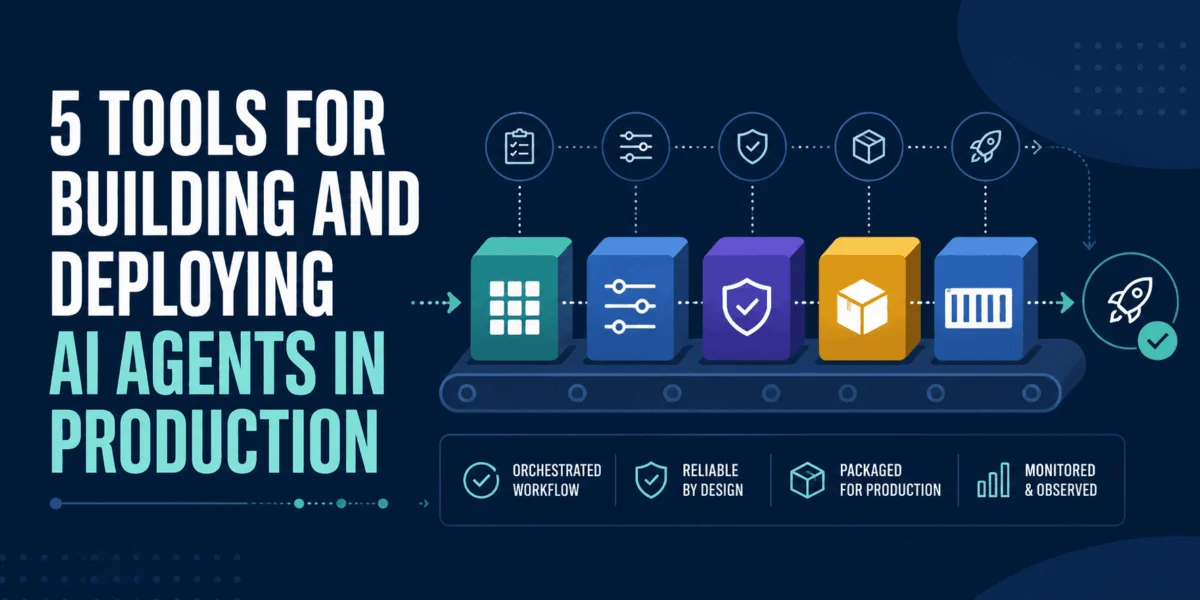
Building an AI agent in a Jupyter notebook is a task that can be accomplished in a single afternoon. However, the transition from a local script to a production-grade system—capable of navigating real-world traffic, surviving midnight system crashes, and maintaining data integrity—is a Herculean effort that many development teams vastly underestimate.
Current industry data suggests that only a small fraction of generative AI pilots successfully make the leap to production. The primary bottleneck is rarely the Large Language Model (LLM) itself; rather, it is the absence of a robust, multi-layered infrastructure beneath the model. As we look toward the landscape of 2026, it is clear that successful production agents rely on a specialized stack of five distinct layers: logic, sandboxing, memory, observability, and scalable infrastructure.
1. The Logic Layer: Orchestrating Complexity with LangGraph
A standard agent loop is essentially a basic Python while loop that calls an LLM. While sufficient for simple tasks, this approach collapses the moment the agent requires branching logic, retries for failed tool calls, human-in-the-loop approvals, or the ability to resume after a server restart.
The Shift to State Machines
LangGraph has emerged as the industry standard for moving beyond "flat" agentic chains. By representing an agent as a directed graph, LangGraph treats execution as a series of state transitions. Nodes act as functions, and edges dictate the conditional routing. Because every transition is automatically checkpointed, developers gain the ability to perform time-travel debugging and implement complex pause-and-resume workflows.
Production Reality: Persistence
While the default in-memory checkpointer is suitable for rapid prototyping, it is insufficient for production. Moving to a Postgres-backed checkpointer is the pivotal moment a LangGraph project transitions from a script to professional infrastructure. Industry leaders like Klarna, LinkedIn, and Uber have adopted this architecture, contributing to a repository that has garnered over 30,000 GitHub stars.
2. The Sandbox Layer: Secure Code Execution with E2B
When an AI agent is empowered to write and execute its own code, it creates an immediate security vulnerability. Running model-generated Python directly on your host server is an invitation for catastrophe. You require an ephemeral, isolated environment that can be destroyed the moment a task concludes.
Firecracker MicroVMs
E2B addresses this by providing secure, sandboxed environments powered by Firecracker microVMs. Unlike standard containers, which share the host kernel, these microVMs provide a hardware-level security boundary. This is critical for companies like Perplexity, Hugging Face, and Groq, which require high-frequency code execution without risking the integrity of their core infrastructure.
The Tradeoff
E2B is optimized for short-lived, ephemeral tasks—such as script execution or code verification. Its tier-based runtime limits (e.g., 24 hours on Pro plans) mean it is less suited for agents that must maintain a persistent, long-running state. For those use cases, architects must look toward the memory and infrastructure layers.
3. The Memory Layer: Contextual Continuity with Mem0
LLMs are inherently stateless; every interaction begins from a blank slate. Without a memory layer, agents suffer from "amnesia," failing to retain user preferences or the context of multi-day workflows.

Intelligent Retrieval
Mem0 acts as an intelligent memory layer, extracting pertinent facts from conversations and storing them in a vector database. It leverages a hybrid approach of semantic similarity, keyword matching, and entity matching to inject relevant context before the model generates a response.
Strategic Pairing
Mem0 is most effective when paired with a framework like LangGraph. While LangGraph manages thread-scoped state and fault tolerance, Mem0 manages long-term, cross-thread memory. This synergy allows the agent to recall specific user preferences across completely separate sessions, providing a seamless experience that feels human-like.
4. The Observability Layer: Debugging with LangSmith
An agent that fails silently is far more dangerous than one that fails loudly. When an agent enters production, "observability" becomes non-negotiable. You need a comprehensive record of every decision, tool call, and observation to ensure that when an incident occurs, you are debugging from evidence rather than speculation.

Tracing vs. Logging
LangSmith provides a platform for tracing, evaluating, and deploying agents. Unlike standard logging, tracing allows developers to replay a specific run, identifying the exact moment an agent diverged from its intended logic.
Economic Implications
For growing teams, the barrier to entry is low. LangSmith’s free tier allows for 5,000 traces per month, with a scalable Plus tier that accommodates larger enterprise volumes. By integrating observability from the first version, teams can reduce the time-to-resolution for complex bugs from days to minutes.
5. The Infrastructure Layer: Scaling with Modal
Once logic, sandboxing, memory, and observability are established, the final challenge is hosting. Agent workloads are notoriously "bursty"—they may remain idle for hours before spiking during high-traffic windows.

Serverless Efficiency
Modal provides a serverless compute platform tailored for AI. It allows for rapid scaling—spinning up infrastructure as needed and scaling to zero when the task is complete. This has proven essential for companies like DoorDash, Anthropic, and Meta. Reports from Sacra indicate that Modal’s growth has been explosive, with annualized revenue reaching an estimated $300 million by April 2026.
The Latency Factor
A critical metric for agent workloads is "cold-start time." Modal’s GPU memory snapshots can reduce cold-start latency by up to 10x, a factor that is negligible in a local environment but vital when running thousands of agent sessions daily.
Chronology of Adoption
The path to a mature AI agent typically follows a specific chronological order:

- Logic (Build): The primary agentic flow is established using a framework like LangGraph.
- Sandbox (Isolation): A secure execution layer is added to manage LLM-generated code.
- Observability (Monitoring): Tracing is wired in early to identify failure points.
- Memory (Context): A memory layer is introduced to improve user experience and consistency.
- Infrastructure (Scale): The system is migrated to a scalable platform like Modal for production deployment.
Implications for the Future of AI
The era of the "monolithic agent" is ending. The teams that successfully deploy agents in 2026 and beyond are not searching for a "silver bullet" framework. Instead, they are treating these five layers as distinct, solvable engineering challenges.
By deconstructing the agent into these modular components, organizations can create systems that are not only performant but also maintainable and secure. As LLMs become more commoditized, the competitive advantage will increasingly belong to those who master this stack—those who can ensure their agents behave reliably, scale gracefully, and learn from every interaction.
The transition from a prototype in a notebook to a robust production system is the defining challenge for the current generation of AI engineers. With the right tools—LangGraph, E2B, Mem0, LangSmith, and Modal—this transition is no longer a matter of luck, but a matter of disciplined engineering.