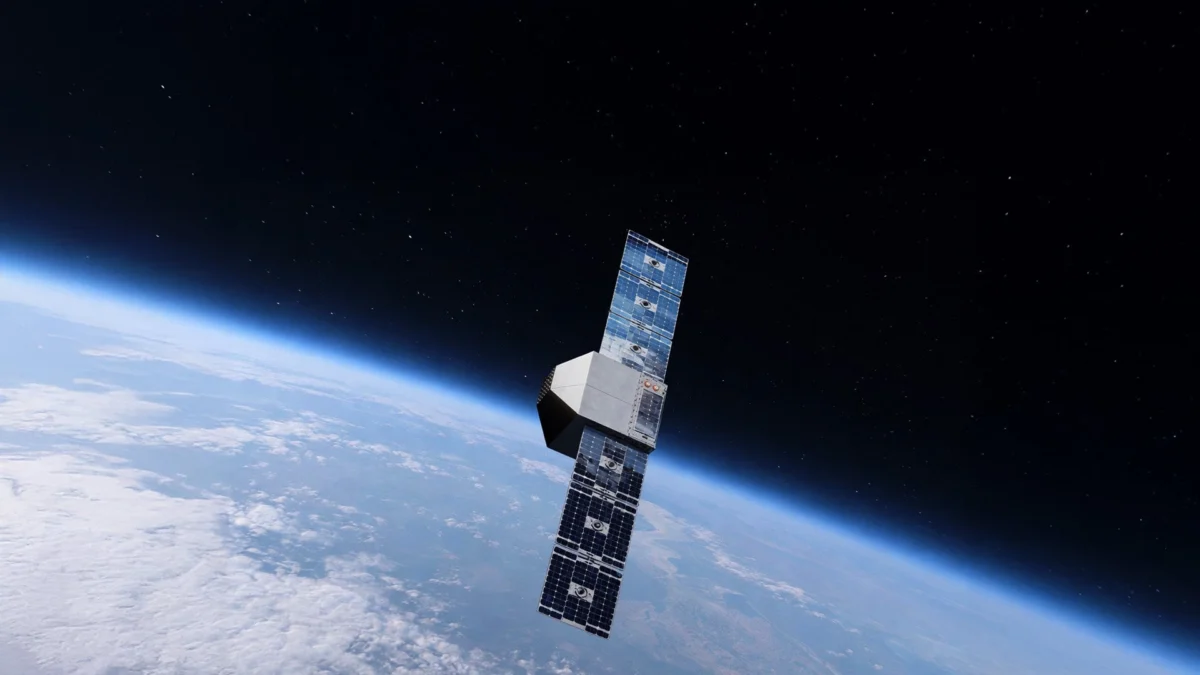
The race for the next frontier in satellite technology has shifted its gaze downward. While much of the space industry focuses on reaching higher orbits or deep space exploration, a quiet revolution is taking place in the "graveyard" of traditional satellites: Very Low Earth Orbit (VLEO). Spanish startup Kreios Space has officially announced a strategic partnership with Kongsberg NanoAvionics to launch a mission that could fundamentally alter how we operate in the thinning atmosphere of the thermosphere.
By utilizing an innovative Air-Breathing Electric Propulsion (ABEP) system, the mission aims to transform the primary challenge of VLEO—atmospheric drag—into its greatest asset.
The Core Mission: Transforming Drag into Fuel
At the heart of the collaboration is the mission to demonstrate that satellites can operate sustainably at altitudes between 150 km and 300 km. Historically, this altitude range has been considered prohibitive for long-term operations. The residual atmospheric gases at these heights create significant aerodynamic drag, which typically forces satellites to exhaust their propellant reserves rapidly just to maintain their orbital velocity. Once the fuel is spent, the satellite deorbits and burns up in the atmosphere.
Kreios Space’s proprietary ABEP technology flips this paradigm. Instead of carrying a finite amount of heavy chemical propellant, the spacecraft acts as a "space-based ramjet." It captures residual atmospheric gases—predominantly oxygen and nitrogen—and feeds them into an electric thruster. These gases are ionized and accelerated, providing the thrust necessary to counteract drag.
By eliminating the need for a massive propellant tank, Kreios Space is looking to extend the mission life of satellites in VLEO from a few months to several years. To test this, the company has tapped Kongsberg NanoAvionics, a leader in small satellite bus manufacturing, to provide the foundational infrastructure for this demonstration mission.
Project Chronology: From Concept to Integration
The partnership between Kreios Space and NanoAvionics represents a significant milestone in the maturation of VLEO technologies. While the companies have not released a specific launch date, the roadmap for the mission is well-defined:
- Platform Selection: Kreios Space has finalized the selection of the NanoAvionics MP42 microsatellite bus. This 200 kg platform is designed for flexibility, offering the modularity required to integrate the ABEP system alongside an optical payload.
- Payload Integration: The mission will carry an optical imaging system capable of sub-meter resolution in the visible and near-infrared (VNIR) spectral range. While the specific vendor for this camera remains undisclosed, NanoAvionics will lead the integration process.
- Ground Testing and Commissioning: Before the launch, the integrated satellite will undergo a rigorous series of vibration, thermal-vacuum, and electromagnetic interference tests at NanoAvionics’ facilities.
- On-Orbit Demonstration: Once deployed, the spacecraft will perform a series of maneuvers to validate the ABEP system’s efficiency. The team will monitor how effectively the thruster compensates for drag while simultaneously collecting high-resolution Earth observation data.
Supporting Data: Why VLEO Matters
The push into VLEO is driven by hard physics. As altitude decreases, the physics of imaging and communications improves exponentially.
Enhanced Resolution
In Earth Observation (EO), resolution is a function of the distance between the sensor and the target. Moving from a standard 500 km sun-synchronous orbit down to 200 km allows for a massive increase in ground sampling distance (GSD). With the same size optics, a satellite in VLEO can capture images with nearly triple the clarity of one in a higher orbit. This is a game-changer for high-precision surveillance, agricultural monitoring, and urban planning.
Signal Integrity and Latency
For satellite communications, VLEO offers a significant reduction in the "path loss" of radio signals. Shorter distances mean less signal attenuation, which allows for higher data rates, lower power consumption for ground terminals, and significantly reduced latency. For applications like real-time remote sensing or low-latency satellite broadband, the advantages are undeniable.
The Drag Challenge
However, the environment is hostile. At 200 km, the atmosphere is not a vacuum; it is a dense, high-energy environment filled with atomic oxygen, which is highly corrosive. Furthermore, the drag forces are orders of magnitude higher than at 500 km. Without an ABEP system or a very large propellant reservoir, a satellite would require significant fuel to remain in station, making current mission architectures economically unviable. Kreios Space’s mission is intended to prove that ABEP is the "missing link" for sustained, cost-effective VLEO operations.
Official Responses and Strategic Vision
The collaboration has been met with enthusiasm from both the startup ecosystem and the established aerospace manufacturing sector.
"Kreios is building the satellites that make sustained operations in Very Low Earth Orbit possible," said Adriàn Senar, CEO of Kreios Space. "By enabling satellites to fly lower, longer, and more efficiently, we are enabling higher-resolution Earth observation, much better satellite communications, more responsive and accurate missions, and a more sustainable orbital infrastructure."
The choice of the MP42 bus from NanoAvionics is a strategic endorsement of the modular small-sat movement. NanoAvionics has built a reputation for providing "plug-and-play" architectures that allow startups like Kreios to focus on their core innovation—in this case, the propulsion system—rather than reinventing the wheel of satellite bus engineering.
For NanoAvionics, the project serves as a proving ground for their bus’s adaptability. Managing the integration of an experimental propulsion system that literally "breathes" the atmosphere is a complex engineering task that requires precise thermal management and power distribution.
Implications: The Future of the Orbital Economy
The successful demonstration of this mission will have profound implications for the global space economy.
1. The New Standard for Earth Observation
If Kreios Space succeeds, the industry could see a shift in the requirements for EO satellites. We may move away from massive, multi-ton satellites in high orbits toward constellations of smaller, more nimble satellites in VLEO. This would democratize access to high-resolution imagery, as the cost of launching and maintaining these satellites would drop significantly.
2. Orbital Sustainability
Paradoxically, operating in VLEO is safer for the space environment. Because the atmosphere is thicker, any debris generated in VLEO naturally deorbits much faster than debris in higher, "cleaner" orbits. By keeping satellites in VLEO, companies reduce the risk of contributing to long-term space junk, provided they can maintain control of the spacecraft.
3. Responsive Space
The ability to maintain a satellite in a lower orbit allows for "responsive space" capabilities. A satellite can stay "parked" at a lower altitude, ready to perform high-resolution tasks on short notice, or move to a different orbital plane with lower propellant costs compared to traditional systems.
4. A Template for Future Propulsion
Beyond Earth, ABEP technologies could find applications on other planets with atmospheres. Similar concepts have been explored for Mars or even Titan. By perfecting the art of "in-situ resource utilization" (ISRU) of atmospheric gases, Kreios Space is essentially creating a blueprint for the future of propulsion throughout the solar system.
Conclusion: A High-Stakes Demonstration
The upcoming mission by Kreios Space and Kongsberg NanoAvionics is more than just a technical test; it is an economic experiment. It challenges the assumption that the "lower" reaches of space are only for transient missions.
As the space industry becomes increasingly crowded, the ability to operate in every available orbital shell is essential. By conquering the drag of the thermosphere, Kreios Space is not just opening a new altitude—they are opening a new dimension of efficiency. With the MP42 bus providing the stable foundation and the ABEP system providing the long-term endurance, the mission is poised to set a new standard for how we design, launch, and operate in the challenging environment of Very Low Earth Orbit. All eyes will be on the launchpad as this Spanish-led initiative prepares to rewrite the rules of satellite endurance.