LINKÖPING, Sweden — As the Swedish Air Force marked its centennial at Malmen Air Base this past weekend, the festivities served as more than a nostalgic look at a century of aviation history. Amidst the roar of vintage trainers and the modern agility of the JAS 39 Gripen, Swedish defense giant Saab pulled back the curtain on a transformative vision for the future of aerial combat: a trio of unmanned aircraft designed to serve as the “loyal wingmen” for the next generation of Swedish air power.
The unveiling of the A1, A2, and A3 platforms represents a strategic pivot for Sweden, moving from a philosophy of purely manned dominance to a mixed-fleet ecosystem. This development positions Saab at the vanguard of the global shift toward Autonomous Collaborative Platforms (ACPs), mirroring the United States’ Collaborative Combat Aircraft (CCA) program while maintaining a distinctively Swedish industrial identity.
The Roadmap: From Supersonic Demonstrator to Combat Reality
Saab’s strategy is built upon a tiered development cycle, designed to incrementally prove the viability of AI-driven, pilot-assisted combat.
The A1: The Supersonic Foundation
The A1 is slated to be the first milestone in this ambitious project. It will function as a supersonic demonstrator, engineered to test the fundamental flight dynamics and AI integration required for autonomous flight. Notably, Saab has selected the General Electric F414 engine—the same powerplant that drives the Gripen E/F—ensuring a degree of logistical commonality that will appeal to existing Gripen operators. Saab expects the A1 to take to the skies within the next 15 months.
The A2: Internal Payload and Stealth
Following the A1, the A2 will introduce increased complexity. While details remain guarded, the A2 is designed with an internal weapons bay, a critical requirement for modern low-observable (stealth) operations. This platform will serve as the bridge between basic flight testing and true, mission-capable deployment. Both the A1 and A2 are projected to be flight-ready within a four-year window.
The A3: The Commercial Vanguard
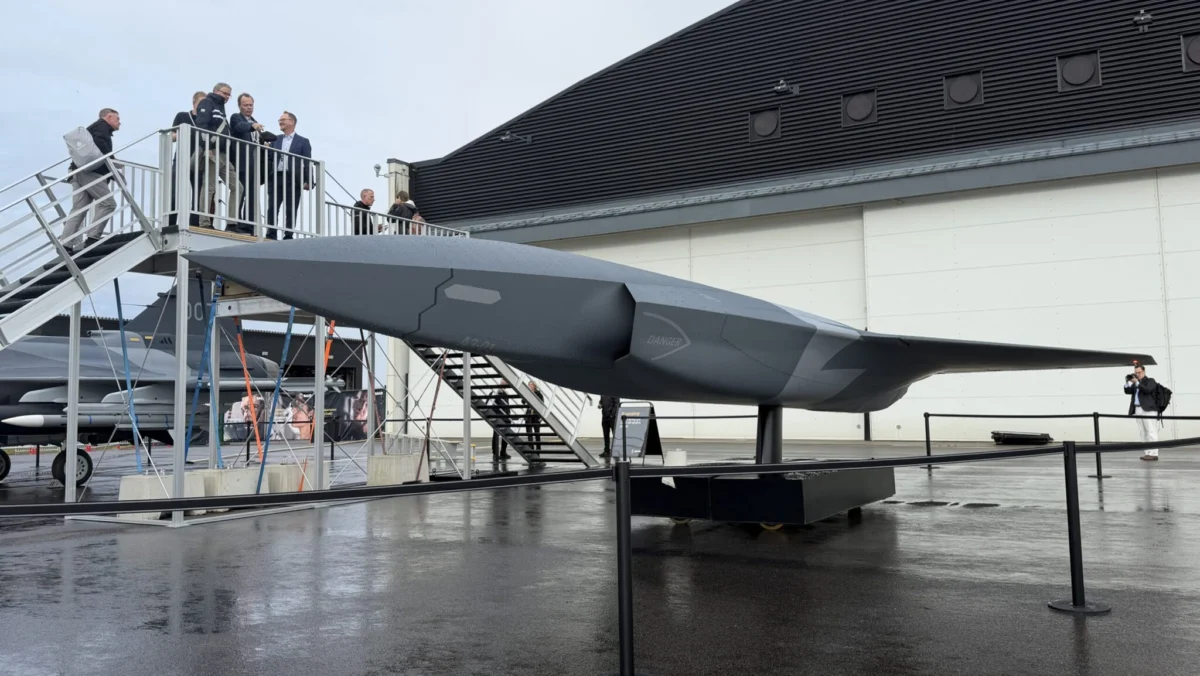
The A3 stands as the potential final product—the “production” model intended for export and integration into the Swedish Air Force’s future structure. A full-scale model showcased at the air show displayed a sleek, modular design. Saab estimates that if the Swedish government provides the necessary funding, the A3 could enter full service within a decade.
Economic Rationale and Operational Integration
A central pillar of the A3’s appeal is its cost-efficiency. In an era of ballooning defense budgets, Saab is positioning its ACPs as a force multiplier that does not break the bank. During a media briefing at the air show, company officials estimated that the A3’s lifecycle cost would hover at approximately one-third that of a manned Gripen E, with an initial purchase price roughly half that of its pilot-operated counterpart.
Brig. Gen. Niclas Magnusson, Sweden’s deputy air chief, emphasized that this is not a move to replace the pilot, but to empower them. “I think we need both,” Magnusson stated. “I think we need them also combined. So I think that is the future, you know, mixed squadrons with both manned and unmanned. But it’s going to be a few years ahead.”
This "mixed squadron" concept envisions a manned mother-platform (such as a Gripen E or a future successor) directing a swarm of A3 units to perform high-risk, deep-strike, or reconnaissance operations that would otherwise endanger a human pilot.
The Political Calculus: A Decision Looming in the Riksdag
While the technical roadmap is clear, the financial path is subject to the rigorous deliberative processes of the Swedish government. The Swedish Defense Materiel Administration (FMV) has already awarded initial development contracts to Saab and GKN Aerospace under the “Combat Aircraft Path Selection” (Vägval stridsflyg) program. This initiative is explicitly tasked with determining how Sweden will maintain its fighter capability beyond 2040, when the current Gripen E fleet will require either replacement or significant augmentation.
Defense Minister Pål Jonson, present at the air show, offered a cautious but optimistic endorsement. “I think it would be a natural further development of the Gripen system to have a loyal wingman component that can perform deep operations together with the mother platform,” Jonson said.
The timeline for a final decision is structured and intensive. The Swedish Armed Forces and the FMV are expected to deliver a comprehensive budget and strategy proposal next March. Following this, a state inquiry into industrial and defense policy will be launched, with input from a parliamentary reference group expected by September 2027. The Riksdag is anticipated to reach a definitive decision on the program between 2028 and 2030.
A New Era: The NATO Dividend
The unveiling of these autonomous systems coincides with a period of unprecedented momentum for Saab. Since Sweden’s accession to NATO, the company has seen its market position transform from a regional powerhouse to a central pillar of European defense.
Saab currently boasts a staggering order backlog of 318 billion kronor ($33.6 billion). This includes major international contracts:
- Poland: The procurement of three A26 submarines.
- Ukraine: A $2.5 billion contract for 16 Gripen E jets.
- GlobalEye: The acquisition of up to ten airborne early warning and control aircraft by NATO and Canada.
- Middle East: A newly announced $1 billion order for two GlobalEye aircraft from an undisclosed regional partner.
Saab CEO Micael Johansson was blunt regarding the catalyst for this growth. “I do not think NATO would have selected GlobalEye if we hadn’t been in the alliance. The same goes for a number of other contracts. I don’t think Poland would have chosen our submarines either,” Johansson noted.
The presence of the alliance is felt not just in the ledger, but on the tarmac. Observing F-35s parked alongside Swedish Gripens at the centennial air show, the contrast between the past and present was stark. Sweden’s integration into NATO has effectively validated the long-term design philosophy of the Gripen. As Johan Segertoft, head of the Gripen business unit, pointed out, the aircraft was built for NATO interoperability decades before the formal treaty was signed. “In 2002, the Gripen C came out—NATO interoperable, fully NATO compliant—more than 20 years before Sweden joined the alliance,” Segertoft explained.
Implications for Global Air Power
The development of the A-series autonomous platforms signals that Sweden intends to remain a primary player in the fighter aircraft industry. By focusing on ACPs, Saab is addressing the "mass" problem that currently plagues Western air forces: the high cost and low numbers of fifth- and sixth-generation fighters.
If successful, the A3 will allow the Swedish Air Force to maintain a persistent presence in contested environments while minimizing the risk to human personnel. Furthermore, the modular nature of the system ensures that Sweden can export these capabilities to other NATO members, potentially standardizing the "loyal wingman" concept across the European theater.
As the international security landscape grows increasingly volatile, the ability to rapidly field, sustain, and integrate autonomous assets will define the next century of military aviation. For Sweden, a nation that has spent 100 years building an independent air force, the path forward appears to be one of collaboration—both with its allies in NATO and with the artificial intelligence that will fly alongside its pilots in the decades to come.
The work ahead is, as Minister Jonson described it, “intensive.” Yet, as the A3 model stood silent in the hangar at Malmen, the message was clear: the Swedish Air Force is not just looking back at its first 100 years; it is already firmly focused on the next 100.