In the rapidly evolving landscape of software development, a new vernacular has emerged to describe the shift toward AI-assisted programming: "vibe coding." The term, which oscillates between a celebrated vision of the future and a pejorative shorthand for reckless development, has sparked intense debate among industry veterans and newcomers alike.
Rather than viewing vibe coding through the binary lens of "good" or "bad," a more nuanced investigation reveals it as a potent, yet volatile, force. By analyzing recent empirical studies, academic research, and industry-wide shifts, we can map where this paradigm acts as a force multiplier for productivity and where it introduces critical, often invisible, technical debt.
The Genesis of Vibe Coding: A New Paradigm
At its core, vibe coding represents a shift from imperative syntax to declarative intent. Traditionally, developers spent the majority of their cognitive bandwidth translating business requirements into precise logical structures—navigating frameworks, managing environment variables, and orchestrating database schemas.
Vibe coding flips this hierarchy. It allows practitioners to initiate a project with a high-level specification: "Build a dashboard that filters customers by churn probability." This conversational interface democratizes software creation, inviting analysts, marketers, and domain experts to participate in the construction of tools that were previously gated behind years of programming expertise.
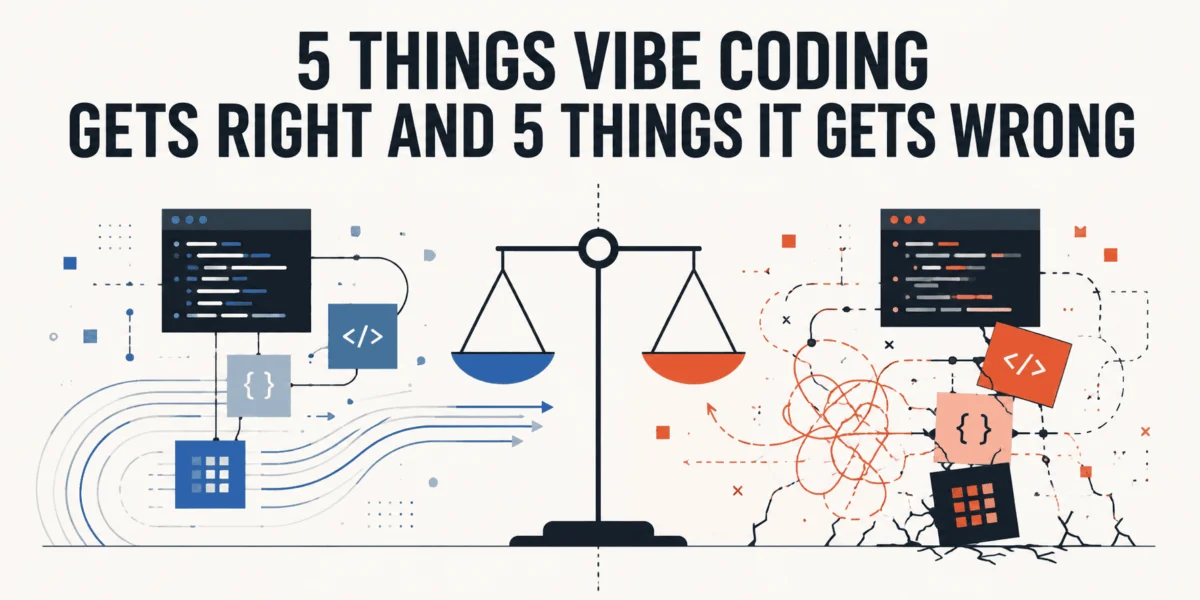
5 Things Vibe Coding Gets Right: Velocity and Accessibility
1. The Death of Prototyping Friction
The most significant triumph of vibe coding is the drastic reduction in the "idea-to-prototype" timeline. Many revolutionary concepts have historically withered on the vine due to the sheer logistical overhead of setting up full-stack environments. AI tools eliminate this initial barrier.
The impact on the startup ecosystem is already palpable. As Y Combinator managing partner Jared Friedman recently noted, a substantial portion of the W25 batch arrived with codebases that were nearly 95% AI-generated. This statistic does not imply the code was flawless, but it demonstrates a paradigm shift: AI is now the bedrock upon which new ventures test the viability of their concepts.
2. Conversational Programming as the New Interface
Vibe coding treats the software lifecycle as a dialogue rather than a coding session. By removing the immediate burden of syntax, it lowers the barrier to entry for domain experts. When a product manager can describe a feature with nuance—focusing on user behavior rather than API endpoints—the output is often more aligned with business goals. Programming skill remains vital, but the nature of that skill is shifting toward architectural design and precise specification.
3. Efficiency in Bounded, Repetitive Tasks
AI excels at the "glue work" of software engineering. Tasks such as writing API wrappers, form validation, data transformation scripts, and test scaffolding are often categorized as low-value cognitive labor. A controlled experiment using GitHub Copilot confirmed this, finding that developers completed JavaScript HTTP server tasks 55.8% faster with AI assistance. For these well-defined, bounded problems, AI acts as a tireless junior developer, allowing human engineers to focus on complex, creative problem-solving.
4. The Iterative Feedback Loop
A successful "vibe" workflow is fundamentally circular: Prompt, Run, Observe, Fix, Test, Repeat. This loop keeps the creator tethered to the reality of the software’s output. Rather than spending days reading documentation, the developer engages with a living, breathing interface. The most effective practitioners treat AI not as an oracle that provides a final product, but as a sparring partner that requires constant validation.
5. Democratization of Software Creation
Perhaps the most profound societal implication is the expanded participation in software development. Data analysts building custom Streamlit apps or researchers developing internal annotation tools represent a massive surge in human productivity. When software creation is no longer locked behind the gates of deep technical training, the velocity of innovation across all sectors increases.
5 Things Vibe Coding Gets Wrong: The Hidden Dangers
1. The Fallacy of "Working" Software
The most perilous trap for the vibe coder is the assertion that "it works." In modern software engineering, the "happy path" is rarely the true measure of success. A demo that renders a chart or submits a form is functionally incomplete if it fails to account for malformed data, API timeouts, or concurrency issues. Vibe coding often generates the aesthetic of functionality while leaving the structural integrity of the application hollow.
2. The Security Vacuum
Security remains the Achilles’ heel of AI-generated code. A recent benchmark evaluating agent-generated code revealed a startling disparity: while agents could produce functionally correct solutions 61% of the time, only 10.5% of those solutions were secure. When developers rely on AI for authentication, payment processing, or data handling, they are often unknowingly introducing critical vulnerabilities that would take months to audit later.
3. The "Expert" Paradox in Mature Codebases
There is a common misconception that AI acceleration scales linearly with experience. However, a randomized controlled trial conducted by METR found that experienced developers working on mature, complex codebases actually took 19% longer when using AI tools. This is because mature repositories carry "hidden" context—history, conventions, and architectural constraints—that a model cannot fully grasp. In these environments, the overhead of reviewing, correcting, and integrating AI-generated code often exceeds the time it would take to simply write the solution from scratch.
4. Replacing Judgment with Confidence
Vibe coding risks creating a generation of developers who rely on the machine to resolve errors without understanding the underlying mechanics. When a user pastes a stack trace into an LLM repeatedly until the code "works," they are learning how to prompt, not how to engineer. Stack Overflow’s 2025 Developer Survey corroborates this unease: 46% of developers report a lack of trust in AI accuracy. This skepticism is not a hindrance—it is the hallmark of professional judgment.
5. The Blind Spot of Unstated Requirements
AI is literal; it fulfills the request, not the intent. If a user asks for a login page, the AI provides a login page. It does not automatically include password hashing, rate limiting, CSRF protection, or secure session management. The "vibe" approach fails to account for the implicit constraints that seasoned engineers know are mandatory for production-ready systems. Without a human to provide the guardrails, the AI will build the fastest, not the safest, path.
Implications for the Future of Work
The rise of vibe coding is not a signal that software engineering is becoming obsolete; rather, it is a signal that the discipline is bifurcating.
The Shift in Engineering Roles
The future of the software industry will be defined by the "Human-in-the-loop" model. As the barrier to building entry-level applications continues to drop, the value of the software engineer will shift away from the ability to write boilerplate code and toward the ability to conduct rigorous security reviews, architectural oversight, and high-level system integration.
The Need for New Standards
Industry leaders are already beginning to respond. We are seeing a move toward AI-native integrated development environments (IDEs) that include built-in security scanners and automated test suites specifically designed to catch the common hallucinations of generative models. Furthermore, professional certification will likely evolve to emphasize AI-assisted debugging and prompt engineering for systemic robustness.
Final Synthesis
Vibe coding is a double-edged sword. It successfully multiplies the output of the individual, but it also multiplies the potential for systemic fragility. For the hobbyist or the startup founder looking to validate a concept, it is an unparalleled tool. For the enterprise architect responsible for systems handling health data, financial transactions, or critical infrastructure, it remains a dangerous shortcut that requires extreme caution.
Ultimately, the goal of software engineering remains unchanged: to create reliable, secure, and maintainable systems. Vibe coding, when wielded by those who possess both the vision to prompt effectively and the judgment to verify ruthlessly, can be a transformative force. When wielded by those who mistake output for outcomes, it is a liability that the industry cannot afford. As we move forward, the most valuable developer will not be the one who generates the most code, but the one who best orchestrates the intelligence of the machine to ensure the safety and success of the final product.