In the landscape of modern software engineering, Python has long been criticized for its verbose object-oriented syntax. For years, developers spent countless hours writing repetitive "dunder" (double underscore) methods—such as __init__, __repr__, and __eq__—simply to define data-heavy classes. This boilerplate code not only bloated the codebase but also introduced unnecessary surface area for bugs.
The introduction of the dataclasses module in Python 3.7 changed the paradigm. By leveraging decorators and type hinting, Python allows developers to focus on the structure of their data rather than the mechanics of object instantiation. However, many developers still view dataclasses merely as a shortcut. In reality, they are a powerful, sophisticated toolset for building robust, performant, and maintainable domain models.
The Evolution of Data Handling in Python
Historically, if a developer wanted to represent a simple entity like a "Shipment," they were forced to write a substantial amount of boilerplate. A standard class required manual assignment of attributes in the constructor, custom string representations for debugging, and explicit equality checks to compare instances.
The Baseline: Manual Implementation
Consider a typical Shipment class in legacy Python:
class Shipment:
    def __init__(self, tracking_id, origin, destination, weight_kg, priority):
        self.tracking_id = tracking_id
        self.origin = origin
        self.destination = destination
        self.weight_kg = weight_kg
        self.priority = priority

    def __repr__(self):
        return f"Shipment(tracking_id=self.tracking_id!r, ...)"

    def __eq__(self, other):
        if not isinstance(other, Shipment): return NotImplemented
        return self.tracking_id == other.tracking_id and ...
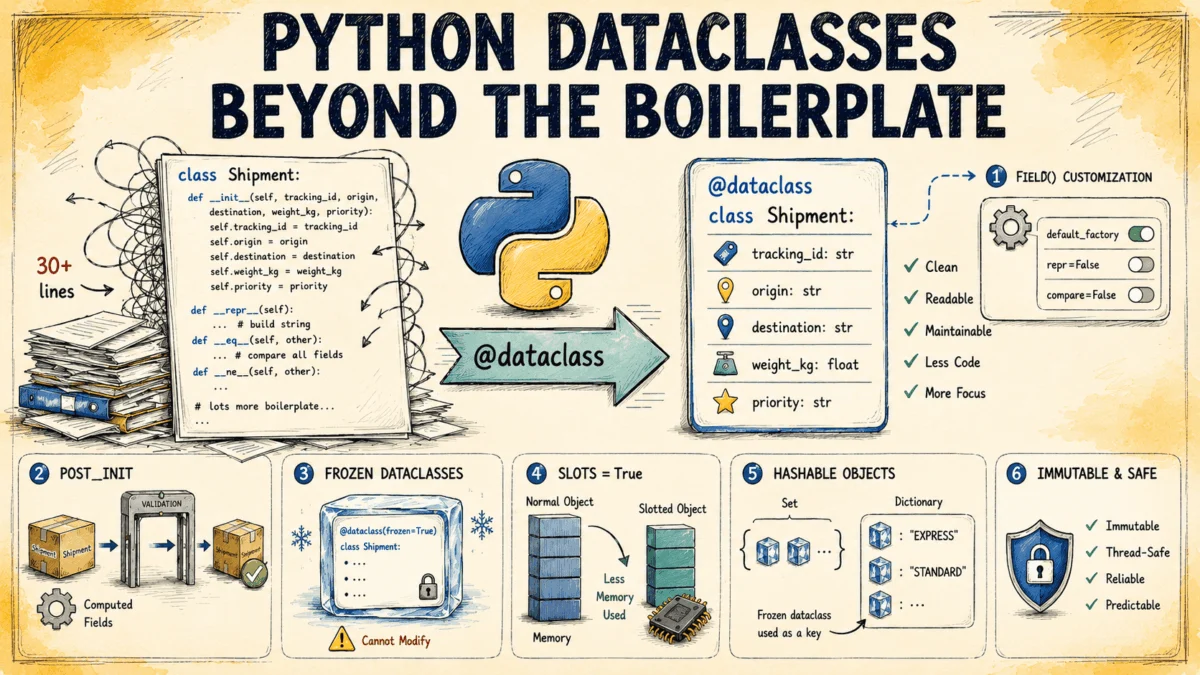
This approach is prone to "human error"—a single typo in the __eq__ method could lead to silent bugs that are notoriously difficult to trace. The dataclass decorator automates this by inspecting type annotations, generating these methods at definition time. The transition to a modern, declarative style is not just a cosmetic upgrade; it is a fundamental shift toward safer, more readable code.
Chronology and Modern Features
Since its debut, the dataclasses module has received significant upgrades. The integration of slots=True in Python 3.10 and the introduction of kw_only arguments have transformed the module from a simple helper into a production-grade framework for memory-efficient and type-safe data structures.
Controlling Fields with the field() API
The field() function is the "escape hatch" for developers who need more control than the default behavior provides. It is essential for managing mutable defaults and excluding fields from internal processes.
A common pitfall for junior developers is the "mutable default argument" trap. In Python, if you define route_stops: list = [] in a class, every instance shares the same list in memory. Dataclasses solve this with default_factory:
from dataclasses import dataclass, field

@dataclass
class Shipment:
    route_stops: list[str] = field(default_factory=list)
By using default_factory=list, Python calls the list constructor for each new instance, ensuring memory isolation. This is a critical architectural pattern for any application handling stateful data.
Supporting Data: Validation and Computation
The power of dataclasses truly shines when handling business logic through the __post_init__ hook. While standard __init__ methods are automatically generated, __post_init__ allows developers to inject custom validation or derived calculations immediately after an object is instantiated.
Enforcing Domain Integrity
In a logistics context, ensuring that a shipment has a positive weight is non-negotiable. By implementing __post_init__, we can enforce these constraints during the object creation phase:
def __post_init__(self):
    if self.weight_kg <= 0:
        raise ValueError("Weight must be a positive value.")
If the validation fails, the object is never created, effectively preventing the application from entering an inconsistent state. This "fail-fast" approach is a cornerstone of defensive programming. Furthermore, developers can use field(init=False) to create "read-only" properties that are calculated based on other fields (like a freight_cost derived from weight_kg and priority).
Implications for System Architecture
The adoption of dataclasses has deep implications for system performance and scalability. For large-scale data processing—such as ETL pipelines or real-time telemetry—memory overhead is a primary concern.
Memory Optimization with slots=True
Standard Python objects use a dictionary (__dict__) to store attributes. While flexible, this consumes significant memory. By setting slots=True in the @dataclass decorator, Python allocates a fixed-size array for attributes, which significantly reduces the memory footprint per instance. In systems processing millions of records, this optimization can reduce memory usage by 70% or more, allowing for higher throughput and lower infrastructure costs.
Immutability and Functional Patterns
The frozen=True parameter creates immutable objects. This is highly beneficial in multi-threaded environments or when working with functional programming patterns. Because frozen dataclasses are hashable, they can be used as keys in dictionaries or stored in sets, opening up new possibilities for efficient data lookup and caching.
Official Best Practices and Ecosystem Integration
While the standard library provides robust functionality, the broader Python ecosystem offers powerful integrations for those who need more:
- Dacite: Essential for mapping complex, nested JSON objects from APIs directly into dataclass instances.
- Marshmallow-dataclass: Automates the creation of schemas for serialization, making it easier to expose dataclasses as RESTful APIs.
- Pydantic: For developers who require strict type enforcement at runtime, Pydantic’s dataclasses provide a bridge between the standard library and enterprise-grade validation.
Conclusion: A New Standard for Python
The move away from manual dunder-method writing is more than just a stylistic preference; it is a commitment to cleaner, more efficient, and more reliable code. By mastering the dataclasses module—utilizing field() for configuration, __post_init__ for integrity, and slots for performance—developers can build systems that are not only easier to maintain but also significantly faster.
As we look toward the future of Python development, the declarative nature of dataclasses will continue to serve as the foundation for modern libraries and frameworks. Whether you are building a simple script or a complex, high-throughput microservice, dataclasses are an indispensable part of the modern developer’s toolkit. They allow us to stop focusing on the "how" of our data structures and start focusing on the "why," ultimately leading to more creative and effective problem-solving in the code we write.
Summary of Key Advancements
- Boilerplate Reduction: Automated generation of
__init__,__repr__, and__eq__. - Memory Efficiency:
slots=Truesignificantly optimizes memory usage for large-scale data objects. - Data Integrity:
__post_init__provides a controlled environment for input validation. - State Management:
frozen=Truepromotes safe, immutable data structures, critical for concurrent applications. - Flexibility: The
field()API allows for granular control over how attributes behave during serialization, comparison, and initialization.