In the rapidly evolving landscape of artificial intelligence, the initial gold rush centered on "building"—using LLMs to generate clean code, launch websites, and deploy applications in seconds. However, as the novelty of AI-generated landing pages fades, a new paradigm is emerging. Bengaluru-based startup Runable is betting that the true value of AI lies not in the creation of a digital storefront, but in the grueling, complex task of filling that store with customers.
To fuel this pivot, the startup has secured $21 million in Series A funding. The round was co-led by Susquehanna Venture Capital and Nexus Venture Partners, with continued participation from existing backers Together Fund and Array VC. This all-equity, primary funding round values the company at $65 million post-money, according to co-founder and CEO Umesh Kumar.
The Evolution of Runable: From Infrastructure to Growth
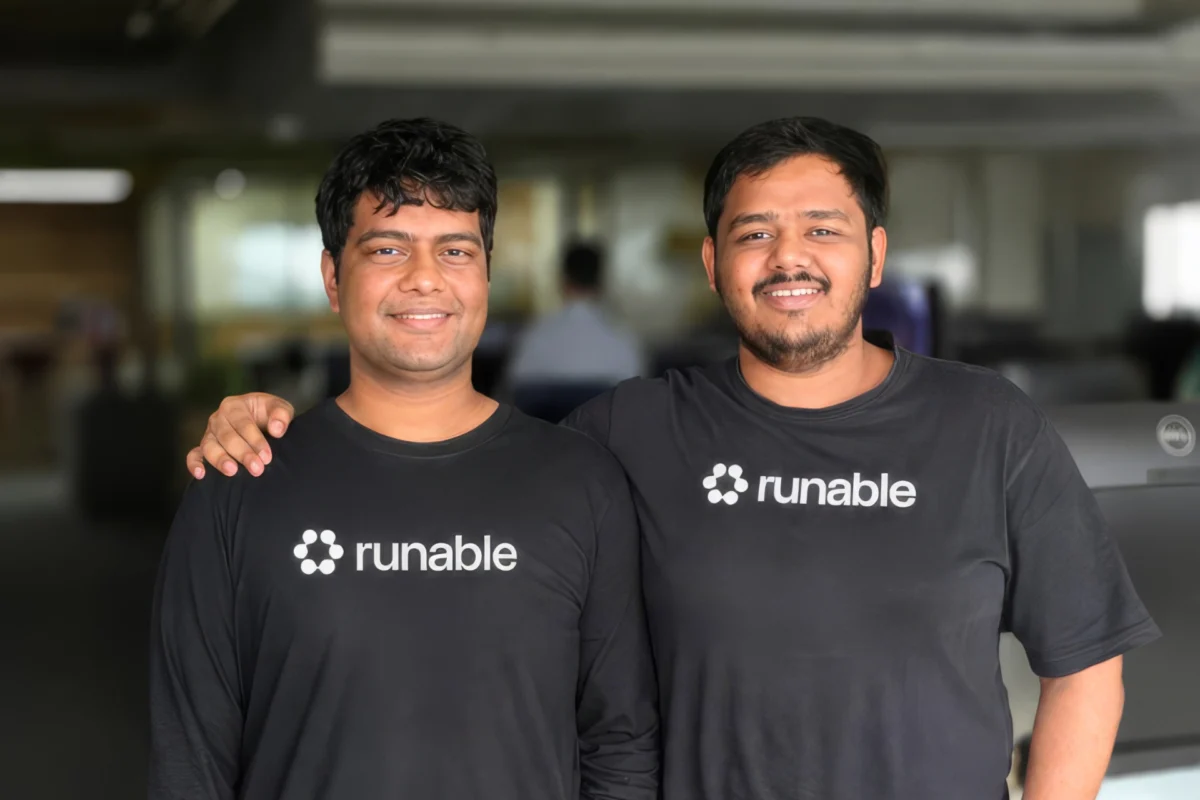
Founded in 2025, Runable began its journey as an AI infrastructure firm. Initially, the team focused on building sophisticated browser technology capable of scraping data at massive scale. Founders Umesh Kumar and Saksham Sarda quickly discovered, however, that their user base was far more interested in application than extraction.
As users utilized the platform’s agents to scrape data, they began demanding the ability to turn that information into finished products—slide decks, websites, and marketing collateral. Recognizing a shift in market appetite, the founders pivoted from infrastructure-as-a-service to a general-purpose AI agent model.
The gamble paid off with remarkable speed. Within three weeks of enabling payment features in March, the startup hit a $2 million annualized revenue run rate. Today, the platform boasts 1.7 million registered users, with significant traction in the United States, the United Kingdom, and Japan.
A Chronology of the "Grow" Strategy
Runable’s transition can be mapped through three distinct phases of development:
- The Infrastructure Phase (Early 2025): The company focuses on browser automation and large-scale data scraping, establishing the foundational "agentic" architecture that would later allow them to interact with complex web interfaces.
- The Creation Phase (March 2025): With the launch of monetization, the company shifts focus to helping non-technical users build websites and apps via natural language prompts. This period saw the company move into direct competition with platforms like Replit, Cursor, and Lovable.
- The "Grow" Phase (Present Day): Having successfully mastered the creation of digital assets, Runable is now positioning itself as a growth engine. The agent now integrates SEO management, social media orchestration, and ad campaign deployment, aiming to solve the "last mile" problem of small business operations.
Challenging the Titans: The "Outcomes Over Code" Thesis
The current AI market is saturated with high-profile players. From OpenAI’s Codex and Anthropic’s Claude Code to developer-centric tools like Cursor and Lovable, the race to build the world’s best coding assistant is fierce. Runable, however, is consciously stepping out of that lane.
"In the end, a business doesn’t require Codex or Claude Code or anything. They require real outcomes," CEO Umesh Kumar explained in an exclusive interview. "If I am paying an agency $10,000 to run my Google Ads, can someone come in and do it for me for a lower price? That’s where Runable comes in."
While other platforms focus on the technical implementation of software, Runable focuses on the business outcome: customer acquisition. The goal is to allow a small business owner to approach the AI with a simple, high-level directive—"Get me 100 new customers for my coffee subscription service"—rather than forcing the user to manually configure marketing funnels, analytics dashboards, and advertising budgets.
Supporting Data and Market Economics
Runable’s growth trajectory is backed by aggressive usage statistics. In the last 90 days, the platform’s users have consumed more than 1 trillion tokens, with 60% to 70% of that usage originating from paying customers.
This high consumption comes with a significant caveat: negative gross margins. Currently, the startup is subsidizing AI inference costs to lower the barrier to entry for its customers. However, the leadership team views this as a temporary bridge to profitability.
"We are seeing this path where you can provide the same quality of inference at almost 10x less cost," Kumar noted. As model efficiency increases and inference costs drop, the startup expects its unit economics to improve significantly. By maintaining a mix of proprietary and third-party models, Runable aims to insulate itself from the volatility of external AI pricing while optimizing for performance.
The "Soft Wedge" Strategy
A primary challenge for any agent-based platform is the integration with external ecosystems. In testing, Runable—like many of its competitors—requires a "soft wedge" to bridge the gap between AI intent and real-world action.
When tasked with running an ad campaign, Runable can build the assets and the targeting strategy, but it requires access to a Meta or Google Ads account to finalize the spend. While this creates friction, Runable has begun to implement "soft wedge" partnerships that allow for direct ad placement on certain platforms (such as ChatGPT) without requiring the user to navigate the complex backend of a traditional ad manager.
These partnerships represent a crucial competitive moat. While companies like Cursor or Lovable offer superior experiences for developers writing local code, Runable is optimizing for the "non-technical business owner." They aren’t trying to beat coding agents; they are trying to render the need for a marketing agency obsolete.
Implications for the Future of Business Operations
The implications of Runable’s strategy are profound for the SME (Small and Medium Enterprise) sector. For decades, small businesses have been forced to outsource their growth strategies to expensive agencies or spend hundreds of hours learning complex martech stacks.
Runable proposes a future where the business owner acts as the CEO of a company run by agents. By handling the underlying infrastructure—hosting, deployment, analytics, and now distribution—Runable acts as a "co-founder in a box."
However, the startup faces a stiff challenge: the very platforms they rely on for AI models are also moving toward "agentic" workflows. OpenAI and Anthropic are increasingly building out capabilities that could, in theory, perform the same tasks as Runable.
Runable’s response is to double down on the full-stack experience. As Kumar points out, providing the model is only half the battle; the other half is the "glue"—the analytics, the deployment, and the continuous monitoring that turns a static website into a functioning, revenue-generating business.
Conclusion: The Path Ahead
With its Series A secured, Runable’s next six months will be critical. The startup is shifting its geographic focus, expecting Japan to join the U.S. and the U.K. as a primary revenue driver by next month.
As the AI hype cycle matures, the market is beginning to demand more than just "impressive" demos. The success of Runable will ultimately depend on whether its agent can consistently deliver on its promise of "real outcomes." If they can prove that their agent is not just a clever tool for building, but a reliable machine for generating revenue, they may well define the next generation of business software.
For now, the team of 15 in Bengaluru is focused on the immediate task: moving from 1.7 million registered users to a sustainable, profitable business that proves that in the AI era, the most successful companies will be the ones that help others grow.