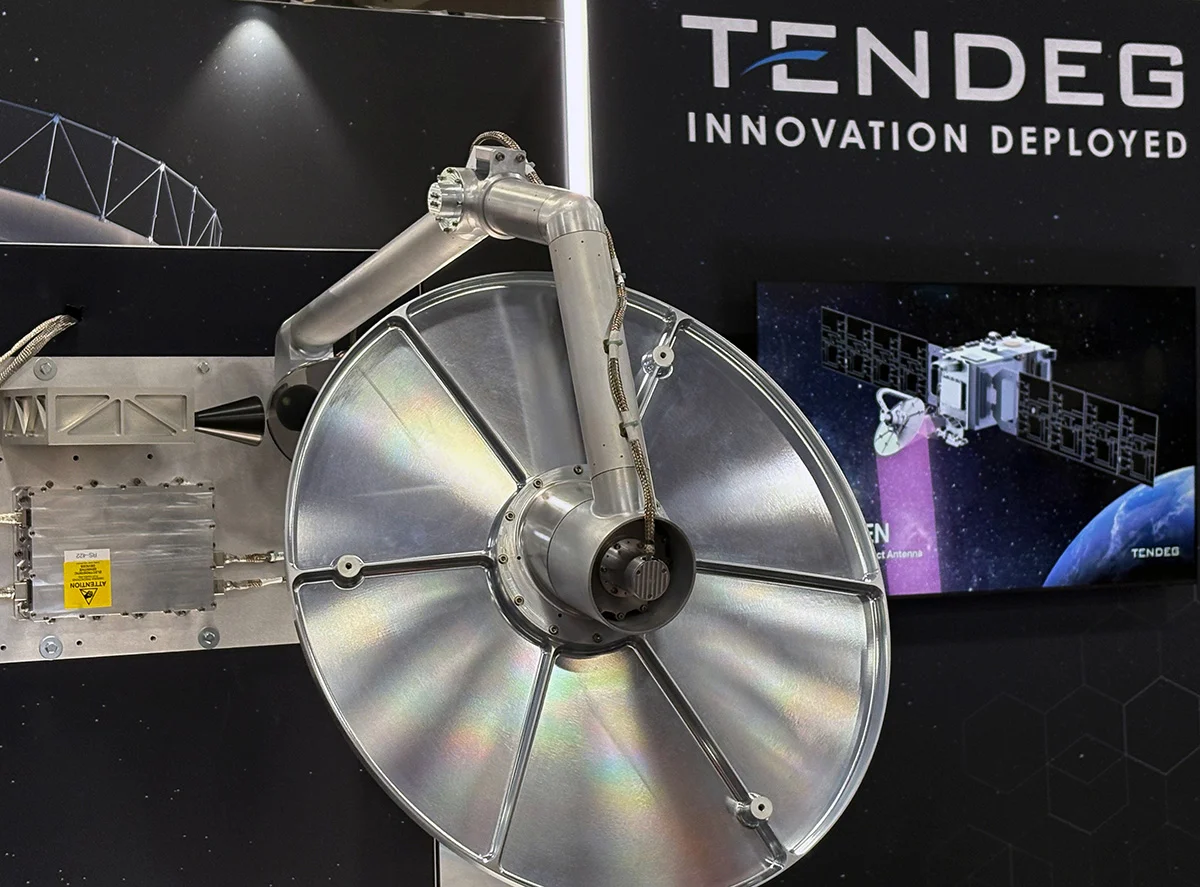
SALT LAKE CITY — In a move to address the critical communications bottlenecks facing the rapidly expanding small satellite market, aerospace manufacturer Tendeg has officially launched its newest hardware platform: the NewTEN two-axis steerable reflector antenna.
Unveiled at the 40th Annual Small Satellite Conference in Salt Lake City, Utah, the NewTEN antenna is engineered to deliver enhanced communications performance, expanded pointing capabilities, and simplified integration pathways for small spacecraft. Critically, the system is designed from the ground up to support the high-rate, repeatable manufacturing pipelines demanded by modern proliferated Low Earth Orbit (pLEO) constellations.
Main Facts: A Paradigm Shift in SmallSat RF Architecture
The NewTEN antenna represents a significant departure from traditional gimbaled antenna designs. At its core, the system pairs a compact, offset-fed reflector with a highly precise, two-axis pointing mechanism. However, the defining engineering breakthrough of the NewTEN is its stationary Radio Frequency (RF) feed.
+-----------------------------------------------------------------+
|                    NewTEN Architectural Design                  |
+-----------------------------------------------------------------+
|                                                                 |
|     [ Moving Component ]                [ Stationary Component ]|
|   +-----------------------+              +--------------------+ |
|   |  Offset-Fed Reflector |              |      RF Feed       | |
|   |         Dish          |              | (Fixed to Bus)     | |
|   +-----------+-----------+              +---------+----------+ |
|               |                                    |            |
|               v                                    v            |
|     [ 2-Axis Gimbal ]                    [ Thermal Straps & ]   |
|   (Steers Reflector Only)                [ RF Routing Lines ]   |
|                                                                 |
+-----------------------------------------------------------------+
By keeping the RF feed physically fixed to the spacecraft bus while allowing the reflector to steer independently, Tendeg has solved several of the most persistent integration and thermal challenges in satellite communications design.
Key Technical Specifications and Design Features
- Target Frequency Spectrum: High-bandwidth communications ranging from X-band, Ku-band, and Ka-band, up to next-generation Q/V-band frequencies.
- Pointing Mechanism: Two-axis gimbal system optimizing pointing access without requiring the rotation of heavy RF components.
- RF Routing: Stationary feed design eliminates the need for complex, heavy, and lossy RF rotary joints or highly flexible waveguides.
- Thermal Dissipation: Direct thermal pathing from the RF feed to the spacecraft body, allowing high-power amplifiers to dissipate heat directly into the satellite’s primary structure.
- Target Platforms: Micro-satellites, smallsats, and standardized bus platforms (typically ranging from 50 kg to 500 kg classes) where Size, Weight, and Power (SWaP) budgets are severely constrained.
Chronology: The Road to the 40th Annual SmallSat Conference
The debut of the NewTEN antenna on Monday, August 24, 2026, marks a major milestone in Tendeg’s multi-year pivot toward standardized, product-focused manufacturing. Historically known for engineering bespoke, highly complex deployable structures and large-aperture mesh reflectors, the Colorado-based manufacturer has spent the last several years scaling its capabilities to support high-rate production.
       2020–2024                     2025                       2026 (August 24)
+----------------------+     +------------------+     +----------------------------------+
| Custom R&D & Bespoke | --> | Manufacturing    | --> | Launch of NewTEN Antenna at      |
| Deployable Antennas  |     | Campus Expansion |     | 40th Small Satellite Conference  |
+----------------------+ +------------------+ +----------------------------------+- Phase 1: Custom R&D and Bespoke Deliveries (2020–2024): Tendeg establishes itself as a premier supplier of precision flight hardware, designing custom deployable mesh antennas for commercial Earth observation, scientific research, and defense missions.
- Phase 2: Manufacturing Infrastructure Expansion (2025): Recognizing the industry-wide shift toward proliferated constellations, Tendeg invests heavily in its Louisville, Colorado manufacturing campus. The expansion focuses on establishing repeatable assembly lines, automated testing protocols, and supply chain pipelines optimized for high-volume production.
- Phase 3: The NewTEN Product Launch (August 2026): Tendeg officially transitions to a product-platform model. The NewTEN is introduced to the global aerospace community at the 40th Annual Small Satellite Conference, positioned as an off-the-shelf, low-risk solution for constellation developers.
Technical Deep-Dive: Overcoming the Limitations of Traditional Gimbals
To appreciate the design of the NewTEN, it is necessary to examine the physical and electromagnetic limitations of traditional steerable antennas on small spacecraft.
The Challenge of RF Routing and Rotary Joints
In standard steerable antenna configurations, the entire antenna assembly—including the feed horn, polarizers, and sometimes the active RF electronics (such as Low Noise Amplifiers or Solid State Power Amplifiers)—is mounted directly onto a two-axis gimbal. As the gimbal moves to track a ground station or another satellite, the RF signal must travel from the moving assembly to the stationary spacecraft bus.
This routing typically requires either RF rotary joints or flexible coaxial cables/waveguides. At lower frequencies (such as S-band or L-band), flexible cables are manageable. However, as modern operators push into higher-frequency bands like Ka-band (26.5–40 GHz) and Q/V-band (33–75 GHz) to secure greater bandwidth, traditional routing methods become highly problematic:
- Insertion Loss: RF rotary joints introduce significant signal attenuation (insertion loss) at high frequencies, degrading the overall Link Budget of the satellite.
- Mechanical Wear: Flexible waveguides and cables degrade over thousands of orbital thermal cycles and steering movements, introducing a critical single point of failure.
- Mass and Complexity: Rotary joints are heavy, expensive, and require precision alignment, driving up both the cost and weight of the payload.
The NewTEN Stationary Feed Solution
Tendeg’s NewTEN bypasses these failure modes by decoupling the RF feed from the steering mechanism. The RF feed horn remains rigidly fixed to the spacecraft structure. The two-axis gimbal mechanism is responsible solely for manipulating the lightweight offset-fed reflector dish.
Traditional Gimbaled Antenna vs. Tendeg NewTEN Architecture

Traditional Setup:
[Gimbal Motor] ---> [Moves Feed + Reflector + RF Electronics] ---> [Requires Lossy Rotary Joints]

Tendeg NewTEN:
[Gimbal Motor] ---> [Moves Lightweight Reflector Only]
                          ^
                          | (Reflects signal to/from)
                          v
                    [Fixed RF Feed] ---> [Direct Waveguide to Internal Spacecraft Bus]
Because the feed does not move relative to the satellite body, the RF signal can be routed directly from the payload electronics to the feed horn using short, rigid, low-loss waveguides. This architecture virtually eliminates insertion losses, maximizes signal integrity, and dramatically improves the reliability of the communications subsystem.
Optimizing Thermal Management
Thermal dissipation is a constant battle for smallsat designers. High-throughput transmitters generate substantial waste heat. In a traditional moving-feed design, dissipating this heat is exceptionally difficult because the thermal energy must cross the moving gimbal joints to reach the spacecraft’s radiators.
With the NewTEN’s stationary feed, the high-power RF components can be thermally strapped directly to the satellite’s primary structural panel. This allows for highly efficient passive thermal management, reducing the risk of component degradation and allowing the transmitter to operate at higher duty cycles without overheating.

Official Responses: Industry Leaders Address the Constellation Bottleneck
During the unveiling at the SmallSat Conference, Tendeg executives emphasized that the NewTEN was designed to solve systemic supply chain and integration issues, rather than just acting as a standalone piece of high-performance hardware.
Gregg Freebury, founder and CEO of Tendeg, highlighted the trade-offs that satellite mission architects have historically been forced to accept:
"Mission architects don’t have to choose between limited pointing access and complex custom gimbaled antennas. We developed NewTEN to provide a flexible low-SWaP solution that can be easily integrated and produced at scale."
Freebury’s comments touch on a broader industry pain point. Historically, space missions requiring high-gain steerable communications had to commission custom-engineered gimbal systems. These custom systems often carried multi-million dollar non-recurring engineering (NRE) costs and took years to design, build, and qualify. For operators deploying constellations of 50, 100, or 500 satellites, such bespoke procurement models are economically and logistically unfeasible.
By offering a standardized, common architecture that accommodates X through Q/V-band communications, Tendeg aims to eliminate these custom engineering phases, allowing operators to rapidly integrate a flight-proven communications payload across an entire fleet.
Implications: Reshaping the Landscape of Proliferated Constellations
The introduction of the NewTEN antenna comes at a pivotal moment for the global space sector. The industry is undergoing a massive transition from a small number of large, exquisite satellites in Geostationary Orbit (GEO) to massive, distributed architectures in Low Earth Orbit (LEO). This shift has profound implications for defense, commercial telecommunications, and scientific exploration.
| Market Segment | Key Challenges Addressed by NewTEN | Operational Impact |
|---|---|---|
| National Security & Defense | Bandwidth limits, jam resistance, rapid deployment timelines. | Enables secure, high-data-rate tactical downlinks (X & Ka-band) for tactical military constellations. |
| Commercial Telecom | Spectrum congestion, high-volume production needs. | Facilitates the transition to Q/V-band backhaul links, vastly increasing global internet constellation capacity. |
| Earth Observation | High-volume raw data downlinks, weight/power constraints. | Allows imaging satellites to downlink gigabits of synthetic aperture radar (SAR) or multispectral data per pass. |
Defense and National Security Applications
For defense agencies, such as the U.S. Space Development Agency (SDA) and its Proliferated Warfighter Space Architecture (PWSA), the ability to rapidly produce and deploy standardized satellite components is a national security priority. Military communications require robust, directional, and highly steerable antennas to maintain secure links while mitigating jamming attempts.
The NewTEN’s low-SWaP footprint and high-frequency capabilities make it an ideal candidate for military tactical data networks. The reduction in integration complexity directly translates to faster launch schedules and lower overall program risks for defense contractors.
Unlocking the Q/V-Band Frontier
As the Ka-band spectrum becomes increasingly crowded with thousands of active satellites, both commercial and civil operators are looking to the Q-band and V-band frequencies to support the next generation of ultra-high-throughput satellite (HTS) networks. However, operating at these extremely high frequencies requires highly precise pointing accuracy, as even a fraction of a degree of misalignment can result in a complete loss of signal.
The NewTEN’s dual-axis steering mechanism provides the necessary angular precision to maintain robust links at Q/V-band frequencies. By offering a platform that is pre-engineered for these high-frequency regimes, Tendeg is positioning itself as a key enabler of the next wave of global broadband infrastructure.
The Future of Space Industrialization
Ultimately, products like the NewTEN signify the maturation of the space economy into a true industrial sector. The era of the "laboratory-built" satellite is giving way to automated factories and standardized components. By focusing on repeatability, thermal simplicity, and broad frequency compatibility, Tendeg’s NewTEN is poised to play a crucial role in connecting the next generation of spacecraft to the world below.