New York, NY – August 15, 2026 – T-Mobile has solidified its position as the undisputed leader in the United States 5G Fixed Wireless Access (FWA) market, delivering superior download and upload speeds, as well as lower latency compared to its primary competitors, AT&T Internet Air and Verizon 5G Home Internet, during the second quarter of 2026. This finding, derived from comprehensive analysis of Ookla Speedtest Intelligence data, underscores T-Mobile’s sustained network advantage in this rapidly growing broadband sector.
The FWA market, which has surpassed 17 million connections across these three major carriers by the first quarter of 2026, is no longer a niche offering but a significant mainstream broadband alternative. Its growing importance is highlighted by its representation of 13.74% of the 123.75 million total US home broadband subscriptions. As FWA increasingly competes for urban and suburban households, the quality of network performance – measured by speed, latency, and consistency – becomes a critical differentiator.
T-Mobile’s Unrivaled Performance in Q2 2026
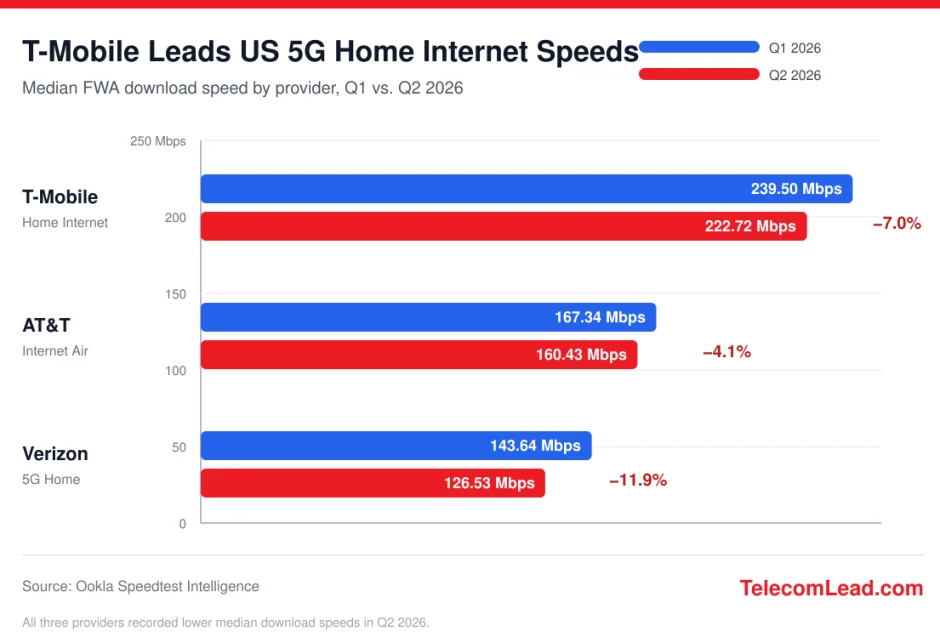
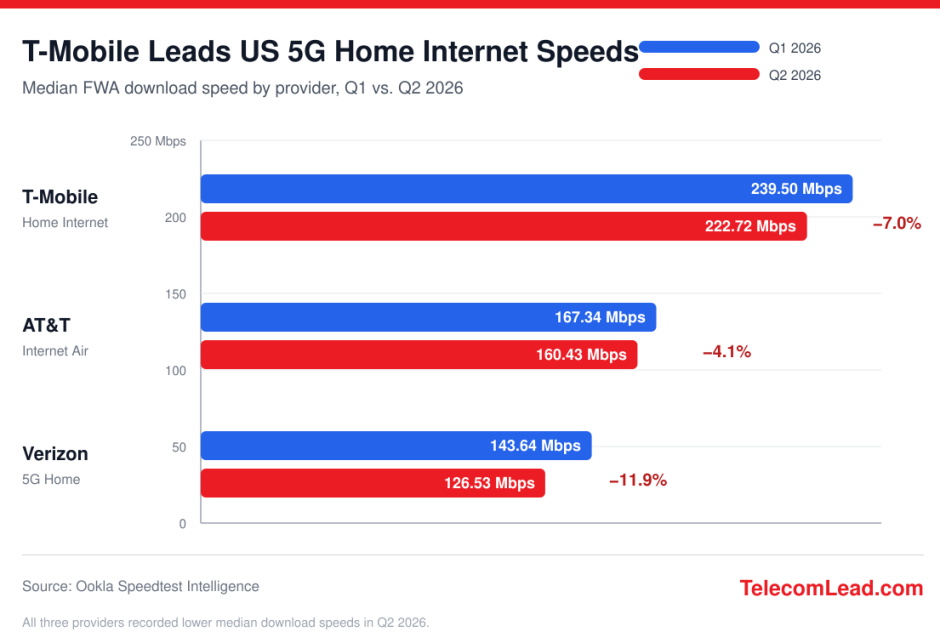
Ookla’s Q2 2026 data paints a clear picture of T-Mobile’s dominance. The carrier’s FWA service achieved an impressive average download speed of 222.72 Mbps. This figure represents a substantial lead over AT&T Internet Air, which clocked in at 160.43 Mbps, and Verizon 5G Home Internet, at 126.53 Mbps. T-Mobile’s download speeds were a remarkable 38.8% faster than AT&T’s and a staggering 76% ahead of Verizon’s.
Beyond download speeds, T-Mobile also excelled in other crucial performance metrics. It recorded the highest average upload speed at 18.12 Mbps and boasted the lowest multi-server latency at 46 milliseconds. These combined metrics position T-Mobile as the premier choice for users requiring robust and responsive internet access for a wide range of applications, from seamless video conferencing and immersive online gaming to efficient cloud computing.
A Quarterly Dip, But a Dominant Position Maintained
While T-Mobile maintained its leadership, the second quarter of 2026 did see a slight performance decline across all three major FWA providers. This trend is attributed to well-understood seasonal factors, including the impact of foliage on signal propagation, higher ambient temperatures affecting equipment, and increased network congestion during peak usage periods.
T-Mobile’s download speed saw a 7% decrease, moving from 239.50 Mbps in Q1 to 222.72 Mbps in Q2. Similarly, AT&T experienced a 4.1% dip, from 167.34 Mbps to 160.43 Mbps. Verizon saw the most significant drop in download speeds, falling 11.9% from 143.64 Mbps to 126.53 Mbps.
Despite these quarterly fluctuations, T-Mobile’s network strength is further emphasized by its lowest recorded download speed during a typical 24-hour period, which was approximately 165 Mbps. This figure is remarkably close to Verizon’s peak performance of around 170 Mbps, illustrating the sheer scale of T-Mobile’s network advantage even during its slower periods.
AT&T’s Ascendancy and Spectrum Investments
AT&T has emerged as a formidable challenger, demonstrating significant progress in its FWA performance. The carrier’s download speed in Q1 2026, at 167.34 Mbps, represented a nearly 60% improvement over its Q3 2025 performance of 104.61 Mbps. This substantial leap is a direct result of AT&T’s strategic investments in low-band and mid-band spectrum, notably through its $23 billion acquisition of spectrum assets from EchoStar. This spectrum expansion has demonstrably enhanced AT&T’s network capacity and coverage, positioning it as a stronger competitor in the FWA landscape.
However, AT&T’s upload speed performance experienced a decline in Q2 2026. After a notable increase from 9.23 Mbps in Q3 2025 to 12.55 Mbps in Q1 2026, its upload speed dropped to 10.06 Mbps in Q2. This decline placed AT&T behind both T-Mobile and Verizon in upload performance for the quarter. Despite this, AT&T’s consistent improvement in download speeds has successfully elevated it to the second-ranked FWA provider for downloads, a significant achievement after trailing both competitors for the first three quarters of 2025.
Upload Speeds Face Greater Quarterly Declines
The Q2 2026 analysis revealed that upload performance deteriorated more significantly than download performance across all three major FWA providers. T-Mobile’s upload speed saw a 21.5% decrease, from 23.07 Mbps to 18.12 Mbps. AT&T experienced a 19.8% decline, dropping from 12.55 Mbps to 10.06 Mbps. Verizon’s upload speed also fell by 14%, from 14.35 Mbps to 12.20 Mbps.
Even with these quarterly decreases, T-Mobile’s Q2 upload performance remained robust, outperforming Verizon by 48.5% and AT&T by 80.1%. This sustained leadership in upload speeds is crucial for a growing number of applications that rely on fast data transmission for tasks such as uploading large files, participating in high-quality video calls, and engaging in real-time content creation.
Latency: T-Mobile Sets the Bar for Responsiveness
In terms of latency, T-Mobile again demonstrated its network superiority, recording the lowest multi-server latency at 46 milliseconds in Q2 2026. This is a significant advantage over Verizon, which registered 53 milliseconds, and AT&T, which recorded 69 milliseconds. The improvements in latency are marginal across all providers, with T-Mobile increasing from 45 ms to 46 ms, Verizon from 52 ms to 53 ms, and AT&T from 67 ms to 69 ms.
Low latency is a critical factor for real-time applications where even small delays can impact user experience. T-Mobile’s consistently lower latency provides a tangible benefit for users engaged in activities such as online gaming, video conferencing, and accessing cloud-based services, where immediate responsiveness is paramount.
Verizon’s Stability in Slower Connections
While Verizon lagged behind its competitors in overall download performance, its FWA service demonstrated a notable characteristic: greater stability for its slower connections. The bottom 10% of Verizon’s customer speed tests consistently fell within a narrow range of 21.09 Mbps to 24.75 Mbps, regardless of network load or time of day.

In contrast, T-Mobile and AT&T exhibited more variability in their slowest connections. T-Mobile’s bottom-decile speed peaked at 59.65 Mbps in the early morning but dropped by a significant 62.4% to 22.43 Mbps during prime evening hours. AT&T’s comparable performance saw an even steeper decline of 67.84%, from 46.86 Mbps in the early morning to 15.07 Mbps at 8 p.m.
This suggests that while T-Mobile and AT&T offer considerably higher peak potential speeds, they can experience greater performance fluctuations during periods of high network congestion. Verizon, while delivering slower speeds at the lower end of its performance spectrum, offers a more predictable and consistent experience for these users. This consistency could be a key selling point for a segment of the market that prioritizes reliability over the absolute highest speeds.
Furthermore, Verizon appears to maintain an FWA speed ceiling of approximately 300 Mbps. This contrasts with T-Mobile, where the fastest 10% of tests frequently exceeded 600 Mbps, and AT&T, which approached 500 Mbps during periods of low congestion. This indicates that while Verizon may offer a more stable experience for its lower-tier users, it falls short in delivering the ultra-high speeds that T-Mobile and AT&T are capable of achieving for their top-performing connections.
The Evolving Landscape of US FWA Competition
The Q2 2026 performance data firmly establishes T-Mobile as the leader in the US FWA market, excelling in download speeds, upload speeds, and latency. AT&T has made substantial strides, solidifying its position as a strong second with its strategic spectrum acquisitions, and has now surpassed Verizon in median download speed. Verizon, while trailing in headline speeds, offers a more consistent experience for its slowest connections, a niche but important attribute.
However, significant challenges remain for all three networks. Weaker performance in rural areas, evening congestion, and seasonal signal interference continue to impact the FWA experience across the board. As the FWA market matures and expands beyond its initial focus on rural coverage to become a mainstream urban and suburban broadband alternative, the importance of network quality – encompassing speed, latency, and consistency – will only intensify.
The ability of these providers to meet and exceed benchmarks like the FCC’s 100 Mbps download and 20 Mbps upload targets will be crucial for competitive success. As more households rely on FWA for their primary internet needs, the nuanced performance metrics revealed by Ookla’s data will increasingly influence consumer choices and shape the future of broadband competition in the United States. The ongoing race for network superiority, driven by spectrum acquisition, technological innovation, and infrastructure investment, promises to keep the FWA market dynamic and highly competitive for the foreseeable future.
By BABURAJAN KIZHAKEDATH