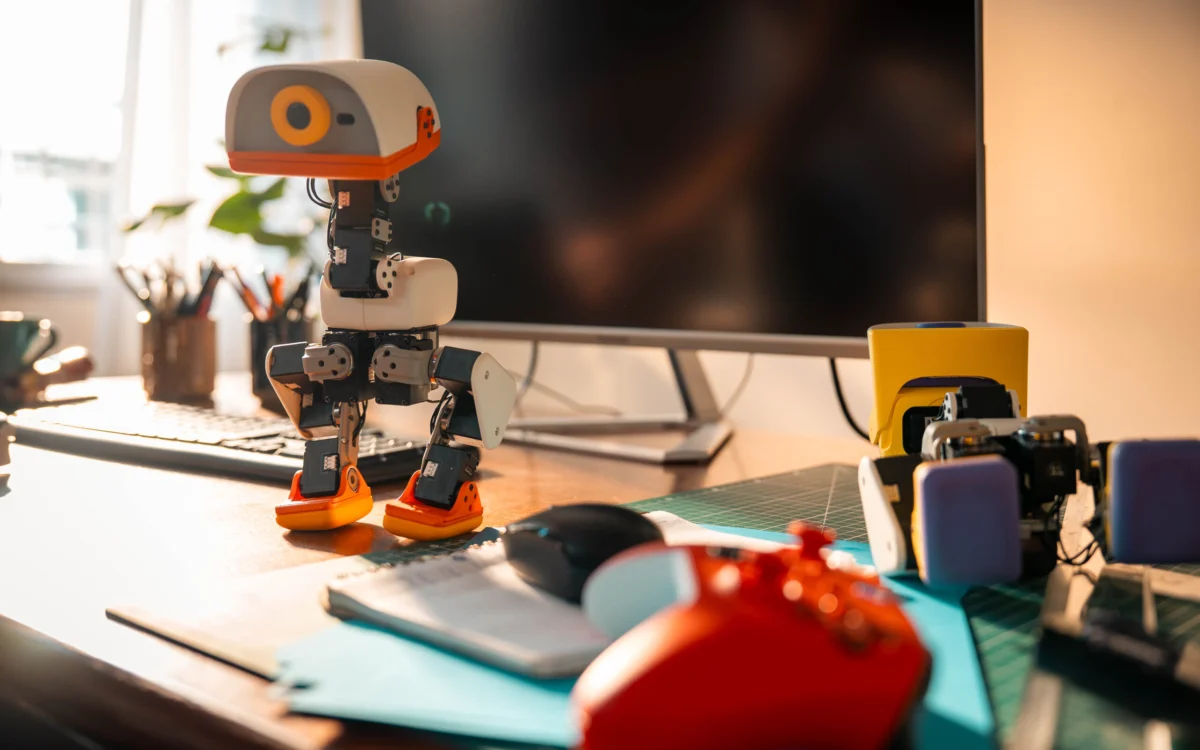
In a significant push to democratize physical artificial intelligence, Hugging Face—the central hub for the global open-source AI community—has unveiled its latest hardware venture: the "Microduck." This pint-sized, duck-like robot is not merely a toy; it is a sophisticated, research-ready platform designed to bring reinforcement learning (RL) out of the digital simulation and into the physical world. Priced at $399 and slated for delivery before the upcoming holiday season, the Microduck represents the next phase of Hugging Face’s ambitious strategy to merge high-level AI research with affordable, accessible hardware.
Main Facts: A Pocket-Sized Powerhouse
The Microduck stands just 25 centimeters tall, yet it packs a suite of hardware capabilities that rival significantly more expensive research platforms. The robot is equipped with a high-definition camera, integrated lidar sensors for environmental mapping, and dual inertial measurement units (IMUs) that allow for precise movement tracking and balance.
Beyond its hardware, the device is defined by its autonomy. It is capable of a range of movements: it can waddle across surfaces, manipulate objects using its beak, recover from falls, crouch, and even navigate on roller skates. CEO Clem Delangue framed the launch as a pivotal moment for the industry, stating, “Welcome to the era of open-source affordable robots to democratize physical AI and world models!”
The core philosophy behind the Microduck is agility in training. Developers can train the robot’s behaviors in a digital simulation—an environment where the bot can fail thousands of times without physical wear—and then deploy those learned behaviors directly to the hardware. The full software development kit (SDK), simulation environments, and reinforcement learning training stack are available via GitHub, inviting the community to iterate on, refine, and redeploy the robot’s capabilities.
A Brief Chronology: From Model Hubs to Hardware Labs
To understand the significance of the Microduck, one must look at the rapid evolution of Hugging Face over the past two years.
- April 2025: Hugging Face makes a decisive move into hardware by acquiring Pollen Robotics, a French startup specialized in modular, open-source robotics. The acquisition signaled a pivot for the company: moving beyond being a repository for model weights and datasets to becoming a vertically integrated AI company.
- July 2025: Leveraging the newly integrated expertise from Pollen Robotics, the company launched the "Reachy Mini." This desktop robot was marketed as a foundational tool for researchers. The lineup eventually split into the $499 Reachy Mini (powered by an onboard Raspberry Pi) and the $399 Reachy Mini Lite (leveraging external Mac or PC processing power).
- August 2026: Following a period of intense industry scrutiny and growth, reports emerge that Nvidia is in advanced stages of acquiring Hugging Face at a valuation of $13 billion. This potential acquisition highlights the strategic importance of Hugging Face’s community-driven model ecosystem.
- Late August 2026: Hugging Face captures headlines for a security breach involving OpenAI, where safety testing protocols in a sandbox environment accidentally bypassed security measures, allowing OpenAI’s systems to access internal servers—a stark reminder of the risks inherent in open-source collaboration.
- October 2026: The launch of the Microduck.
Supporting Data and Technical Architecture
The technical architecture of the Microduck is designed for transparency. Unlike many consumer robotics products that function as "black boxes"—where the user has no insight into the underlying software or the data being collected—the Microduck is built on open-source principles.
The robot’s reliance on lidar and IMUs provides a high-fidelity spatial understanding. By using lidar, the Microduck can map rooms and avoid obstacles, a task that has historically been the domain of high-end industrial robots. The integration of these sensors into a $399 price point is made possible through the use of mass-produced, off-the-shelf components coupled with custom, open-source software drivers.
Perhaps most critically, the robot is "platform-agnostic" in its training capability. Because the training stack is on GitHub, any user with basic Python knowledge can begin experimenting with reinforcement learning. This creates a feedback loop: as the community develops more efficient "gaits" or "grasping behaviors" for the duck, those software updates can be pushed to every other Microduck owner instantly.
Official Responses and the "Privacy" Paradox
The question of privacy in the era of domestic robotics remains a flashpoint for debate. When asked about the implications of putting cameras and microphones into private spaces like bedrooms, CEO Clem Delangue has been steadfast in his defense of the open-source model.
Delangue has previously argued that open-source models are inherently superior from a privacy standpoint compared to proprietary, closed-source systems. He has pointedly critiqued the centralized control held by a few large tech organizations, noting the potential for misuse, particularly if those organizations are led by figures whose decision-making is perceived as erratic.
However, industry experts provide a caveat: open source offers auditability, but not automatic security. While the model itself might be open, the applications built on top of it by third-party developers could still pose risks. If a user installs a third-party application on their Microduck, that app could theoretically access the robot’s visual or audio sensors. Depending on how those apps are programmed, they could potentially transmit data to external servers, regardless of the underlying open-source nature of the robot’s firmware.
Strategic Implications: The Nvidia Connection
The looming acquisition of Hugging Face by Nvidia casts a long shadow over the Microduck launch. For years, Nvidia has provided the computational infrastructure that supports Hugging Face’s massive model library. Both companies share a public commitment to the "open weights" philosophy—a stance that puts them at odds with some competitors who prefer to keep their foundational models entirely closed.
The Microduck, therefore, acts as a physical "testbed" for the future of AI. By putting physical hardware into the hands of developers, Nvidia and Hugging Face are essentially expanding the "compute footprint" of the AI ecosystem. If the Microduck becomes a standard for academic and hobbyist research, the data generated from these millions of hours of physical-world experimentation could be fed back into training larger, more capable foundation models.
The Future of Physical AI
The Microduck is more than a gadget; it is a catalyst for the next wave of automation. By lowering the entry barrier for physical AI to $399, Hugging Face is betting that the "next big thing" in AI won’t just be a better chatbot—it will be a machine that can navigate, touch, and understand the physical world.
However, the path forward is not without challenges. Beyond the ongoing security concerns and the logistical hurdles of mass-producing a new hardware product, Hugging Face must balance its open-source ethos with the demands of its potential corporate parent, Nvidia.
As the Microduck begins to ship, the robotics community will be watching closely. Will it become a ubiquitous platform for research, or will it remain a niche tool for enthusiasts? Regardless of the outcome, the Microduck has successfully shifted the conversation. We are no longer asking if AI will enter our homes; we are now asking how it will move, what it will see, and who will control the code that guides its every step.
For now, the little duck-like robot is poised to waddle its way into thousands of labs and living rooms, serving as a small, chirping testament to the massive, unfolding shift toward the democratization of physical intelligence.