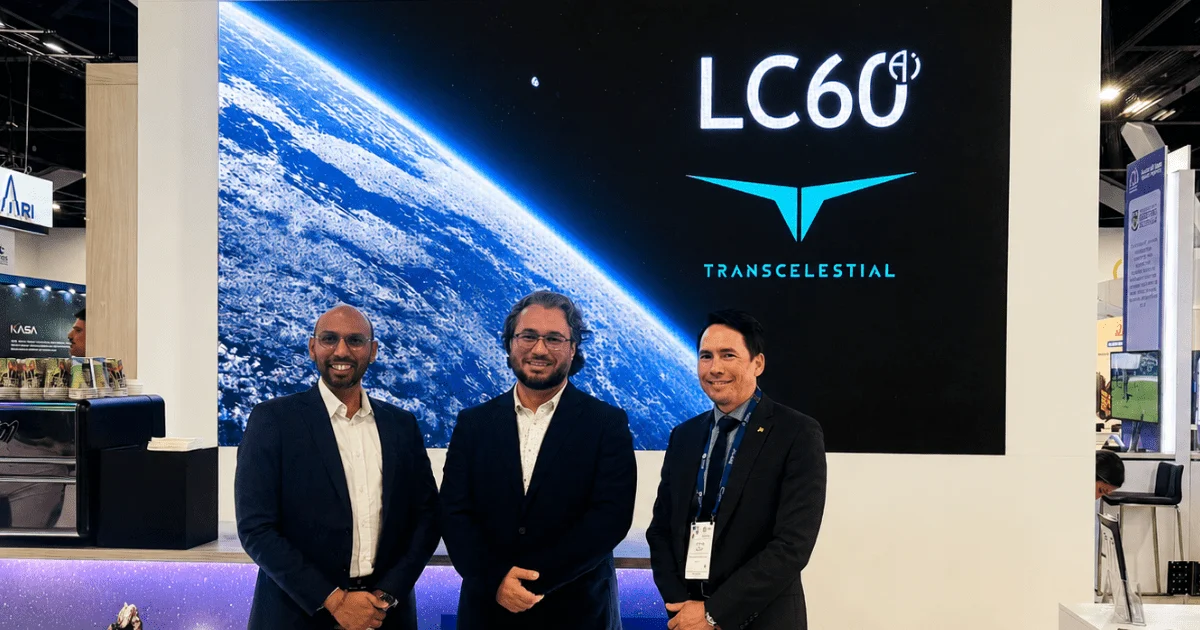
SAN FRANCISCO / PERTH — August 20, 2026 — In a major development for the commercialization of space-based laser communications, Australian Earth observation (EO) operator LatConnect 60 (LC60) has signed a landmark commercial contract with laser communications specialist Transcelestial. Under the terms of the agreement, Transcelestial will supply its cutting-edge optical communications terminal for LC60’s upcoming SWIRSAT-1 mission.
In addition to the flight hardware, the contract grants LC60 full access to Transcelestial’s rapidly expanding optical ground station network. This integrated approach will facilitate high-speed space-to-ground data transport and streamline ground station operations, bypassing the traditional bottlenecks associated with radio frequency (RF) downlinks.
Main Facts: The Core of the Agreement
The commercial agreement between LatConnect 60 and Transcelestial represents a paradigm shift in how satellite operators manage data downlinks. Rather than procuring a flight terminal and independently constructing or licensing a dedicated ground segment, LC60 is utilizing an integrated "Space-to-Ground-as-a-Service" model.
Key Components of the Contract:
- High-Capacity Flight Hardware: Transcelestial will deliver an optical communications terminal designed to support data transfer rates of up to 10 Gigabits per second (Gbps) aboard the SWIRSAT-1 satellite.
- Integrated Ground Network Access: LC60 will leverage Transcelestial’s established optical ground station network, which currently features two operational stations in Singapore and Spain, with plans to expand to five or six stations by the end of 2026.
- End-to-End Data Transport: The agreement covers ongoing data transport and ground operations. Once commissioned, the network will seamlessly route high-volume Short-Wave Infrared (SWIR) imagery from orbit directly into LC60’s proprietary processing and customer-delivery environment.
- Operational Division of Labor: LC60 retains absolute control over mission tasking, data ownership, and customer delivery. Transcelestial will act as the utility provider, managing the underlying high-capacity transport layer—essentially providing an orbital equivalent of dark fiber.
Chronology: The Road to SWIRSAT and Optical Maturity
The partnership is the culmination of several years of rapid technological maturation for both companies, set against the backdrop of a burgeoning sovereign space industry in Australia.
[March 2026] ------------------> [August 2026] -------------> [End of 2026] ------------> [Q1 2027] --------------> [2029]
Transcelestial deploys           LC60 & Transcelestial        Ground network             Launch of SWIRSAT-1     LC60 constellation
Post-Quantum Cryptography        sign commercial contract     expands to 5-6 stations    and SWIRSAT-2           reaches 18 satellites
Transcelestial’s Technology Timeline
- Early Deployments: Transcelestial successfully validated its space-grade hardware with the integration and commissioning of its optical terminal on the 6G StarLab mission.
- March 2026: Transcelestial integrated production-ready post-quantum cryptography (PQC) at the application layer, establishing a new benchmark for secure space-to-ground communications.
- August 2026: The company scaled its manufacturing capabilities at its proprietary facility, reaching a production capacity of over 100 optical terminals per month. This industrial scaling allows the ground network to simultaneously service multiple commercial missions.
LatConnect 60’s Constellation Roadmap
- Sovereign Foundations: LC60 established its footprint as a vertically integrated Earth intelligence provider, securing crucial developmental support from the Australian Space Agency and the Government of Western Australia.
- August 2026 (The Present Agreement): LC60 secures Transcelestial’s 10Gbps terminal for its flagship SWIRSAT-1 satellite, marking the second major Australian space mission to adopt Transcelestial’s optical technology (following an earlier integration program with launch provider Gilmour Space).
- Q1 2027: Scheduled launch of LC60’s first two SWIRSAT satellites, establishing sovereign, high-resolution SWIR sensing capabilities.
- 2029: Planned completion of an 18-satellite constellation, offering rapid revisit rates and continuous global monitoring.
Supporting Data: RF vs. Optical Performance Metrics
The technical driver behind LC60’s pivot to optical communications is the sheer volume of data generated by modern hyperspectral and SWIR sensors. Traditional RF downlinks are increasingly incapable of handling the data payloads of high-resolution constellations without severe compromises.
The Downlink Bottleneck: A Comparative Analysis
| Metric | Traditional Small-Sat RF (X-Band) | Transcelestial Optical (Standard) | Transcelestial Optical (High-Speed) |
|---|---|---|---|
| Data Transfer Rate | ~100 Mbps | 1 Gbps | 10 Gbps |
| Data Volume per 7-Min Pass | ~5 Gigabytes (GB) | ~50 Gigabytes (GB) | ~500 Gigabytes (GB) |
| Spectrum Licensing Required | Yes (Complex & Costly) | No | No |
| Susceptibility to Jamming | High | Negligible | Negligible |
| Onboard Compression Required | High (Loss of fidelity) | Minimal to None | None |
Overcoming Environmental and Security Challenges
Optical communications have historically faced challenges from atmospheric attenuation (such as cloud cover). Transcelestial mitigates these issues through network diversity and advanced signal processing:
- Geographic Redundancy: By deploying ground stations in geographically diverse regions (e.g., Singapore and Spain), the system can dynamically reroute data to a clear station if weather conditions degrade at another.
- Adaptive Data Rates & Forward Error Correction (FEC): During a single pass, the terminal continuously optimizes throughput based on atmospheric geometry, maximizing data yield rather than dropping to a lowest-common-denominator fallback rate.
- Quantum-Resistant Security: Because laser beams are highly directional and narrow, physical interception is practically impossible without placing an asset directly in the beam path. Transcelestial layers this physical security with post-quantum cryptography (PQC) at the application layer, protecting sensitive Earth-intelligence data against future decryption threats.
Official Responses: Executive Perspectives
Leadership from both companies emphasized that the contract represents a structural shift in how space data is commercialized, moving away from fragmented infrastructure development toward unified service procurement.
Dr. Mohammad Danesh, Co-Founder and Chief Technology Officer of Transcelestial, highlighted the economic and regulatory relief this model brings to operators:

"Earth-observation operators are collecting far more data than they can get to the ground. RF downlink is spectrum-constrained, license-heavy, and expensive per gigabyte. What LatConnect 60 is buying is a high-capacity optical path plus the ground network to terminate it, bought as a service, with no spectrum licensing and no optical ground segment for them to build."
Venkat Pillay, Founder and Chief Executive Officer of LatConnect 60, emphasized the operational necessity of integrating the sensor and the downlink path:
"For an Earth-intelligence mission, the sensor and the data path cannot be treated separately. The mission only creates value when we can move high-volume SWIR imagery from collection to users within useful delivery windows. Transcelestial’s terminal will reduce the time needed to clear imagery from our SWIRSATs."
Implications: Disrupting Earth Observation and Telecom
The agreement between LatConnect 60 and Transcelestial has far-reaching implications for the broader space economy, regulatory frameworks, and national security.
1. The Demise of the RF Regulatory Bottleneck
Securing RF spectrum licenses from the International Telecommunication Union (ITU) and national regulators is a notoriously slow, expensive, and politically fraught process. Because optical communications operate in the unregulated near-infrared spectrum, LC60 can bypass years of bureaucratic delays. This allows the company to scale its 18-satellite constellation by 2029 without the risk of regulatory gridlock.
2. Democratization of Ground Segment Infrastructure
Building and maintaining optical ground stations requires significant capital expenditure (CapEx). By establishing an "as-a-service" model, Transcelestial is effectively acting as an orbital telecommunications carrier. This allows emerging EO operators to convert what would have been massive upfront CapEx into predictable operational expenditure (OpEx), leveling the playing field for mid-tier space enterprises.
3. Advancing Sovereign Intelligence Capabilities
Short-Wave Infrared (SWIR) imagery is highly valued in agriculture, defense, carbon accounting, and resource management due to its ability to penetrate smoke, dust, and haze, and identify material compositions invisible to the naked eye. By pairing SWIR sensors with 10Gbps laser downlinks, LC60 can deliver actionable intelligence to defense and civil clients within minutes rather than days. Backed by the Australian Space Agency and the Western Australian Government, this partnership strengthens Australia’s position as a self-reliant provider of critical space intelligence.
4. Step Toward the "Undersea Cable in the Sky"
For Transcelestial, this contract represents a vital commercial validation of its long-term vision: establishing a dense constellation of low-Earth orbit (LEO) satellites that act as a high-speed laser backhaul network. By proving the reliability of its space-to-ground and ground-station-as-a-service model with commercial partners like LC60, Transcelestial is laying the groundwork for a global, laser-based telecom network designed to replace or supplement vulnerable subsea fiber-optic cables.