SALT LAKE CITY, Utah — The small satellite industry is undergoing a profound paradigm shift. For years, the primary challenges for smallsat operators were simply getting a payload into orbit and ensuring basic communications. Today, as the Low Earth Orbit (LEO) environment becomes increasingly crowded, competitive, and contested, the conversation has shifted from basic survival to dynamic maneuverability.
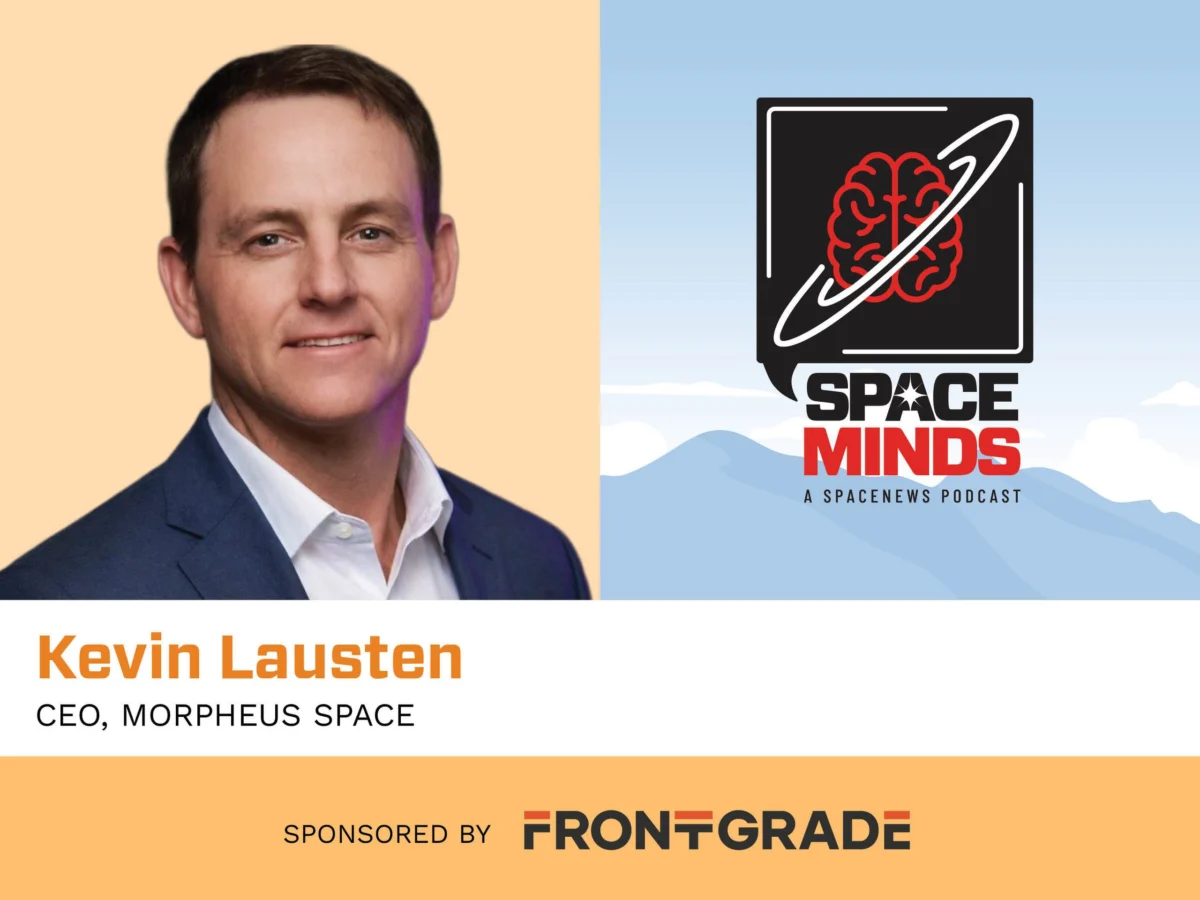
At the 2026 Small Satellite Conference in Salt Lake City, Utah, this technological evolution took center stage. In an exclusive interview on SpaceNews’ weekly podcast Space Minds, Executive Editor Mike Gruss sat down with Kevin Lausten, CEO of Morpheus Space, to discuss why satellite propulsion is experiencing an unprecedented "moment."
From the pressing realities of orbital congestion to the geopolitical demands for domestic manufacturing sovereignty and the rise of autonomous production, the discussion highlighted how propulsion has evolved from a secondary subsystem into a critical enabler of modern space operations.
Main Facts: The Intersection of Mobility and Space Sovereignty
The core theme of the 2026 Small Satellite Conference centered on adaptability. As thousands of new satellites are launched annually, the space domain is no longer a peaceful, empty vacuum; it is a highly congested highway and, increasingly, a theater of geopolitical competition.
In this environment, passive satellites—those lacking the ability to alter their orbits—are rapidly becoming liabilities. During the Space Minds interview, Kevin Lausten outlined several key pillars driving the current propulsion boom:
- The Mandate for Maneuverability: Propulsion is no longer optional. To survive collision risks, perform active debris avoidance, and meet tightening international regulatory standards, satellites must possess reliable, responsive propulsion systems.
- The Definition of Sovereignty: Geopolitical tensions have forced nations to re-evaluate their supply chains. "Sovereignty" in the space sector now means having domestic access to critical technologies, reducing reliance on foreign components, and ensuring that allied nations can deploy space assets without ITAR (International Traffic in Arms Regulations) or supply chain bottlenecks.
- Autonomy in Production and Operations: The sheer volume of satellites being manufactured requires a transition from bespoke, hand-crafted thrusters to automated, software-defined production lines. Furthermore, operational autonomy is migrating onboard the spacecraft, allowing propulsion systems to make real-time maneuvering decisions without waiting for ground commands.
Chronology: The Evolution of SmallSat Propulsion
To understand why propulsion is "having a moment" in 2026, it is necessary to trace the technological timeline of the small satellite sector over the past fifteen years.
+-----------------------------------------------------------------------------+
|                                  TIMELINE                                   |
+-----------------------------------------------------------------------------+
|  2010–2015: The CubeSat Pioneer Era                                         |
|  - Satellites are largely passive "space dart" payloads.                    |
|  - Minimal to no onboard propulsion; heavy reliance on primary rideshares.   |
|                                                                             |
|  2016–2020: The Constellation Boom                                          |
|  - Megaconstellations (e.g., SpaceX Starlink, OneWeb) emerge.               |
|  - Electric propulsion (Hall-effect thrusters) becomes a validated standard. |
|                                                                             |
|  2021–2025: Regulatory and Security Tightening                              |
|  - Debris mitigation rules shorten post-mission deorbit windows.            |
|  - Space Force introduces "Dynamic Space Operations" (DSO) concept.          |
|                                                                             |
|  2026: The Era of Autonomous, Sovereign Mobility                            |
|  - Propulsion is mandatory for orbital slot management and defense.         |
|  - Shift toward domestic manufacturing and autonomous collision avoidance.   |
+-----------------------------------------------------------------------------+
The CubeSat Pioneer Era (2010–2015)
In the early days of the CubeSat revolution, miniaturized satellites were primarily academic projects or simple technology demonstrators. Due to mass, volume, and power constraints, these early spacecraft lacked onboard propulsion. They were placed into orbit by primary launch vehicles and left to drift. If they were on a collision course, there was nothing operators could do but watch and hope.
The Megaconstellation Boom (2016–2020)
The deployment of massive commercial communications constellations fundamentally changed the economics of space. Companies realized that to manage fleets of hundreds or thousands of satellites, active propulsion was necessary for orbital insertion, slot management, and collision avoidance. During this period, electric propulsion (EP)—specifically Hall-effect and gridded ion thrusters—became the gold standard for commercial LEO constellations. However, these systems remained relatively bulky and expensive for smaller, standardized CubeSats and MicroSats.
Regulatory and Security Pressures (2021–2025)
As the number of active payloads in LEO surpassed 10,000, regulators stepped in. The U.S. Federal Communications Commission (FCC) implemented a landmark rule requiring satellite operators to deorbit their spacecraft within five years of mission completion, down from the previous 25-year guideline. Concurrently, military space agencies, particularly the U.S. Space Force, began emphasizing "Dynamic Space Operations" (DSO)—the ability for military satellites to maneuver freely to evade threats, inspect other objects, or change orbital planes.
The Present Day (2026)
Propulsion has transitioned from a specialized luxury to a fundamental utility. Manufacturers like Morpheus Space are delivering highly integrated, modular, and intelligent electric propulsion systems that can scale from small CubeSats to larger ESPA-class satellites, satisfying both commercial economic needs and national security requirements.
Supporting Data: The Cost of Congestion and the Scaling of LEO
The urgency surrounding the propulsion market is driven by hard numbers. The outer space environment is more crowded than at any point in human history, and the risk of catastrophic collisions is rising exponentially.
Orbital Congestion by the Numbers
According to space tracking data compiled in early 2026:
- Active Satellites: There are currently over 12,500 active satellites in orbit, a number projected to exceed 30,000 by 2030.
- Tracked Debris: Government agencies track more than 35,000 pieces of orbital debris larger than 10 centimeters, alongside millions of smaller, untrackable fragments.
- Conjunction Alerts: Satellite operators now receive hundreds of "conjunction alerts" (warnings of close passes with other objects) every week. Without active propulsion to execute avoidance maneuvers, operators face a statistical certainty of losing assets to debris impacts.
Estimated Small Satellite Propulsion Market Valuation (2022 - 2030)

Year | Market Size (USD Billions)
-----+---------------------------
2022 | $0.85B
2024 | $1.40B
2026 | $2.30B (Est.)
2028 | $3.80B (Proj.)
2030 | $5.50B (Proj.)
The economic impact is clear: a satellite without propulsion is a stranded asset once its initial orbit decays. By integrating compact electric propulsion systems, operators can extend mission lifetimes by 3 to 5 years, yielding a massive return on investment (ROI) that easily offsets the initial cost of the propulsion hardware.
Official Responses and Expert Viewpoints: Insights from Kevin Lausten
During his discussion with Mike Gruss on Space Minds, Morpheus Space CEO Kevin Lausten provided critical context on how his company and the broader industry are adapting to these systemic market changes.
On the Critical Role of Mobility in Congested Space
Lausten emphasized that the traditional view of satellites as static, passive platforms is dead.

"Propulsion is having a moment because the space domain is no longer static," Lausten observed. "If you cannot move, you cannot adapt. Whether you are a commercial operator trying to avoid a piece of debris, or a national security operator trying to evade an adversary’s counter-space capabilities, mobility is the foundation of space domain awareness and survivability."
On "Sovereignty" and the Supply Chain
One of the most complex challenges facing the modern aerospace sector is supply chain vulnerability. The COVID-19 pandemic, coupled with heightened geopolitical rivalries in Europe and the Indo-Pacific, exposed the risks of relying on highly globalized, fragile supply chains for critical defense and aerospace components.
Lausten noted that allied nations are increasingly demanding "sovereign capability" in space technology. This means that defense departments and national space agencies want propulsion systems manufactured domestically or within highly trusted allied networks.
"Sovereignty isn’t just a political buzzword; it’s an operational requirement," Lausten explained. "Our customers want to know that their propulsion systems are secure, ITAR-compliant, and free from foreign interference or supply disruptions. Building a localized, robust industrial base is key to securing the space systems of tomorrow."
On Autonomy and "Software-Defined" Propulsion
To meet the soaring demand for satellites, propulsion manufacturers must move away from the traditional, manual assembly methods of the past. Morpheus Space has pioneered the use of automated manufacturing and intelligent, software-defined propulsion architectures.
By utilizing artificial intelligence and machine learning in both the design phase and onboard the satellite, modern thrusters can self-diagnose, optimize fuel consumption in real time, and coordinate maneuvers autonomously with other spacecraft in a constellation.
"We are moving away from the era where ground controllers have to manually calculate and command every single burn," Lausten stated. "Autonomy allows the spacecraft to understand its environment, detect threats, and execute maneuvers instantly. It changes the economics of operating massive constellations."
Implications: The Future of Space Operations and the Defense Ecosystem
The insights shared at the 2026 Small Satellite Conference point to several long-term implications for the commercial space industry, international regulators, and global defense frameworks.
1. The Transition to "Dynamic Space Operations" (DSO)
For decades, military satellites were designed to remain in a fixed orbit for 15 years, hoarding their limited fuel supply like gold. The U.S. Space Force’s pivot to DSO represents a fundamental doctrine shift. Future military space architectures will rely on smaller, proliferated constellations of maneuverable satellites that can change orbits dynamically to perform missions, inspect suspicious targets, or dodge anti-satellite (ASAT) weapons. This doctrine is entirely dependent on the highly efficient, modular electric propulsion systems discussed by Lausten.
2. The Role of the Industrial Sub-Tier Base
As propulsion systems become more sophisticated, they rely on an underlying ecosystem of high-reliability microelectronics, radio frequency (RF) systems, and motion control components. This reality was highlighted by the sponsorship of the Space Minds podcast by Frontgrade Technologies.
Frontgrade—a company whose technology has supported every U.S. crewed space mission since Apollo 11—exemplifies the critical role that sub-tier suppliers play in the modern space race. To build modular, scalable propulsion and processing architectures that can be deployed quickly, propulsion manufacturers must partner with microelectronics firms capable of delivering radiation-hardened, mission-critical hardware. This interconnected supply chain is the true backbone of space sovereignty.
3. Sustainability and Deorbit Mandates
As debris mitigation rules become stricter, propulsion will become a licensing requirement. It is highly likely that within the next decade, international space agencies will refuse to license any satellite destined for an altitude above 400 kilometers unless it features an active, verifiable propulsion system capable of post-mission disposal. This regulatory shift will solidify propulsion as a permanent, non-negotiable component of satellite design.
Conclusion: A Mobile Future
The 2026 Small Satellite Conference made one reality abundantly clear: the era of the passive satellite is over. As the space sector continues to mature, the ability to navigate, adapt, and survive in an increasingly complex orbital environment will separate successful missions from costly failures.
Through a combination of autonomous manufacturing, localized sovereign supply chains, and intelligent onboard systems, companies like Morpheus Space are ensuring that the satellites of tomorrow have the mobility they need to thrive. Supported by a robust domestic industrial base of microelectronics and RF pioneers like Frontgrade, the propulsion sector is poised to remain the most critical, dynamic segment of the aerospace industry for decades to come.