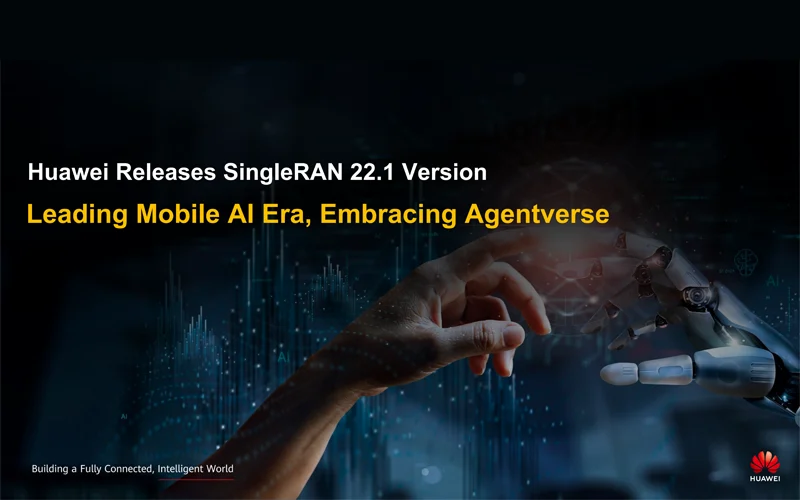
The telecommunications landscape is on the precipice of a seismic shift. As artificial intelligence evolves from passive, cloud-based tools into active, autonomous entities known as "AI Agents," the very fabric of our mobile infrastructure is being pushed to its breaking point. Traditional networks, designed primarily for human consumption—scrolling social media, streaming high-definition video, and browsing the web—are fundamentally ill-equipped to handle the erratic, high-density, and mission-critical demands of an "Agentic" future.
In response, Huawei has unveiled its latest software solution, SingleRAN 22.1. More than just a routine update, this technology marks the first commercial foray into a "Mobile AI" network architecture, designed to sustain the billions of autonomous agents that industry experts predict will define the next decade of digital interaction.
The Rise of the Agentverse: A New Economic Reality
The "Agentverse"—an interconnected ecosystem of autonomous AI agents—is no longer a futuristic concept found in science fiction; it is an imminent economic reality.
Forecasts and Industry Consensus
The scale of this transition is staggering. According to recent projections from IDC, the number of actively deployed AI agents is expected to reach over 1 billion by 2029, doubling to 2.2 billion by 2030. These figures, while impressive, are conservative compared to other industry benchmarks. Huawei’s Intelligent World 2035 report paints an even more ambitious picture, predicting that 900 billion AI agents will be active globally, with 90% of these operating within mobile environments.
This transformation is underpinned by a shift in how humans interact with technology. As NVIDIA CEO Jensen Huang famously suggested, we are approaching a future where each individual employee could be supported by over 100 AI agents. These agents will not merely wait for input; they will proactively transmit data, coordinate with other agents in real-time, and execute complex tasks on behalf of their users.
The Technical Bottleneck
This explosion of agents creates a "traffic jam" in existing networks. Unlike the predictable, downlink-heavy nature of human web browsing, agent services require:
- Massive Uplink Capacity: Agents constantly stream sensory and operational data back to the cloud or edge servers.
- Deterministic Low Latency: For multi-agent collaboration, millisecond-level response times are not just preferred; they are mandatory.
- Service Continuity: Constant, reliable interaction is required to ensure that agents remain "perpetual" in their intelligence.
Current "best-effort" connectivity models are rapidly becoming obsolete. To support this, networks must transition from being simple data pipes to intelligent, multidimensional orchestration platforms.
Chronology: From Concept to Commercial Deployment
The development of SingleRAN 22.1 did not happen in a vacuum. It is the culmination of years of research into 5G-Advanced and AI-native network design.
- Pre-2023: Huawei identifies the limitations of current 5G architectures regarding high-density IoT and AI agent traffic. Initial R&D focuses on "AI for Network" (using AI to optimize the network) and "Network for AI" (optimizing the network to serve AI).
- Early 2024: Huawei announces the vision of the "Mobile AI Era" at global summits, emphasizing the need for a new network topology.
- Mid-2024: The official launch of SingleRAN 22.1 takes place in Shanghai. This release is positioned as the first commercial software package specifically designed to handle the multi-modal data requirements of the Agentverse.
- Late 2024: Rapid global adoption begins. As of the latest reporting, the software has been deployed at 35 operator sites across 23 countries.
- Year-End 2024 Projection: Huawei anticipates that over 100 global operators will have completed the integration of SingleRAN 22.1 into their existing infrastructure.
The Six Pillars of SingleRAN 22.1
At the core of the SingleRAN 22.1 release are six technical advancements designed to create a "multidimensional" network foundation. These features represent a strategic departure from static resource management.
1. Dynamic Uplink Resource Orchestration
To combat the bottleneck of agent-generated data, the software employs advanced algorithms to dynamically allocate uplink resources. This ensures that agent traffic—which is often bursty and unpredictable—is prioritized without disrupting human-centric services.
2. Deterministic Latency Slicing
SingleRAN 22.1 introduces granular network slicing capabilities that allow operators to carve out "deterministic lanes" for specific AI agent applications. Whether it’s an autonomous drone fleet or a swarm of collaborative robotics, the network guarantees the latency required for stable operation.
3. Multi-Modal Traffic Awareness
The software includes enhanced traffic-sensing capabilities. It can distinguish between different types of AI data, applying distinct optimization strategies for high-fidelity video streams versus low-bandwidth command-and-control signals.
4. AI-Native Energy Efficiency
Supporting billions of agents would traditionally be an energy-intensive endeavor. Huawei’s update includes "Green AI" algorithms that automatically power down unused spectrum or baseband components during periods of low activity, ensuring the growth of the Agentverse does not lead to a carbon footprint crisis.
5. Multi-Band Spectrum Aggregation
To achieve the massive capacity required, SingleRAN 22.1 utilizes sophisticated aggregation techniques, binding disparate spectrum bands together to provide a seamless, high-throughput experience that mimics a single, wide channel.
6. Enhanced Edge-Cloud Synergy
The software is purpose-built to facilitate communication between the mobile edge and the cloud. By positioning intelligence closer to the user, it reduces the physical distance data must travel, further slashing latency and improving the responsiveness of AI agents.
Hardware and Software Synergy: The UBBPi Series
A software update is only as powerful as the silicon it runs on. SingleRAN 22.1 serves as the inaugural software package to fully support Huawei’s next-generation UBBPi series baseband boards.
This hardware represents a generational leap in processing power. By combining the advanced algorithms of the 22.1 software with the high-compute architecture of the UBBPi boards, Huawei provides a platform capable of real-time network orchestration. This integration allows the network to adapt its topology in milliseconds, responding to the dynamic movement and data needs of AI agents in real-time.
Implications for the Industry and the "Token Economy"
The implications of this shift extend far beyond simple connectivity. We are witnessing the birth of the "Token Economy," where network capacity and intelligence become commodities that can be bought, sold, and traded in real-time.
A Paradigm Shift for Operators
For telecommunications operators, this is a moment of truth. They are no longer just utilities; they are the backbone of the global AI economy. By adopting architectures like SingleRAN 22.1, operators can move away from flat-rate data models toward a more nuanced, value-added service structure. They can offer "AI-Ready" network tiers that provide the deterministic performance required by enterprise customers, thereby unlocking new revenue streams.
Official Response
He Yunru, Vice President of Huawei Wireless Network Solutions, emphasized the gravity of this transition during the Shanghai launch. "Mobile AI is not a service upgrade; it is a paradigm shift for the industry," he stated. "As the first commercial version for the Mobile AI era, SingleRAN 22.1 comprehensively reconstructs network capabilities, empowering operators to seize new opportunities in the Token economy, making intelligence omnipotent, omnipresent, and perpetual."
Conclusion: Preparing for the Agentic Future
The transition to an AI-agent-driven world is inevitable. As these autonomous entities begin to integrate into every facet of our professional and personal lives, the networks that carry their data must be as dynamic as the intelligence they support.
Huawei’s SingleRAN 22.1 is a proactive measure against the limitations of legacy infrastructure. By focusing on uplink capacity, deterministic latency, and intelligent resource orchestration, it provides the necessary scaffolding for a future where AI agents are everywhere.
With 35 sites already live and a goal of 100 operators by the end of the year, the race to build the "Agentverse" is well underway. The question for operators worldwide is no longer if they should upgrade, but how fast they can adapt to a world where their network must serve not only the humans who use it but the billions of agents that will soon call it home.
Related Industry Developments
- Shared Rural Network: UK operators continue to push 4G connectivity into national parks, bridging the gap between urban hubs and rural landscapes.
- Digital Inclusion: Vodafone continues to focus on "digital divide" initiatives, ensuring that the AI revolution does not leave underserved communities behind.
- Sustainability: Virgin Media O2’s recent achievement in cutting 5,200 tonnes of CO2 highlights the broader industry trend toward carbon-neutral infrastructure, a goal that aligns with the energy-efficient design of new AI-ready networks.