In a landmark development for the UK’s critical national infrastructure, Southern Water has announced a strategic partnership with pioneering technology firm Lightsonic. The collaboration marks a significant shift in how utility companies approach the chronic problem of water leakage, leveraging the expansive reach of the nation’s fibre-optic broadband network to monitor subterranean pipelines in real-time. This technological synergy promises to address a decades-old crisis: the loss of roughly 2.6 billion litres of water every day across the United Kingdom.
The Magnitude of the Challenge: A Leaky Legacy
The UK’s water infrastructure is a patchwork of legacy systems, with many pipes dating back to the Victorian era. These ageing networks are increasingly ill-equipped to handle the pressures of a growing population, urbanization, and a rapidly changing climate.
The current statistics are sobering. Water companies across the UK struggle with the "leakage gap"—the difference between the water treated and pumped into the system and the amount that actually reaches customers’ taps. With approximately 2.6 billion litres being lost daily to fissures, cracks, and burst mains, the environmental and economic costs are mounting. These losses not only represent a waste of energy and chemical treatment resources but also exacerbate water scarcity during periods of drought.
Until now, identifying the exact location of a leak has been a "needle in a haystack" scenario. Traditional methods often require manual inspection, ground-penetrating radar, or the deployment of temporary acoustic sensors that are expensive, labor-intensive, and often difficult to install in dense urban environments.
How Lightsonic Turns Broadband into a Sensory Network
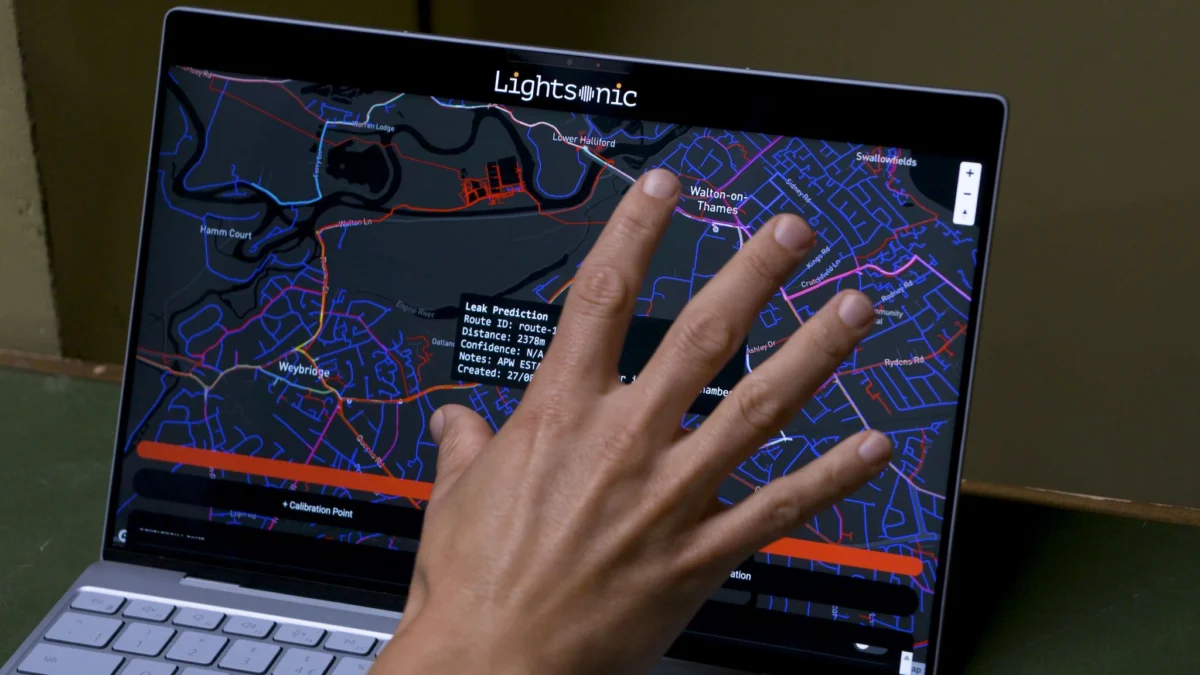
The partnership between Southern Water and Lightsonic introduces an innovative, passive sensing solution that utilizes existing infrastructure. The mechanism, known as Distributed Acoustic Sensing (DAS), capitalizes on the fact that Openreach’s fibre-optic cables frequently run parallel to water mains.
When a leak occurs in a water pipe, the escaping pressurized water creates specific acoustic vibrations. These vibrations travel through the soil and impact the nearby fibre-optic cables. By attaching specialized sensing units to the end of these cables, Lightsonic can detect the minute physical disruptions caused by these sound waves.
The optical signal within the fibre is perturbed by the vibration, creating a measurable change in the light stream. Sophisticated algorithms then analyze these disruptions to pinpoint the exact location of the leak with remarkable accuracy. This allows utility companies to move from a reactive "search and destroy" model—where they wait for a pipe to burst before intervening—to a proactive, data-driven maintenance strategy.
According to Lightsonic, the solution is highly effective, typically detecting 1.2 million litres of water leaks per day for every 100km of network covered annually. With 650km already monitored, the technology has already saved more than 4 million litres of water per day, providing a compelling proof-of-concept for wider adoption.
Chronology of Innovation: From Trial to Partnership
The road to this partnership was paved by a series of successful pilot programs that demonstrated the feasibility of using telecommunications infrastructure for utility monitoring.
- March 2024: Openreach, Lightsonic, and Affinity Water launched a high-profile pilot program. The goal was to determine if fibre-optic networks could reliably detect acoustic anomalies in real-world conditions. The trial was a success, proving that the sensitivity of modern fibre cables was sufficient to differentiate between background traffic noise and the distinct "hiss" of a leaking pipe.
- Mid-2024: Following the successful trial, data analysis revealed that the sensing units could cover vast distances without requiring additional power sources or major excavations, significantly reducing the cost of implementation compared to traditional sensor networks.
- September 2026: Southern Water officially announces its partnership with Lightsonic, marking the transition from a pilot program to a full-scale operational deployment. This announcement highlights the scaling of the technology as a primary tool for leak detection across the South of England.
Supporting Data and Technical Efficacy
The efficiency of this approach lies in its scalability. By piggybacking on the "Full Fibre" rollout—a massive national infrastructure project led by Openreach—Lightsonic avoids the exorbitant costs associated with digging trenches to lay new, dedicated monitoring hardware.

The environmental impact is equally noteworthy. By reducing the volume of lost water, companies decrease the amount of water they need to extract from natural reservoirs and aquifers, thereby preserving ecosystems. Furthermore, the energy required to pump and treat water that eventually leaks out is significant; by curbing leaks, Southern Water is simultaneously reducing its carbon footprint.
The technology’s ability to "prioritize" repairs is perhaps its most vital feature. By providing a heat map of leak severity, Southern Water can allocate its maintenance crews to the most critical failures first, rather than addressing leaks on a first-come, first-served basis. This maximizes the return on investment for maintenance budgets and ensures that the most impactful leaks are stopped as quickly as possible.
Official Perspectives: Aligning Telecoms and Utilities
The collaboration has received strong backing from the leadership of both participating organizations, who view the project as a blueprint for the future of "smart city" infrastructure.
"Ageing infrastructure, leaking networks, and mounting climate pressure are converging, causing major water stress," said Tommy Langnes, CEO of Lightsonic. "By utilizing existing fibre optic infrastructure, we have a solution that can be quickly and effectively scaled across the UK to help utility companies get a handle on leaks, secure supply, and generate savings that can be reinvested to upgrade our ageing network."
From the perspective of Openreach, the project represents a diversification of the value their network provides to society. "The results of our existing pilots with Lightsonic show that our new full fibre infrastructure can deliver value far beyond broadband—and could prove to be a real game changer in solving real-world challenges like water conservation," noted Trevor Linney, Director of Network Technology at Openreach. "Combining Lightsonic’s technology with the reach of Openreach’s Full Fibre network makes continuous utility monitoring genuinely scalable, without the cost and disruption of building a separate sensor network."
Implications for UK Water Security
The timing of this technological leap could not be more critical. The UK is grappling with a volatile climate characterized by record-breaking heatwaves and frequent drought warnings. With "hosepipe bans" becoming a common feature of the British summer, the public and political pressure on water companies to perform has reached an all-time high.
The urgency is further underscored by the recent delay of a major new reservoir project, which was pushed back by five years. With traditional supply-side solutions—such as building new reservoirs—facing environmental, legal, and financial hurdles, the industry must pivot toward demand management and loss reduction.
The use of fibre-optic sensing transforms the UK’s underground digital network into a passive, real-time diagnostic tool for the nation’s physical lifeline. It provides a blueprint for how cross-industry cooperation can solve complex national challenges. If successful on a national scale, this model could be exported to other countries struggling with ageing water infrastructure and limited water resources, positioning the UK as a leader in smart utility management.
As the nation looks toward a future defined by extreme weather events and resource scarcity, the integration of Lightsonic’s acoustic sensing into the Openreach network offers a glimmer of technological optimism. It is a reminder that the solution to our most pressing physical problems may lie not in building something entirely new, but in finding innovative ways to use the infrastructure we already have beneath our feet.