Introduction: A Desert Lesson in Adaptability
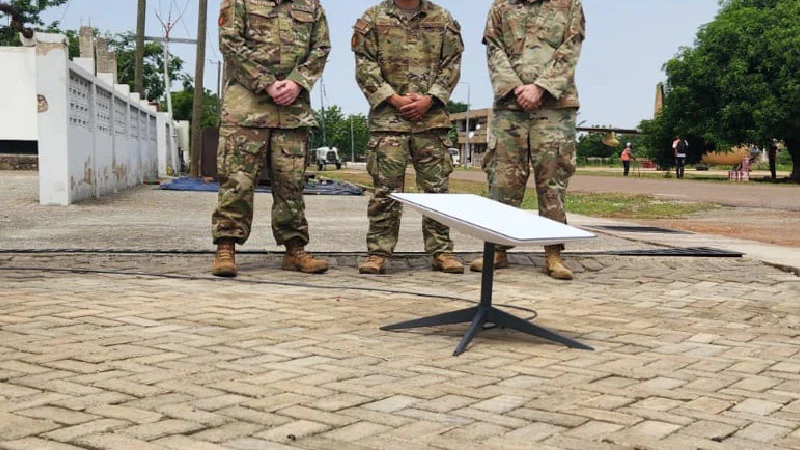
In the sweltering, unforgiving expanse of the Mojave Desert, where temperatures routinely climb past 100 degrees Fahrenheit, the U.S. Army recently found itself at a crossroads between cutting-edge commercial technology and the harsh realities of front-line combat. During the high-stakes "Project Convergence Capstone 6" (PCC6) exercise at Fort Irwin, the 4th Infantry Division (4ID) encountered a critical vulnerability: the Starlink ground terminals, essential for high-speed data throughput, were failing under the thermal stress of the desert sun.
With no civilian contractors available on-site to troubleshoot the sensitive hardware, the responsibility fell to the soldiers. The solution they devised was not a complex software patch or a specialized military-grade cooling shroud, but a display of classic "soldier ingenuity": soaking T-shirts in ice water and draping them over the antennas to dissipate the heat. This makeshift remedy, while rudimentary, effectively restored mission-critical connectivity.
The incident has become a focal point in a broader debate within the Department of Defense (DoD) regarding its acquisition strategy. As the Army shifts toward a "commercial-first" model for its Next Generation Command and Control (NGC2) architecture, the Starlink overheating saga serves as a primary case study in the trade-offs between rapid, cost-effective procurement and the rugged reliability required for global warfare.
Chronology of the PCC6 Stress Test
The events at Fort Irwin this past July were designed specifically to push the boundaries of the Army’s communications infrastructure. Project Convergence is the centerpiece of the Army’s effort to integrate disparate sensors and shooters into a cohesive, multi-domain network.
The Lead-Up
In the months preceding the exercise, the 4th Infantry Division integrated Starlink—alongside various 5G and WiFi-enabled systems—into its command-and-control stack. The goal was to replace cumbersome, legacy communication systems with agile, commercially available hardware that could be fielded in a fraction of the time and cost.
The Thermal Crisis
As the desert heat intensified during the July exercises, the limitations of non-ruggedized commercial hardware became apparent. The Starlink terminals, designed for domestic and civilian use rather than the intense environmental demands of a battlefield, began to throttle data throughput as internal temperatures spiked. This degradation threatened to silence the very network intended to provide commanders with real-time battlefield situational awareness.
The Improvisation
Soldiers on the ground, tasked with maintaining a functioning network, quickly identified the heat as the culprit. Lacking "boutique" cooling solutions, they utilized the resources at hand. By saturating cotton T-shirts in ice water and placing them strategically over the terminals, they achieved a thermodynamic cooling effect that brought the hardware back into operating parameters. This ad-hoc TTP (Tactics, Techniques, and Procedures) allowed the exercise to continue without further downtime, fundamentally altering the Army’s perception of the equipment’s limitations.
Supporting Data: The Economics of "Commercial-First"
The transition toward commercial-off-the-shelf (COTS) technology is driven by more than just speed; it is a response to the crushing costs and development timelines of traditional defense procurement.
The Cost-Benefit Analysis
Army leadership has been transparent about the fiscal advantages of the new strategy. According to Joseph Welch, the portfolio acquisition executive for command and control, the shift is delivering significant budgetary relief.
- Cost Reduction: By moving away from "exquisite," bespoke systems—equipment designed from the ground up to military specifications—the Army is seeing savings ranging from 50% to 75% compared to legacy C2 (Command and Control) systems.
- Speed to Field: Bespoke military tech often takes years, sometimes decades, to iterate. Commercial tech cycles, by contrast, move at the speed of the market. This allows the Army to integrate the latest encryption, bandwidth, and processing power nearly as soon as it hits the civilian sector.
The Ruggedization Trade-off
However, the data from PCC6 suggests that the "savings" come with a hidden cost: the necessity of human intervention. While a ruggedized, military-grade satellite terminal might be engineered to withstand 130-degree heat, it might cost five times as much as a Starlink unit. The Army is now calculating whether it is cheaper to buy expensive, "hardened" gear or to buy cheaper commercial gear and train soldiers to maintain it using low-cost TTPs.
Official Responses: The Leadership Perspective
The response from the Army’s top brass has been surprisingly pragmatic, moving away from the "re-engineer everything" mentality of the past.
Maj. Gen. Patrick Ellis, 4th Infantry Division Commander
Maj. Gen. Ellis, who oversaw the units experiencing the overheating, viewed the situation as a learning opportunity. "We did have a couple cases where things were overheating," Ellis stated during a July press briefing. "But we see when you have commercial-first tech, it’s not necessarily purely ruggedized… But we also found there’s some pretty basic ways for us to accommodate for the heat."
Ellis’s stance is a significant departure from traditional military procurement doctrine, suggesting that the Army does not always need to purchase a "boutique" solution when a soldier-led fix can solve the problem.
Brig. Gen. Shane Taylor, Capability Program Executive
Brig. Gen. Taylor, responsible for the Command and Control Information Network, emphasized that the Army entered the experiment with its eyes open. "We knew the known limitations from some of that commercial tech," he noted.
Taylor highlighted a cultural shift in the service. Previously, if a system failed, the knee-jerk reaction was to "Army-ize" the capability—redesigning it until it was robust enough to survive any environment, regardless of the cost or the time delay. The new philosophy, according to Taylor, is to ask: "Before we go spend quadruple the cost of that equipment, are there some things that we can do?"
Joseph Welch, Portfolio Acquisition Executive
Welch echoed these sentiments at the TechNet conference in Georgia, framing the issue through the lens of mission effectiveness. "Anytime a TTP can be utilized and taught… and it’s not detracting from mission effectiveness, that’s something that’s obviously appealing compared to over-ruggedized or telling vendors to make more rugged equipment."
Implications for Future Warfare
The "wet T-shirt" incident is more than a funny anecdote from the Mojave; it is a bellwether for the future of military acquisition. The implications of this event are manifold, affecting everything from vehicle design to long-term procurement strategy.
Integration of Environmental Mitigation
The Army is now exploring how to better integrate cooling solutions into the vehicles that carry these terminals. Instead of forcing vendors to redesign the terminals to be "bulletproof" against heat, the Army may instead focus on environmental control systems (ECS) within the mobile platforms themselves. By cooling the rack or the interior of the transport vehicle, the Army can extend the life of commercial hardware without requiring the vendor to build a custom, high-cost version of the device.
The "Hybrid" Future
The most likely outcome of the PCC6 findings is a hybrid architecture. The Army is unlikely to go fully commercial or fully bespoke. Instead, it will likely categorize capabilities based on criticality.
- Tier 1 (Critical Infrastructure): Systems that are absolutely essential for survival and fire control will remain ruggedized and bespoke.
- Tier 2 (General Communications): Systems like Starlink will be treated as "expendable" or "adaptable" tech, where the focus is on low cost, high availability, and the use of TTPs to bridge the gap between commercial limitations and military requirements.
Encouraging Market Evolution
As noted by Joseph Welch, the commercial sector is not static. SATCOM technology is evolving rapidly, and the resiliency of commercial constellations is improving. By maintaining a "commercial-first" stance, the Army ensures it can pivot toward the next generation of space-based communications without being locked into a proprietary, obsolete system.
Conclusion: A Shift in Military Culture
The lesson of the Mojave Desert is that the modern battlefield requires a blend of high-tech procurement and low-tech ingenuity. By embracing commercial tech, the Army has gained a massive advantage in speed and cost, but it has also accepted the responsibility of maintaining that equipment in ways that were previously considered "unprofessional" or "unauthorized."
The success of the soldiers at PCC6 proves that the modern warfighter is not just an operator, but a systems integrator. If a wet T-shirt can save a multi-million-dollar communication network, the Army is signaling that it is finally ready to prioritize mission success and financial responsibility over the "exquisite" equipment of the past. As the service moves forward with the next phase of its NGC2 strategy, the goal will remain the same: achieving tactical dominance, not by building the perfect system, but by building a system that the soldier can—and will—keep running at all costs.