In the current landscape of public security, artificial intelligence is typically cast as a master of classification. Security systems are trained to identify specific, pre-labeled hazards: a weapon being drawn, a person falling, or a physical altercation in progress. However, this "identify-and-react" paradigm faces a fundamental bottleneck: public safety threats are rarely static, and it is practically impossible to collect enough labeled data to cover every conceivable form of dangerous behavior.
Hamed Tabkhi, an associate professor at the University of North Carolina at Charlotte (UNC Charlotte) and a leading voice in computer vision, is spearheading a shift away from this rigid framework. Instead of training AI to recognize what a threat looks like, his team is teaching machines to understand what "normal" behavior looks like in a given environment. By analyzing human movement patterns and predicting future actions, his systems can flag behavior that deviates from the expected norm.
“We are building an LLM for movements,” Tabkhi told EE Times. While the analogy is conceptual rather than technical—the system is not a large language model—the underlying logic holds: just as an LLM predicts the next token in a sequence, Tabkhi’s models predict the next sequence of human motion.

The Core Methodology: Behavioral Normalization
The technical foundation of Tabkhi’s approach lies in the transformation of raw video data into compact, abstract representations. Traditional video analytics often rely on the identification of features like faces, clothing, or skin color, which raises significant privacy concerns and risks embedding demographic biases into the system.
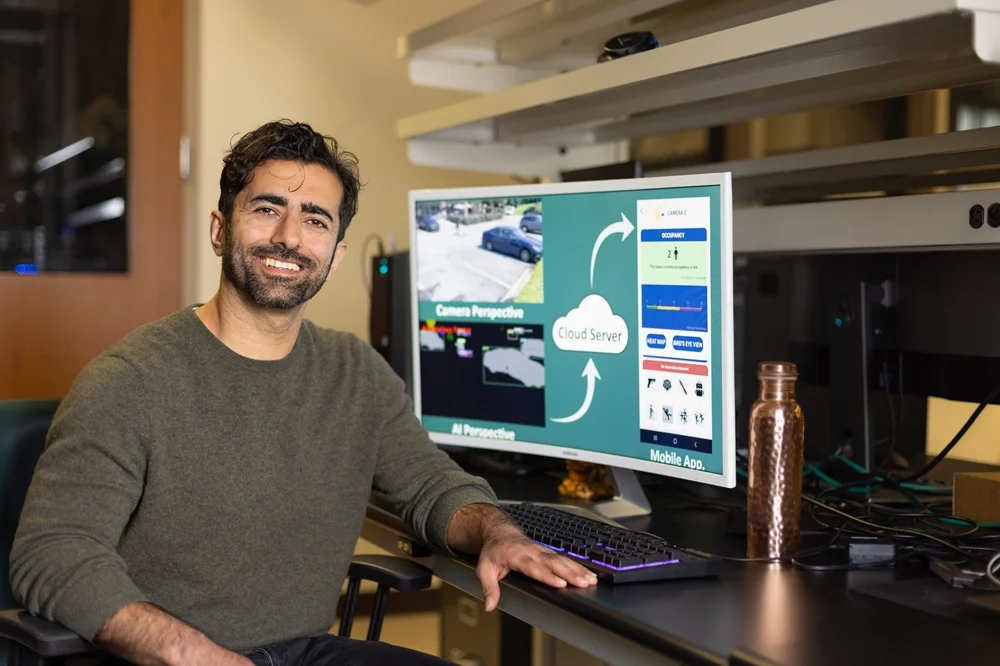
Tabkhi’s group bypasses these issues by focusing exclusively on pose estimation. By converting human activity into “motion heat maps” or “motion tokens,” the system ignores identifying details. It creates a skeletal abstraction of human movement that is universal.
The Evolution of the Research
- 2024 (SPARTA): Tabkhi and his colleagues introduced a transformer architecture known as SPARTA. This system tokenizes pose information across space and time, allowing the model to capture not just the physical configuration of a body, but the evolution of that configuration over time.
- 2025 (Shopformer): Building on the success of SPARTA, the team developed Shopformer. This framework was specifically engineered to detect shoplifting by analyzing sequences of human poses rather than raw pixel data, proving that behavior can be inferred without needing to identify the individual.
- 2026 (Continuous Adaptation): Recent research has focused on the "drift" problem—the reality that environments change, and therefore, the definition of "normal" must evolve. The team introduced a periodic adaptation framework that allows models to learn from new, unlabeled data on-site, ensuring that the system remains accurate as floor plans, crowd patterns, or seasonal variables shift.
Architecture and Edge Deployment
One of the most significant barriers to the adoption of advanced AI in public spaces is the cost of infrastructure. Many security departments are hesitant to replace entire networks of existing CCTV cameras. Tabkhi’s approach is designed as a "complementary layer" that retrofits existing systems.

The software runs on off-the-shelf Nvidia Jetson edge GPU platforms installed within the closed network of a facility. By processing video locally, the system avoids the bandwidth and privacy-related risks of sending sensitive footage to the cloud. The processing device sits behind the firewall, taps into existing IP camera feeds, and performs real-time inference at the edge.
This architecture addresses a critical pain point in the security industry: scalability. Because the system does not require high-fidelity imagery for identification, it can operate efficiently on the lower-resolution, wide-angle cameras already ubiquitous in city centers, university campuses, and retail environments.
The "Normal" Baseline: A Context-Aware Approach
The radical departure in Tabkhi’s philosophy is the treatment of anomaly detection as an open-ended problem. In traditional supervised learning, a model is trained on a "closed set" of classes (e.g., "fighting," "loitering," "carrying a gun"). If an event occurs that wasn’t part of the training set, the model fails.

By contrast, Tabkhi’s models are trained on the environment itself. A coffee shop, an airport terminal, and a high-school hallway all have different rhythms.
“The system learns by itself, so it can adjust itself to the unique environment,” Tabkhi explained. “You can move this system to any environment, and it’s going to learn the normal behavior of that environment.”
His team’s TSGAD (Two-Stream Graph-improved Anomaly Detection) model epitomizes this. By combining learned representations of human movement with trajectory prediction, the model effectively asks, “Given what has happened so far, what should happen next?” When the system observes an action that contradicts the expected physical trajectory of a person in that specific space, it generates an anomaly score.

The Human-in-the-Loop: AI as an "Attention Mechanism"
Perhaps the most important aspect of Tabkhi’s work is the explicit rejection of AI as a final decision-maker. The researchers emphasize that an anomaly is not synonymous with a crime. A group of people breaking into a spontaneous dance in a retail store would be "anomalous" to the system, but it is certainly not a threat.
“AI is not a decision-maker,” Tabkhi stressed. “AI is rather an attention mechanism to enhance and scale human cognition across many cameras.”
This philosophy is codified in the ALFred (Active Learning for Reward) framework. ALFred functions as a bridge between the AI and the security operator. When the AI detects a high-uncertainty event, it doesn’t trigger an alarm; instead, it flags the footage for human review. The operator’s subsequent input—confirming whether the behavior was a threat or a false positive—is fed back into the model. This creates a continuous, semi-supervised loop that iteratively improves the system’s performance and reduces false alarms over time.

Implications for the Future of Public Safety
The work being conducted by the TeCSAR Lab at UNC Charlotte, supported by the National Science Foundation (NSF) Civic Innovation Challenge, has profound implications for the future of urban surveillance.
1. Privacy-Preserving Security
By focusing on skeletal motion, the system is "blind" to race, gender, and facial identity. This inherent privacy-by-design could help alleviate public anxieties regarding the surveillance state, offering a path toward public safety that does not rely on invasive biometric tracking.
2. Mitigating Algorithmic Bias
Because the system focuses on movement patterns rather than physical appearance, it reduces the risk of appearance-based bias. In traditional systems, a person wearing "non-standard" clothing might be flagged as suspicious simply because they differ from the training data’s demographic profile. Tabkhi’s model, by ignoring appearance, focuses solely on the physics of the movement.

3. Sustainability and Cost
The ability to leverage existing hardware and operate at the edge means that municipal governments and private businesses can upgrade their security posture without the massive capital expenditure of a "rip-and-replace" project. This lowers the barrier to entry for smaller municipalities and retail entities to adopt state-of-the-art behavioral analytics.
4. Moving Toward Predictive Awareness
As these models mature, the focus of security is moving from reactive to predictive. By understanding the "language of movement," systems can theoretically identify the precursors to a fall, an accident, or a physical altercation before the event reaches its peak.
Conclusion
The transition from "object recognition" to "behavioral prediction" represents a paradigm shift in how we conceive of machine intelligence in public spaces. By treating video feeds not as collections of images to be labeled, but as ongoing, predictable narratives of human interaction, Hamed Tabkhi and his team are creating a more flexible, privacy-conscious, and scalable approach to security.

Ultimately, the power of this technology lies in its humility. By positioning the AI as an assistant—a filter that brings relevant events to the attention of human operators—the research acknowledges that while machines may be better at processing the "motion of the world," human judgment remains the final, essential layer of safety. As the technology moves from research papers like Shopformer and TSGAD into real-world, wide-scale deployments, it may well define the next decade of public safety infrastructure.