The landscape of Large Language Model (LLM) development is often depicted as an exclusive playground for hyperscalers. With scaling laws suggesting that pre-training or full fine-tuning of multi-billion parameter foundation models necessitates massive clusters of H100 GPUs linked by 3.2 Tbps InfiniBand interconnects, many machine learning engineering teams feel priced out of the state-of-the-art.
In reality, the frontier of AI research is shifting toward efficiency. For most organizations, training and fine-tuning are performed on localized, budget-capped hardware—typically dual or quad workstation setups utilizing NVIDIA RTX 4090s, A10Gs, or L40Ss. These systems are bound by consumer-tier PCIe bandwidth and strict VRAM ceilings ranging from 24 GB to 48 GB per device. Bridging the gap between these constraints and the demands of modern LLMs is the primary challenge facing the current generation of AI engineers.
The Anatomy of a Memory Failure
To understand why standard training protocols collapse on consumer hardware, one must look at the memory footprint of a 7B parameter model. Initializing a model in standard 16-bit precision (FP16/BF16) immediately occupies 14 GB of VRAM for static weights alone.
When you incorporate the AdamW optimizer—the industry standard for model training—the memory requirements balloon. AdamW maintains first and second moment estimates, requiring 8 bytes per parameter (two FP32 values per parameter). For a 7B model, this adds 56 GB of overhead. When compounded by backward-pass gradient tensors (14 GB) and dynamic activation memory that fluctuates with sequence length, the total requirement far exceeds the 24 GB capacity of a single high-end consumer GPU. An "out-of-memory" (OOM) fault is not merely a possibility; it is a mathematical inevitability without aggressive optimization.
Seven Strategic Approaches to Resource Efficiency
To successfully train models under these constraints, engineers must stop viewing hardware as a monolithic block. Instead, they must separate Static Memory Overhead (weights, optimizer states, and persistent gradients) from Dynamic Transient Memory Overhead (intermediate activations and buffers), while identifying whether the bottleneck is Compute-Bound or Memory Bandwidth-Bound.
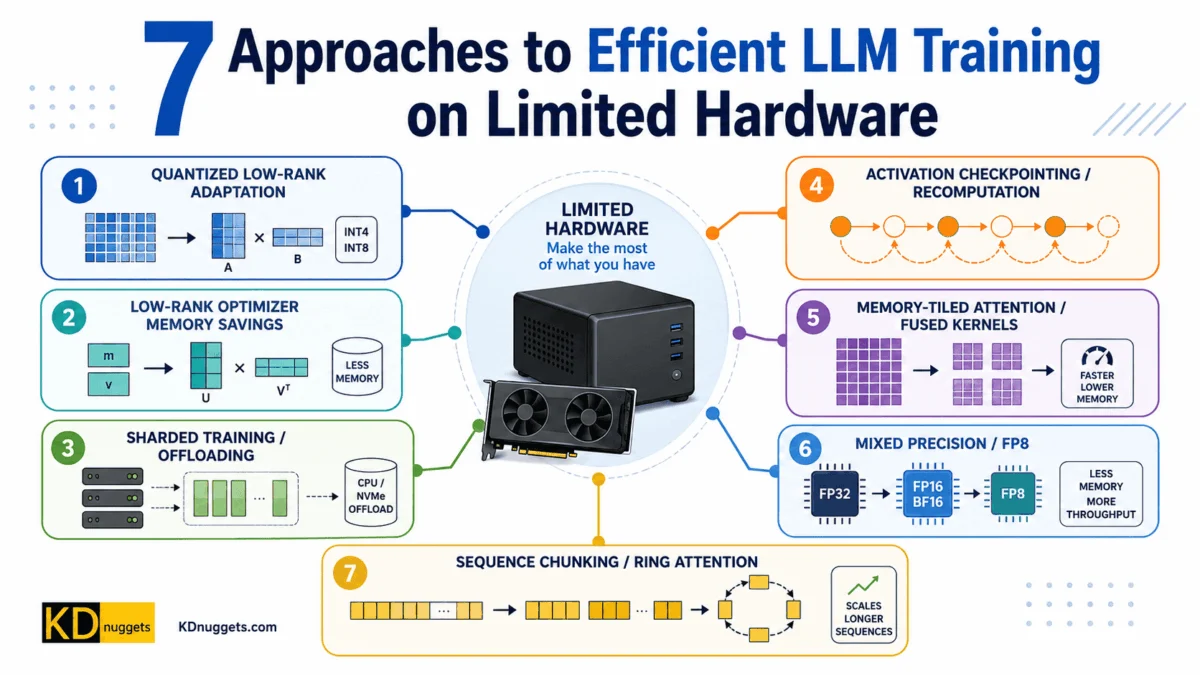
1. Quantized Low-Rank Adaptation (QLoRA and DoRA)
The industry has largely moved away from full-precision fine-tuning in favor of Parameter-Efficient Fine-Tuning (PEFT). QLoRA represents the pinnacle of this shift. By freezing base model weights in a 4-bit NormalFloat (NF4) representation and injecting trainable low-rank decomposition matrices into attention layers, engineers can drastically reduce the footprint.
Recent advancements like DoRA (Weight-Decomposed Low-Rank Adaptation) take this further by decoupling magnitude and directional updates, mirroring the performance of full fine-tuning. While QLoRA introduces a 20-35% compute overhead due to on-the-fly dequantization, it remains the most viable path for fine-tuning 7B to 70B models on 24 GB hardware.
2. Memory-Aware Low-Rank Optimizers (GaLore)
Standard optimizers are memory-hungry. GaLore (Gradient Low-Rank Projection) changes the game by projecting high-dimensional gradient matrices into a compact low-rank subspace. By applying Singular Value Decomposition (SVD) or randomized projections, GaLore tracks momentum and variance only for projected matrices. This allows for full-parameter learning without the massive memory overhead typically associated with AdamW, making it ideal for aggressive domain adaptation where traditional LoRA might fail to capture complex feature distributions.
3. FSDP and ZeRO-3: The Power of Sharding
When a model exceeds the capacity of a single GPU, Fully Sharded Data Parallelism (FSDP) or DeepSpeed’s ZeRO-Stage 3 becomes essential. These protocols shard optimizer states, gradients, and parameters across the available device VRAM and even host RAM. By utilizing "All-Gather" collectives, the system reconstructs layer weights only when needed. While this introduces potential PCIe bottlenecks, it allows for the training of 30B+ parameter models on multi-GPU nodes that would otherwise be impossible to utilize.
4. Strategic Activation Checkpointing
Memory usage is often dominated by intermediate activation tensors generated during the forward pass. Selective activation checkpointing identifies "compute-cheap, memory-heavy" operations—like SwiGLU activations or layer norms—and discards them, recomputing them during the backward pass. While this increases total FLOPs by roughly 30%, it is the single most effective way to handle long-context windows (8k to 32k+ tokens) that would otherwise crash the system.
5. Hardware-Aware Kernels (FlashAttention-2)
The most significant leap in recent years has been the development of FlashAttention-2. By restructuring attention computations to execute entirely within on-chip SRAM, this approach avoids the "memory wall"—the latency incurred by reading and writing to high-bandwidth memory (HBM). Fusing kernels (combining LayerNorm, bias, and activations) minimizes round-trips, ensuring that GPUs spend more time computing and less time waiting for data.
6. Mixed-Precision Training with FP8
Modern architectures like NVIDIA’s Ada Lovelace and Hopper support FP8 (E4M3/E5M2) precision. By utilizing these formats, engineers can halve the memory footprint of activations compared to 16-bit training. When combined with dynamic scaling factors, FP8 allows for near-native precision with double the compute throughput. However, this requires careful management to prevent gradient vanishing, a phenomenon that can lead to rapid loss explosion if not monitored correctly.
7. RingAttention for Long Contexts
For researchers pushing beyond the 32k context limit, RingAttention offers a distributed solution. By splitting sequences along the temporal dimension and passing KV blocks in a ring topology across devices, compute and network communication can be overlapped entirely. This removes the reliance on expensive, proprietary interconnects like NVLink, allowing for "infinite" context scaling on standard hardware.
Implications for the Industry
The shift toward efficient training is not merely a cost-saving measure; it is a democratization of AI. As these techniques mature, the "moat" around foundation model development—previously guarded by the sheer cost of compute—is evaporating.
However, this democratization comes with hidden risks. Long-running training operations on consumer hardware often reveal silent failure modes that enterprise-grade benchmarks overlook. These include:
- Non-deterministic kernel behavior: Inconsistencies across driver versions.
- Thermal throttling: Sustained 100% duty cycles can degrade performance on consumer-grade cooling systems.
- Checkpoint corruption: Asynchronous disk I/O bottlenecks can lead to the silent loss of hours of training progress.
Conclusion: A New Era of Engineering
The future of LLM development is shifting away from brute-force scaling toward sophisticated memory management. By decoupling weight precision, leveraging low-rank projections, and optimizing kernel utilization, engineering teams can reach convergence parity with enterprise-scale clusters on a fraction of the budget.
For the modern machine learning engineer, the goal is no longer to simply "throw more GPUs at the problem." It is to understand the hardware hierarchy—from the CPU’s pinned memory to the GPU’s L1 cache—and architect training pipelines that respect the physical limits of the silicon. As these tools continue to evolve, the ability to train powerful, domain-specific models will become a core competency for any organization, regardless of their access to top-tier data center infrastructure.