WASHINGTON — In a high-stakes development for the U.S. Army’s modernization efforts, the service has officially narrowed the field for its second Indirect Fire Protection Capability (IFPC) Increment 2 interceptor prototype program.
According to an official statement provided to Breaking Defense this week, the Army has selected Lockheed Martin and the joint Boeing-Anduril team to proceed to the demonstration phase of the competition. The decision effectively eliminates the U.S. subsidiary of Israeli defense giant Rafael Advanced Defense Systems from the race, marking a significant milestone in the service’s long-standing effort to plug critical gaps in its short-to-medium-range air defense architecture.
The Strategic Imperative: Closing the "Capability Gap"
The IFPC Increment 2 program serves as the linchpin of the Army’s layered air defense strategy. For years, Pentagon planners have identified a dangerous vulnerability in the service’s defensive umbrella: the "gap" between short-range point defense systems—such as the Stinger-based Maneuver Short-Range Air Defense (M-SHORAD)—and the high-altitude, long-range coverage provided by the Patriot and Terminal High Altitude Area Defense (THAAD) systems.
This void is increasingly susceptible to a new generation of threats, including advanced cruise missiles, unmanned aerial systems (UAS), and swarming drone technology. As peer adversaries continue to refine their long-range precision fires, the Army’s ability to protect fixed and semi-fixed assets relies heavily on the success of the IFPC program.
The current IFPC Inc. 2 launcher, dubbed "Enduring Shield" and developed by Leidos subsidiary Dynetics in partnership with RTX, was intended to provide a robust solution for a variety of threats. However, during developmental testing, Army leadership identified that the initial loadout—centered on the AIM-9X Sidewinder—lacked the performance characteristics necessary to reliably intercept faster, more agile, and lower-flying supersonic cruise missiles. This realization spurred the requirement for a "second interceptor" capable of handling the high-end, high-velocity threat profile.
A Chronology of the Competition
The selection of the two finalists concludes a rapid-fire, highly competitive procurement cycle that began in earnest over two years ago. The timeline reflects the Army’s sense of urgency in fielding these capabilities:
- Early 2024: Following industry feedback sessions, the Army confirms its intent to pursue a secondary, more capable interceptor to augment the Enduring Shield launcher.
- Late 2024: The Army officially awards the core IFPC Increment 2 contract to Dynetics and RTX, establishing the baseline for the Enduring Shield system.
- October 2025: The competitive window for the second interceptor officially opens with the Army awarding Lockheed Martin an Other Transaction Authority (OTA) agreement for the first phase of the program.
- December 2025: The Boeing-Anduril team officially enters the fray, signaling a major challenge to incumbents by leveraging Anduril’s expertise in solid rocket motors and agile manufacturing.
- February 2026: The competition expands as Rafael joins the field, introducing international technology to the mix.
- August 2026: On the final day of the Space and Missile Defense Symposium in Huntsville, Ala., the Army confirms that the field has been winnowed down to Lockheed Martin and the Boeing-Anduril pairing, officially excluding Rafael from the demonstration phase.
Technical Profiles of the Contenders
The competition has forced the industry to innovate in terms of size, weight, power, and cost (SWaP-C). The goal is to provide a "magazine-deep" solution—an interceptor that is small enough to pack in large numbers into the Enduring Shield launcher, yet powerful enough to defeat sophisticated targets.
The Boeing-Anduril Approach
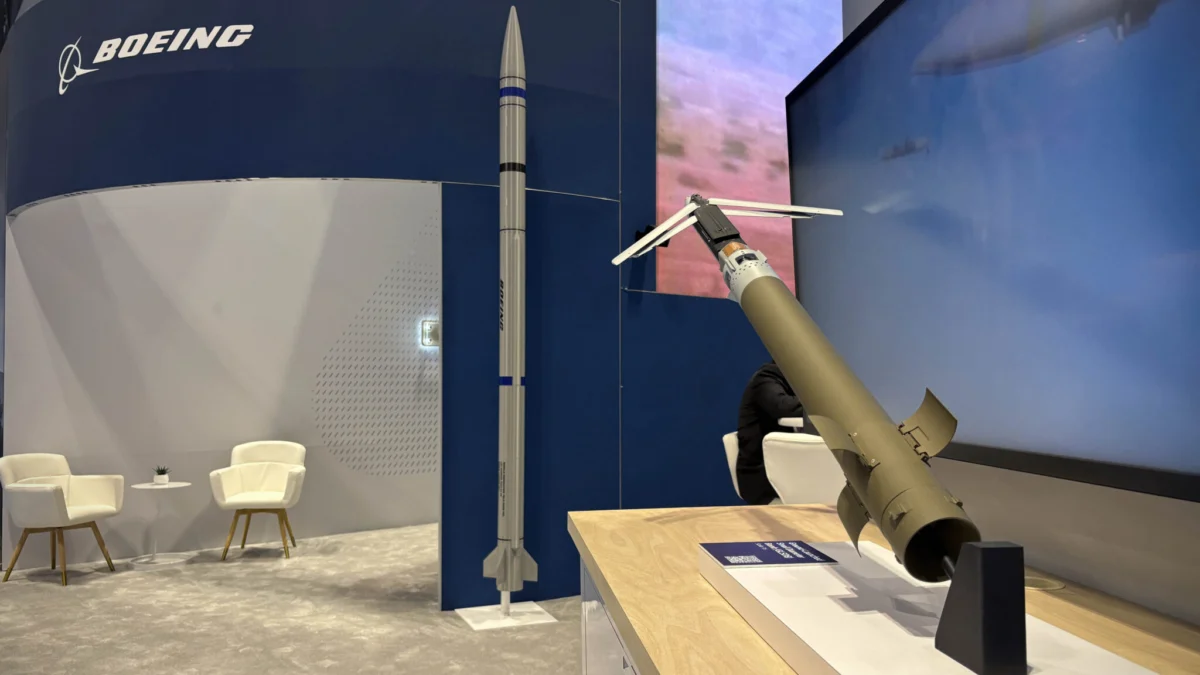
Boeing, leaning on its deep legacy in missile systems, has partnered with Anduril Industries to create an interceptor that emphasizes modularity. In a statement released following the Army’s announcement, Boeing highlighted that its offering integrates advanced seeker technology with a "compact form factor."
A key differentiator for the team is the use of Anduril Rocket Motor Systems, which leverages advanced solid rocket motor technology. Furthermore, the design centers on a Modular Open Systems Architecture (MOSA). This is a critical requirement for the Army, which is mandating that all new systems be "future-proofed" so they can be easily upgraded with new software or hardware components without requiring a complete redesign of the missile.

Bob Ciesla, vice president of Boeing Precision Engagement Systems, characterized the team’s approach as "scalable." He noted that the focus is on providing a reliable, affordable layer of defense that ensures the warfighter has a dependable capability when it matters most.
The Lockheed Martin Strategy
Lockheed Martin, a dominant player in the missile defense space, has remained relatively tight-lipped about the specifics of its current prototype, deferring all inquiries to the Army. However, the company is known to be leveraging its extensive experience with the Patriot Advanced Capability (PAC-3) and other interceptor programs to tailor a solution for the IFPC mission. The company’s ability to manage complex, multi-year supply chains is expected to be a major factor as the program moves toward potential mass production.
Official Responses and Next Steps
The Army’s stance remains strictly focused on the demonstration phase. An Army spokesperson stated, "The companies have been selected to advance to the demonstration phase of the development effort. Additional information regarding the competitive effort will be released when appropriate."
This measured silence is standard for the service, especially given the sensitivity of the technologies involved. The demonstration phase is expected to be grueling, involving live-fire testing against simulated cruise missile threats in various environmental conditions.
While Lockheed Martin and Boeing-Anduril prepare for the next stage, the exit of Rafael marks a notable shift in the competition. Rafael, known for its highly successful Iron Dome and David’s Sling systems, was viewed by many as a formidable contender. However, the Army’s preference for domestic-led solutions and specific technical requirements may have shifted the scales toward the Lockheed and Boeing-Anduril teams.
Strategic Implications: The Future of Air Defense
The outcome of this competition will have lasting implications for the Army’s Air and Missile Defense (AMD) force structure.
- The Rise of MOSA: The mandate for Modular Open Systems Architecture in this competition confirms the Army’s commitment to moving away from "vendor lock." By requiring an interceptor that can be easily updated, the service is ensuring that it can integrate the next generation of seekers and data links as soon as they become available.
- Addressing the Cruise Missile Threat: The transition from the AIM-9X-based solution to a specialized, higher-velocity interceptor underscores a shift in how the Army views the modern battlefield. The cruise missile threat is no longer a niche concern; it is a baseline expectation for any conflict with a near-peer adversary.
- Industrial Base Capacity: By selecting two teams to move to the demonstration phase, the Army is maintaining competition, which historically keeps costs down and ensures that the winning bidder remains incentivized to perform. However, the eventual winner will need to prove that they can ramp up production to meet the Army’s ambitious fielding timelines.
- Leadership Transitions: The program has evolved significantly under the tenure of senior leaders like Lt. Gen. Frank Lozano, the current Program Acquisition Executive for Fires. His emphasis on identifying capability gaps through real-world testing has driven the rapid, adaptive nature of this procurement.
As the Army moves into the demonstration phase, all eyes will be on the Huntsville proving grounds. The performance of the Boeing-Anduril interceptor and the Lockheed Martin solution will determine not just which company wins a lucrative contract, but which defensive capability will ultimately protect U.S. soldiers from the most pressing aerial threats of the next decade.
For now, the field has been halved, the objectives are clear, and the race to secure the skies above the battlefield continues.