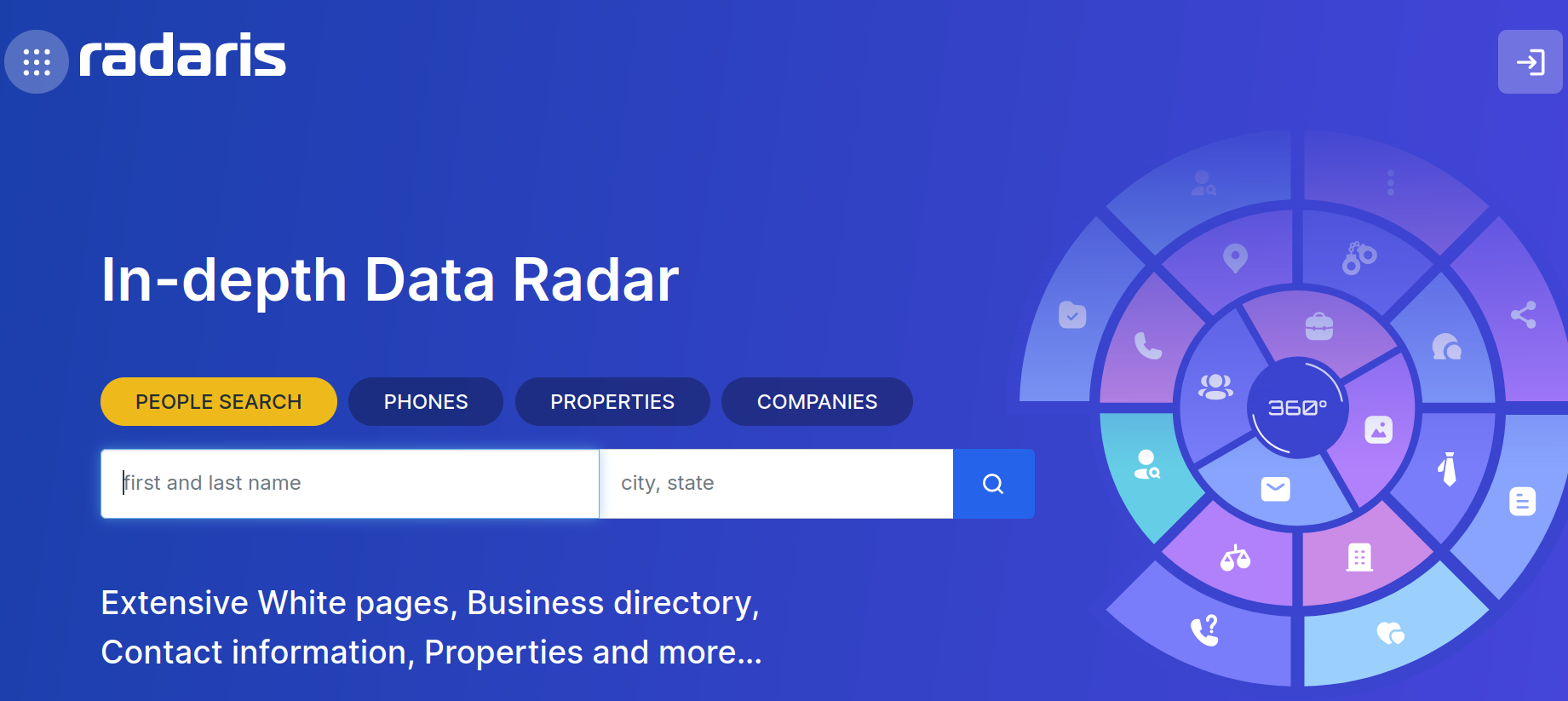
In a landmark development for digital privacy, the notorious data broker Radaris.com—a site long criticized for ignoring requests to scrub the personal details of government officials—has been forced to surrender its primary domain and over a dozen associated sites. The transfer, ordered by a New Jersey court, marks a rare victory in the ongoing legal war between privacy-focused litigants and the sprawling, opaque industry of "people-search" services.
For years, Radaris operated as a digital fortress, relying on a complex web of shell companies and international legal jurisdictions to evade accountability. However, a persistent legal campaign by Atlas Data Privacy Corp, leveraging New Jersey’s “Daniel’s Law,” has finally breached those walls, revealing the inner workings of a massive, Massachusetts-based operation that has long played a game of cat-and-mouse with regulators and privacy advocates.
The Genesis of a Legal Reckoning
The catalyst for this legal upheaval is Daniel’s Law, a robust New Jersey statute named in honor of Daniel Anderl, the son of a federal judge, who was murdered in 2020 by a disgruntled attorney who had tracked the family’s address online. The law provides a vital shield for law enforcement officers, judges, and government personnel, mandating that commercial data brokers purge their sensitive information. Crucially, the statute includes teeth: fines of $1,000 per violation for companies that fail to comply with legitimate removal requests.
In February 2024, Atlas Data Privacy Corp initiated a suit against Radaris, alleging systematic defiance of these mandates. What followed was a masterclass in corporate obfuscation. Attorneys for Radaris engaged in a pattern of procedural stalling, shifting ownership claims across international borders—from the Marshall Islands to the Seychelles—and attempting to shield the true architects of the business from legal discovery.
A Chronology of Evasion and Exposure
The history of Radaris is marked by a recurring cycle of litigation, temporary defeat, and corporate re-branding.
- 2017: Radaris lost a class-action lawsuit by failing to appear, resulting in a $7.5 million default judgment. When plaintiffs attempted to seize the Radaris domain, the company’s legal counsel, Val Gurvits, appealed, successfully arguing that the suit had failed to serve the "actual" owner—at the time, a Cyprus-based entity called Bitseller Expert Limited. The court halted the transfer, and the plaintiffs moved on, allowing the broker to regroup.
- 2024 (February): Atlas Data Privacy Corp sued Radaris under Daniel’s Law.
- 2024 (March): KrebsOnSecurity published an investigation identifying the true operators of the site: Igor and Dmitry Lubarsky, Massachusetts-based brothers. The report exposed that the company had been utilizing a fictitious CEO named “Gary Norden” to solicit investors and maintain a veneer of corporate legitimacy.
- 2025 (June): After the initial lawsuit was mired in delays, Atlas re-filed, casting a wider net to include the various sister domains that had been spun up during the company’s "island-hopping" phase.
- 2026 (August): A New Jersey judge, citing the defendants’ consistent failure to respond to court orders or provide adequate legal defense, ordered the transfer of 14 domains—including Radaris.com—to Atlas.
The Anatomy of the "Shell Game"
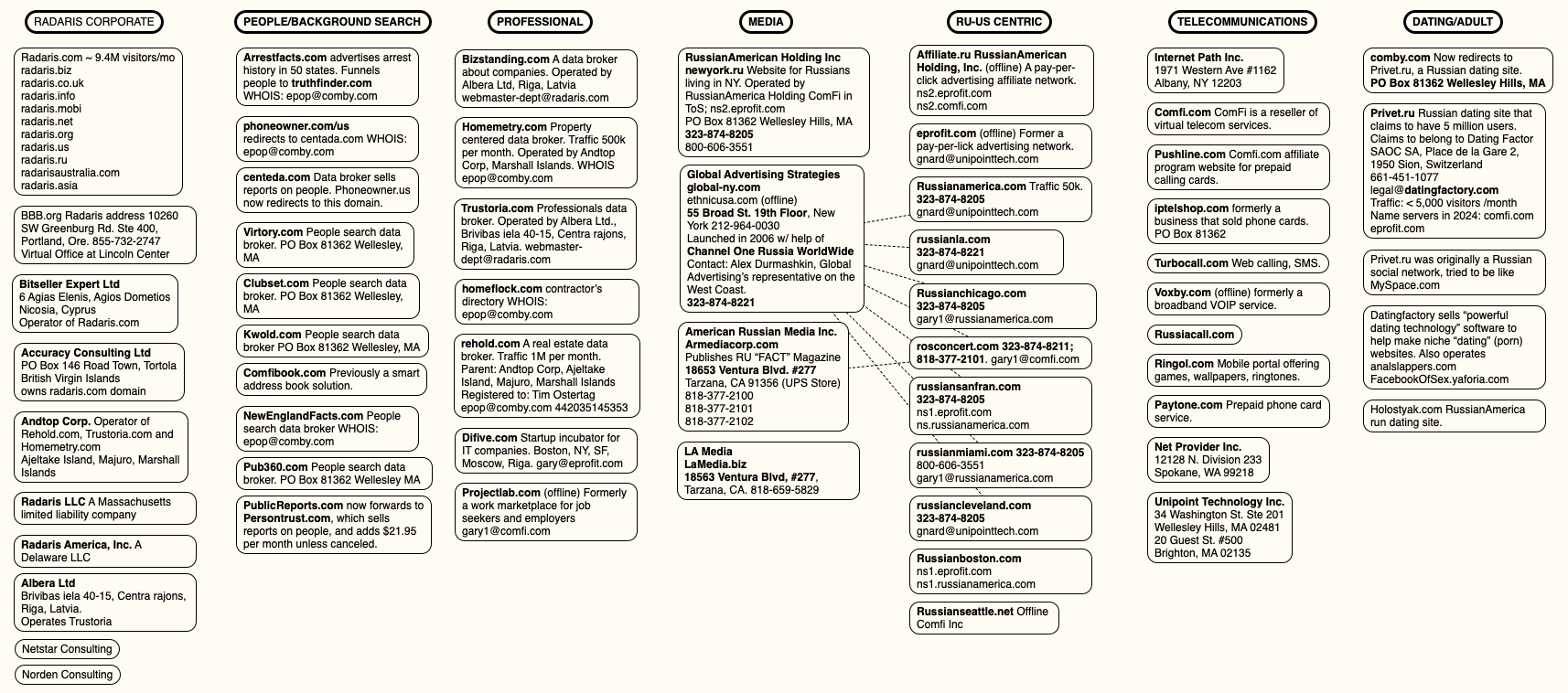
The litigation against Radaris has unearthed a staggering volume of internal evidence. Atlas reportedly obtained over 10,000 emails and documents during the discovery process, painting a picture of a highly centralized operation masquerading as a decentralized, global network.
The documents reveal that entities like Radaris America, Inc., Bitseller Expert Limited, Digital Orbit Corp, and Virtura Corp were merely nominal legal shells. In reality, these sites shared bank accounts, payment processors, and administrative mailboxes, all managed by a small team in the Boston area. According to Atlas, the technical and financial infrastructure relied on a series of mail domains—including centerex.com and scienteco.com—that served as the nervous system for at least 25 different people-search platforms.
Financial records suggest the operation was highly lucrative. Radaris.com alone generated an estimated $42,000 in monthly revenue, while its sister site, Veripages.com, pulled in roughly $45,000. These profits were bolstered by strategic partnerships with major marketing firms and, ironically, even companies that market "data removal" services—a parasitic ecosystem where some entities profit from both the exposure and the subsequent "protection" of personal data.
Official Responses and Legal Maneuvering
The legal team representing the Radaris interests has maintained a combative stance. Victor Worms, an attorney currently representing the interests associated with the seized domains, has argued that the court’s judgment is fundamentally flawed.
“We have made a motion to vacate that default judgment on the grounds that it is void, since a ‘non-entity’ has no legal capacity to sue or be sued,” Worms stated in response to inquiries. He further claimed that the transfer of the domain constitutes a constitutional violation, hinting at a prolonged appellate battle.
Conversely, Matt Adkisson, CEO of Atlas, views the seizure as a necessary intervention. Adkisson described the litigation as a fight against an industry that views legal compliance as merely another cost of doing business. "In the past, they won by attrition," Adkisson noted. "They played shell games with their country of origin and their owners. But we were aware of the threat this posed to law enforcement, and we committed the resources to see it through."
The Broader Implications for Digital Privacy
The Radaris case is a microcosm of a much larger crisis in American digital privacy. While Daniel’s Law provides a blueprint for protection, it is currently under fire. Over 150 data brokers, including the Radaris family, have launched a coordinated legal assault, challenging such laws on First Amendment grounds. They argue that scraping and republishing "public" information is protected speech.
Privacy expert Justin Sherman, author of the upcoming book The Middlemen, notes that the industry is banking on the slow pace of the judicial system to preserve their business model. “The lack of a comprehensive federal privacy law is not for a lack of knowledge,” Sherman says. “We have had millions of wake-up calls, from the exposure of government officials to the recent breach of 153 million driver’s licenses at IDScan.net.”
The challenge, as Sherman points out, is that the current legal framework is hopelessly outdated. Most state laws, including those modeled after Daniel’s Law, contain massive loopholes for "public" records—a category that, in the digital age, has expanded to include virtually every facet of an individual’s life, from property filings to marriage certificates and criminal records.
Looking Ahead: A Ticking Clock
As the Third Circuit Court of Appeals weighs the constitutional validity of Daniel’s Law, the future of the people-search industry hangs in the balance. While 14 states have followed New Jersey’s lead, the legal landscape is fragmented and precarious. West Virginia’s version of the law has already been struck down as unconstitutionally broad, setting the stage for an inevitable showdown at the U.S. Supreme Court.
For now, the radaris.com domain serves as a silent warning to other data brokers. Its homepage, stripped of its ability to sell the private lives of millions, now displays a notice from Atlas. For the victims of data harvesting, the transfer is a symbolic victory—a rare moment where the architects of the surveillance economy were forced to pay the price for their business model. However, until federal legislation addresses the core issue of data collection and brokerage, the "shell games" are likely to continue, leaving the average citizen vulnerable to a system that treats their personal identity as a commodity for sale.