
New Delhi, India – India is embarking on a transformative journey to establish a robust domestic semiconductor ecosystem, moving beyond its established strengths in design and engineering to encompass fabrication, advanced packaging, compound semiconductors, materials, equipment, and cutting-edge research and development. This strategic pivot, underpinned by significant government investment and a burgeoning domestic market, signals India’s intent to become a formidable player in the global semiconductor landscape. The nation has already greenlit twelve major semiconductor projects, attracting over $17 billion in investment commitments, and is fueling this growth with an expanded government framework, including the substantial $13.4 billion Semicon 2.0 initiative.
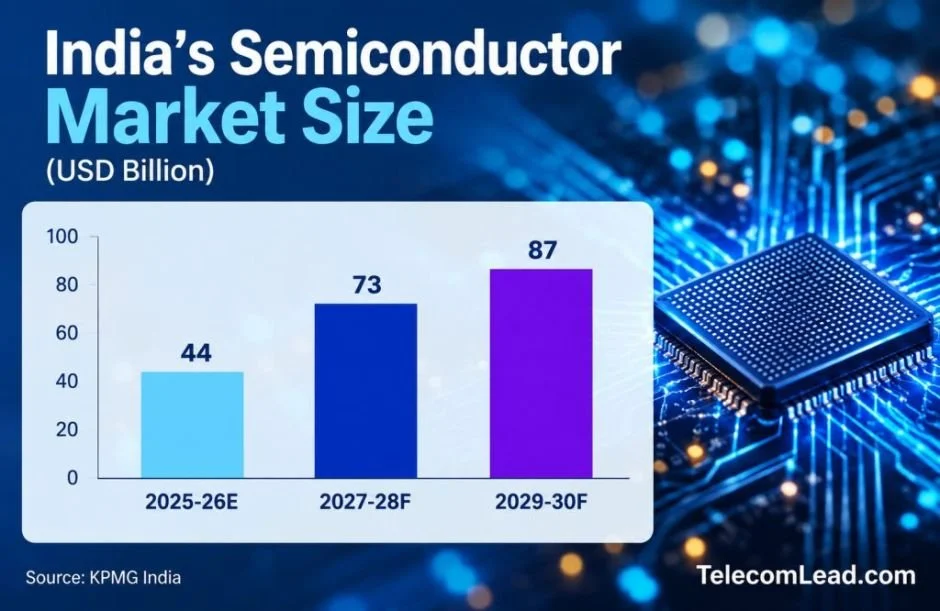
The impetus for this ambitious undertaking is clear: India’s semiconductor demand is on an exponential trajectory. Projections indicate a surge from approximately $44 billion in the 2025-26 fiscal year to a staggering $90 billion by 2029-30. This growth is propelled by a diverse range of sectors, including the ever-expanding mobile device market, critical telecom networks, burgeoning IT infrastructure, the rapidly evolving automotive sector, industrial automation, and the transformative field of artificial intelligence. This confluence of factors positions India not merely as a consumer but as a significant producer and innovator in the semiconductor value chain.
These insights are drawn from the comprehensive "India’s Semiconductor Opportunity: Building a Globally Competitive Ecosystem" report, published in September 2026 by the India Deep Tech Alliance in collaboration with KPMG in India and Nishith Desai Associates. The report meticulously details ten pivotal developments shaping India’s semiconductor trajectory, offering a granular view of the nation’s progress and future potential.
The Foundations of a Semiconductor Powerhouse: Massive Investment and Expanding Scope
India’s commitment to building a self-reliant semiconductor industry is vividly illustrated by the scale of approved projects and the financial backing provided by the government.
$17 Billion Pledged Across Twelve Transformative Projects
A cornerstone of India’s semiconductor strategy is the approval of twelve significant projects, collectively drawing $17 billion in investment commitments across six key states. Crucially, this initiative is rapidly transitioning from mere announcements to tangible realities, with three facilities already commencing commercial production. These projects are designed to create a foundational domestic capacity for semiconductor fabrication, assembly, testing, and packaging, directly addressing India’s heavy reliance on imported chips.
Currently, India fulfills an estimated 90-95% of its semiconductor needs through imports, highlighting the immense opportunity for domestic value creation. In the 2025-26 fiscal year alone, integrated circuit imports were valued at $30.3 billion, with semiconductor device imports adding another $6.2 billion. This substantial import bill underscores the economic rationale and strategic imperative behind India’s drive for indigenous semiconductor manufacturing.
Semicon 2.0: A $13.4 Billion Catalyst for the Next Investment Wave
Building upon the initial momentum, the Indian government has launched Semicon 2.0, a comprehensive program with a substantial budget outlay of $13.4 billion. This initiative represents a significant broadening of India’s semiconductor strategy, extending its ambit to encompass chip design, semiconductor equipment and materials, the establishment of new fabrication plants (fabs), advanced packaging solutions, cutting-edge R&D, and critical workforce development.
The incentive structure under Semicon 2.0 is particularly attractive. It offers fiscal support amounting to 40% of eligible capital expenditure for silicon fabs and 35% for fabs focused on compound semiconductors, photonics, sensors/MEMS, and displays. For advanced packaging, the support stands at 35% of eligible capital expenditure, a notable increase from the 25% offered for legacy packaging. This robust fiscal encouragement is poised to be a central driver for the next generation of semiconductor projects in India, making the nation a compelling destination for global chip manufacturers.
The Engine of Growth: A Booming Domestic Market and Strategic Node Focus
The substantial investments being channeled into India’s semiconductor sector are firmly anchored by the country’s rapidly expanding domestic market.
India’s Chip Market on a Trajectory Towards $90 Billion
The commercial viability of these ambitious semiconductor ventures is underpinned by the projected surge in India’s domestic chip market. Demand is anticipated to more than double from approximately $44 billion in 2025-26 to $90 billion by 2029-30, representing an impressive compound annual growth rate (CAGR) of around 19%.
The largest segment of this demand is expected to come from mobile devices and wearables, projected to reach $42.13 billion by 2029-30. Other significant contributors include telecom semiconductors ($13.22 billion), information technology ($11.31 billion), industrial applications ($7.95 billion), consumer electronics ($5.55 billion), automotive ($4.52 billion), and strategic sectors like defense ($2.19 billion). This vast and diverse domestic demand base offers semiconductor manufacturers setting up operations in India a ready market, even before considering export potential.
The 28/40 nm Sweet Spot: A Strategic Manufacturing Focus
India’s semiconductor manufacturing strategy is pragmatically focused on areas where it can achieve early success and build a strong foundation, rather than immediately competing with global leaders in the most advanced process nodes. The report identifies the 28/40 nanometer (nm) logic manufacturing segment as a particularly strong opportunity for India.
By 2030, it is estimated that around 75% of India’s logic chip demand could be met by 300 mm wafers, with 28/40 nm nodes expected to constitute approximately 35% of this demand. India’s first major fabrication plant, slated for Dholera, is strategically designed for 28 nm and more mature nodes. These chips are crucial for a wide array of applications, including automotive electronics, industrial systems, telecommunications, connectivity solutions, power management, and a broad spectrum of consumer devices. In terms of component-level semiconductor demand by 2029-30, logic chips are forecast to account for about 54%, followed by memory at 21% and discrete semiconductors at 19%. This focus on mature nodes allows India to leverage its strengths and build capacity efficiently.
Beyond Manufacturing: Job Creation, Skill Development, and Private Sector Engagement
India’s semiconductor push is not solely about building factories; it’s about fostering a comprehensive ecosystem that generates high-value employment and stimulates private sector participation.
A High-Value Jobs Multiplier Effect
The semiconductor investment program is poised to be a significant catalyst for job creation, generating high-value direct employment and cascading opportunities throughout the broader semiconductor and electronics value chain. The demand for skilled professionals will extend far beyond engineers within fabrication plants, encompassing specialists in chip design, equipment maintenance, clean-room operations, chemical and material sciences, testing, packaging, construction, logistics, research, and supply chain management.
Recognizing this, Semicon 2.0 designates talent development as one of its six key pillars. The program is designed to fund up to 75% of project costs for educational and workforce development initiatives, ensuring a pipeline of skilled personnel for the burgeoning industry.
Over 68,000 Students Trained in Chip Design: A Foundation of Talent
India’s commitment to building a skilled workforce is already yielding tangible results. Under the "Chips to Startup" program, over 68,000 students have received training in advanced chip design capabilities. Furthermore, 320 academic institutions have been provided with access to Electronic Design Automation (EDA) tools, empowering the next generation of chip designers.
The Design Linked Incentive (DLI) program has separately approved 24 semiconductor design projects and extended EDA tool support to 105 startups and MSMEs. This focus on nurturing domestic intellectual property (IP) and design capabilities is critical. India’s existing strength in semiconductor engineering and design can be leveraged to create high-value domestic IP companies, potentially generating greater economic returns than if India were solely positioned as a manufacturing hub.
Private Capital: A Growing Partner in India’s Semiconductor Ambitions
Government incentives are increasingly being complemented by robust private sector investment. Between 2016 and the year-to-date in 2026, India’s semiconductor sector attracted $687 million in Private Equity-Venture Capital (PE-VC) funding, with nearly 75% of this investment flowing in after the approval of Semicon 1.0 in 2021.
Fabless semiconductor design has been the dominant area for deal activity, accounting for 56 deals, significantly outpacing investments in integrated device manufacturers, foundries/OSAT, and equipment and materials sectors. Adding to this momentum, venture capital members of the India Deep Tech Alliance have committed an initial $1 billion to Indian deep-tech ventures over a five-to-ten-year period, with total commitments subsequently rising to approximately $3 billion. This growing private sector interest underscores the increasing confidence in India’s semiconductor prospects.
Synergies and Strategic Opportunities: Electronics Manufacturing and Advanced Packaging
India’s semiconductor ambitions are intricately linked with the rapid growth of its electronics manufacturing sector, creating a powerful symbiotic relationship.
Electronics Manufacturing at $133 Billion Fuels Chip Demand
India’s electronics manufacturing industry has witnessed remarkable growth, nearly doubling from $74.7 billion in FY2021 to $133 billion in FY2025. Mobile phone manufacturing, in particular, has expanded at an impressive CAGR of approximately 21% during the same period. Government initiatives such as the Electronics Component Manufacturing Scheme (valued at $4.2 billion) and the large-scale electronics manufacturing Production Linked Incentive (PLI) scheme, which has attracted about $1.8 billion in investment and generated $11.5 billion in production, further bolster this sector. The burgeoning domestic production of smartphones, wearables, IT hardware, and consumer electronics provides an increasingly attractive demand base for domestic semiconductor fabs and packaging facilities.
Advanced Packaging: A Rapidly Scalable Opportunity
India’s strategic advantage extends beyond wafer fabrication, with advanced packaging identified as a significant growth area. The report highlights advanced packaging, along with Assembly, Testing, and Packaging (ATMP), and Outsourced Semiconductor Assembly and Test (OSAT) services, as sectors where India can scale relatively quickly. This is in addition to its strengths in semiconductor design, fabless IP, AI accelerator and ASIC design, mature-node fabs, and connectivity and power ICs.
The enhanced fiscal support of 35% for eligible advanced packaging capital expenditure under Semicon 2.0 is expected to stimulate further investment. Advanced packaging is becoming increasingly crucial, especially with the growing trend of AI processors integrating multiple dies, high-bandwidth memory, and specialized accelerators. This sector offers India a pathway into higher-value semiconductor manufacturing without the immense capital outlays associated with cutting-edge fabrication facilities.
The Future Trajectory: AI, Telecom, and Cloud Driving the Next Wave
The future growth of India’s semiconductor sector is intrinsically tied to the nation’s rapidly advancing technological landscape, particularly in areas like Artificial Intelligence, telecommunications, and cloud computing.
AI, Telecom, and Cloud: Catalysts for Future Investment
India’s semiconductor expansion is increasingly intersecting with the development of AI infrastructure. The telecom sector alone is projected to generate $13.22 billion in semiconductor demand by 2029-30, while the information technology sector is expected to contribute another $11.31 billion. Mobile and wearables will add a substantial $42.13 billion to this demand. The opportunities span a wide range of semiconductor components, including processors, memory, networking silicon, RF chips, connectivity ICs, and power management semiconductors.
Looking ahead, the report identifies AI infrastructure chips, advanced memory solutions, next-generation packaging technologies, and high-performance computing chips as strategic opportunities that will require sustained investment in R&D and talent development. India’s growing cooperation with the United States, particularly through initiatives like the TRUST initiative focusing on AI infrastructure, data centers, advanced computing, reliable energy, and digital connectivity, further solidifies its position in this critical domain.
Conclusion: From Vision to Reality – India’s Semiconductor Ascendancy
The evidence overwhelmingly indicates that India’s semiconductor strategy is moving beyond policy pronouncements to tangible execution. Twelve approved projects with $17 billion in investment commitments, three facilities already operational, a comprehensive $13.4 billion Semicon 2.0 program, over 68,000 students trained, and $687 million in PE-VC funding are all measurable indicators of a rapidly developing ecosystem.
The convergence of a projected $90 billion domestic semiconductor market by 2029-30 and a $133 billion electronics manufacturing industry creates a formidable economic base for fabrication, packaging, chip design, and component localization. The ultimate test for India will lie in its execution: transforming incentives into operational fabs and packaging plants, expanding the semiconductor supplier network, and cultivating a sufficiently skilled workforce. With 90-95% of current semiconductor requirements still met through imports, the potential for domestic value creation and global impact remains exceptionally substantial. India is not just entering the semiconductor race; it is poised to redefine its contours.