For the modern data professional, the web browser is not merely a utility—it is the primary workspace. Between navigating complex technical documentation, parsing arXiv research papers, debugging GitHub repositories, and synthesizing industry reports, the browser is where high-level cognitive work happens. As Generative AI has matured, these tasks have been augmented by AI assistants. However, as these tools become ubiquitous, a silent, high-stakes trade-off has emerged: productivity versus data sovereignty.
Main Facts: The Hidden Cost of "Free" AI
The tools most data scientists gravitate toward—Chrome with integrated Gemini, Perplexity, or ChatGPT in a pinned tab—are undeniably powerful. They provide instant summaries and rapid code generation. Yet, they carry a structural privacy cost that is often overlooked in the rush to meet deadlines.
Consumer-grade Gemini often allows conversations to be reviewed by human staff for model improvement. Perplexity, while excellent for research, routes queries and page content to its cloud servers. ChatGPT, unless explicitly toggled off, may utilize your inputs to train future iterations of its models. For a casual user, this is a negligible risk. For a data professional handling proprietary datasets, unreleased model architectures, or sensitive client intelligence, these defaults are a liability.
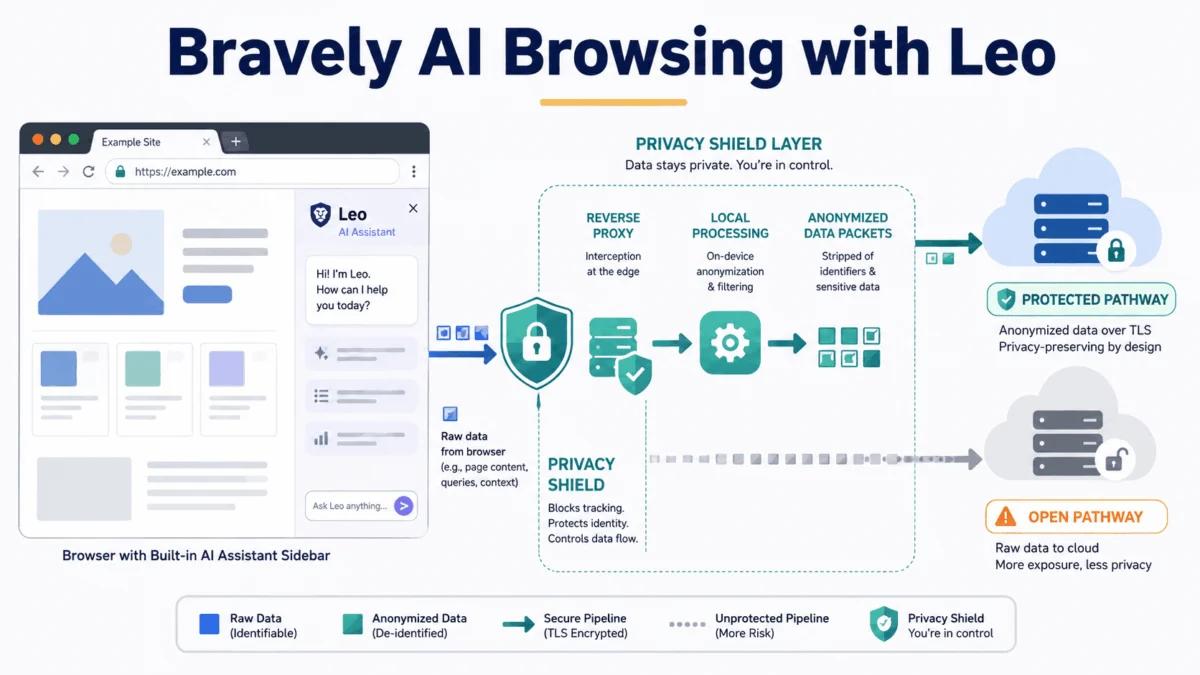
Enter Brave Leo. Unlike third-party extensions or standalone chatbots, Leo is a privacy-first AI assistant baked directly into the Brave browser’s infrastructure. It functions as a native sidebar that parses active browser content without logging, storing, or training on user data. It is a paradigm shift in how we conceive of browser-based intelligence.
Chronology: The Evolution of Browser-Integrated AI
To understand the significance of Leo, one must look at the rapid evolution of the "browser AI" ecosystem:
- 2023: The "Chatbot Era" begins. Data professionals start pinning ChatGPT and Claude tabs. The reliance on copy-pasting code and documents into external cloud environments becomes standard, creating a massive shadow-IT risk.
- 2024: Browser giants respond. Microsoft integrates Copilot into Edge; Google embeds Gemini into Chrome. These integrations increase convenience but tighten the grip of proprietary cloud-based data ingestion.
- April 2026: Brave introduces Brave Ocelot, a local-first summarization model that processes data entirely on the user’s hardware. This marks a milestone in browser-based privacy, ensuring that sensitive documents never leave the local device.
- May 2026: Brave expands the ecosystem with Agentic Browsing in early access, allowing the browser to perform multi-step, autonomous tasks within an isolated profile, keeping the user’s intent and data within the browser’s hardened security boundary.
- Present Day: The market reaches a tipping point. Professionals are increasingly choosing "Privacy-First" over "Feature-First," with tools like Leo setting the benchmark for zero-knowledge AI interactions.
Supporting Data: Comparative Architectures
The difference between mainstream AI and Brave Leo is not aesthetic; it is architectural.
| Feature | Mainstream AI (Gemini/ChatGPT) | Brave Leo |
|---|---|---|
| Data Training | Used for model improvement (by default) | Never used for training |
| Data Retention | Stored on cloud servers | Discarded after session |
| Identity | Account-linked | Anonymized (Reverse Proxy) |
| Hardware | Cloud-dependent | Local-first options (Ocelot) |
Leo’s implementation uses a reverse proxy to strip the user’s IP address before queries reach the LLM. Because Brave operates on a credential-based token system, even for its $14.99/month Premium tier, payments remain decoupled from chat history. This structural separation ensures that even if an account is compromised or subpoenaed, there is no history of the user’s AI-assisted research to uncover.
Official Responses and Strategic Positioning
Brave’s approach is a calculated move to capture the professional market that feels alienated by the aggressive data collection policies of Big Tech. Vinod Chugani, a leading AI and data science educator, notes that the shift is essential for professionals. "The assumption that AI assistance requires handing your work to a cloud service is worth questioning," says Chugani. "Leo doesn’t ask you to trade capability for privacy. It brings frontier models into a browser environment where your inputs are structurally inaccessible to anyone but you."
By supporting models like Claude Sonnet 4, DeepSeek R1, and Kimi K2.5, Brave has signaled that they are not just a browser, but an infrastructure provider for secure AI workflows.
Implications for Data Workflows
The move toward private, page-aware AI is changing how data scientists approach their daily tasks.
Summarization and Synthesis
Leo’s ability to read an active tab in real-time eliminates the need to copy-paste sensitive research papers into third-party interfaces. By using a prompt such as, "Summarize this page: extract methodology, evaluation metrics, and identified limitations," the user receives an instant, structured output. Because the model reads the DOM directly, the interaction remains isolated from the public internet.
Code Generation and Debugging
For developers, Leo’s context-awareness is a force multiplier. It can analyze the documentation of an obscure library in one tab while generating code in another, ensuring that the generated code is grounded in the specific structure of the current documentation.
The "Skills" Advantage
Introduced in late 2025, Skills allow for multi-step prompt chains. A data professional can define a workflow—e.g., "Summarize -> Extract Tables -> Format as CSV"—and apply it across hundreds of documents. Because these are saved locally, they represent a reusable automation asset that remains private to the user.
Building a "Best-of-Breed" Privacy Stack
The future of data science is not a single tool, but a strategic stack. Professionals are increasingly adopting a "Hybrid AI" strategy:
- Use Leo for: Daily documentation, sensitive proprietary datasets, and reviewing client-confidential research where data leakage is a risk.
- Use Perplexity for: Public-domain, broad-market research that requires live web crawling and deep citation synthesis.
- Use Local Models (via BYOM): For extremely sensitive, offline-first analysis where zero trust in any third-party server is required.
Limitations and Future Outlook
No tool is without its trade-offs. Leo lacks the autonomous, cross-web crawling capabilities of Perplexity. It is not designed to answer questions like "What happened in the markets five minutes ago?" as effectively as tools integrated into the live web search index. Furthermore, its memory is session-based; it does not "remember" you across days or weeks unless the user opts into specific, local-only history features.
However, for the data professional, these limitations are actually features. A tool that forgets is a tool that cannot leak. By focusing on the "current context" rather than "long-term memory," Leo minimizes the attack surface for accidental data exposure.
Conclusion
The transition to Brave Leo represents a maturation of the AI industry. As data professionals, we are moving past the "novelty phase" of AI, where we were willing to sacrifice privacy for a faster answer. We are entering an era of "Professional AI," where the integrity of our data is as important as the quality of the insights generated from it.
By integrating high-end models like Claude Sonnet and DeepSeek into a privacy-hardened, local-first browser environment, Brave has provided a robust answer to the question of how we can leverage modern AI without compromising our professional ethics or the security of our proprietary work. For those who live in their browser, the choice is no longer between privacy and performance—it is between a tool that works for you, and a tool that works for its provider.