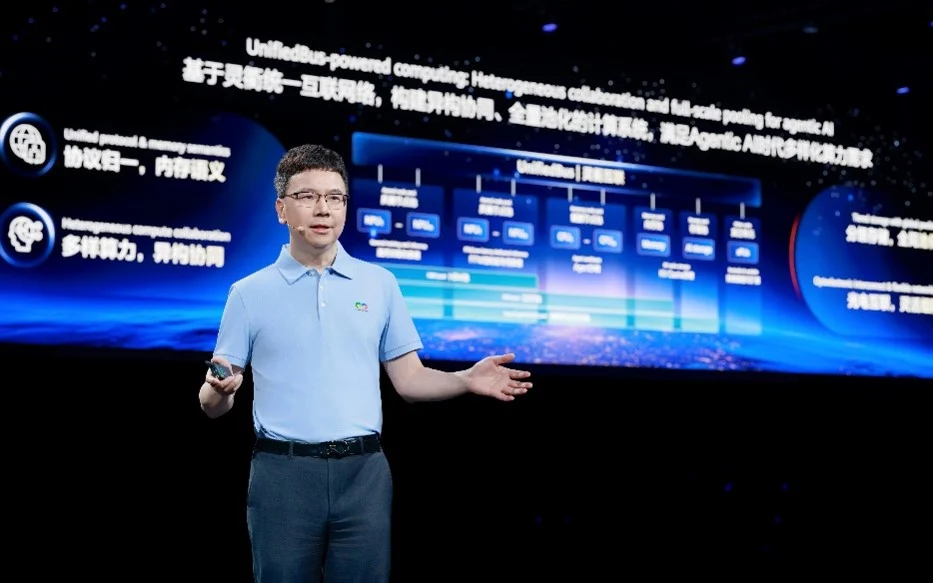
SHANGHAI – As the global race to develop increasingly sophisticated AI models reaches a fever pitch, the physical limitations of current data center architectures have emerged as the primary obstacle to innovation. At HUAWEI CONNECT 2026, held at the Shanghai World Expo Exhibition & Convention Center, Huawei took a decisive step toward overcoming these hurdles. Yang Chaobin, Executive Director of the Board and CEO of the ICT Business Group, unveiled the "UnifiedBus" interconnect architecture—a fundamental redesign of how computing clusters communicate, aimed at ushering in the era of agentic AI.
The Bottleneck: Why Traditional Clusters Are Stalling
To understand the significance of UnifiedBus, one must first recognize the "utilization crisis" currently plaguing the AI industry. In his keynote, Yang provided a sobering reality check on the state of modern supercomputing.
"In a traditional computing architecture, resource utilization declines as a cluster scales," Yang explained. According to Huawei’s internal data, a cluster consisting of 100,000 Neural Processing Units (NPUs) often suffers from severe inefficiencies, with as little as 20% of its raw computing capacity actually being utilized by active models. The remaining 80% is frequently left idle, shackled by the latency of data communications and memory access.
The shift toward "agentic AI"—systems capable of performing complex, multi-step tasks autonomously—has exacerbated this problem. A single 10-trillion-parameter model requires enormous quantities of intermediate data that far exceed the memory capacity of any individual accelerator. Furthermore, as AI agents interact with models hundreds of times per hour, the resulting "KV cache" (Key-Value cache) demand creates a massive strain on system memory. When communication between processors becomes the bottleneck, the entire cluster’s performance collapses, regardless of how many thousands of NPUs are connected.
The UnifiedBus Solution: Architectural Innovation
Huawei’s answer to this stagnation is the UnifiedBus interconnect technology. Designed to serve as the backbone for the next generation of AI, UnifiedBus facilitates seamless collaboration between individual clusters and "SuperPoDs" (Super Points of Delivery).
The architecture is designed to transform the data center from a collection of fragmented processors into a fluid, unified pool of intelligence. By decoupling compute from traditional rigid storage hierarchies, UnifiedBus allows for the elastic scaling of resources. Whether a task requires the power of a single cabinet or the combined force of a million-NPU cluster, the architecture ensures that the "fabric" connecting these components remains optimized for high-bandwidth, low-latency data transfer.
Chronology: A Roadmap to Intelligent Transformation
The unveiling at HUAWEI CONNECT 2026 represents the culmination of a multi-year R&D cycle at Huawei.
- Phase 1: Foundation (2023–2024): Huawei focused on scaling its Atlas and Kunpeng product lines, identifying the communication bottlenecks inherent in large-scale cluster training.
- Phase 2: Integration (2025): Development of the UnifiedBus protocol, aimed at standardizing data movement between heterogeneous compute and storage nodes.
- Phase 3: The SuperCluster Era (2026): The formal launch of the Agentic AI SuperCluster, integrating TaiShan 950 and Atlas 960 hardware with the new interconnect fabric.
During the three-day event, attendees witnessed live demonstrations of the UnifiedBus in action. The technology’s ability to allow small and medium-sized enterprises (SMEs) to run trillion-parameter models locally—a feat previously reserved for hyperscale tech giants—drew significant attention from the international developer community.
Supporting Data: Technical Capabilities and Product Ecosystem
The hardware ecosystem supporting UnifiedBus is comprehensive, spanning from the cabinet level to massive cluster deployments.
The Agentic AI SuperCluster
At the heart of the new offering is the Agentic AI SuperCluster, a powerhouse system comprising:
- TaiShan 950 CPUs: Providing the foundational logic and management.
- Atlas 960 SuperPoDs: The primary engines for massive-scale NPU acceleration.
- OceanStor M900: High-speed memory storage designed to handle the massive KV cache requirements of agentic models.
- Xinghe UBG Switches: The intelligent routing layer that facilitates the "UnifiedBus" connectivity.
Democratizing Compute: The Atlas 650E
Huawei has also lowered the barrier to entry for smaller organizations. The new Atlas 650E air-cooled server series demonstrates the versatility of the UnifiedBus. By linking two of these units, enterprises can achieve a switch-free interconnect across 16 NPUs. This "plug-and-play" capability allows firms to scale from a small, local setup to a sophisticated, multi-node SuperPoD without the need for the massive infrastructure investments typically required for high-performance computing (HPC).
Collaboration: The Open-Source Ecosystem
Hardware, however, is only one side of the coin. Huawei emphasized that the success of UnifiedBus depends heavily on software and community adoption. Yang highlighted that the Ascend ecosystem is moving away from the proprietary siloing that has historically hindered AI development.
Huawei is currently collaborating with major open-source frameworks, including:
- DeepSeek Harness and OpenCode: For developing intelligent management and inference acceleration.
- openJiuwen: Focusing on security framework agent plugins.
Furthermore, Huawei has engaged with over 90 mainstream open-source communities and 50+ partners, including academic institutions, to build 26 industry-specific operator libraries. This strategy is designed to ensure that developers can easily integrate industry-specific agents into existing IT systems, effectively turning "dumb" data silos into intelligent, active business assets.
Implications: The New Cornerstone of Industrial Intelligence
The implications of the UnifiedBus architecture are profound. By addressing the "compute bottleneck," Huawei is signaling that the era of mere model training is giving way to the era of industrial application.
Economic Impact
For SMEs, the ability to train and run massive models locally—rather than relying solely on expensive, public cloud-based API calls—could fundamentally alter the economics of AI adoption. It offers a path to data sovereignty and privacy, allowing companies to keep sensitive intellectual property on-premises while maintaining the performance levels of global AI leaders.
Technical Trajectory
The industry-wide move toward "agentic" systems—where AI can take autonomous action—requires a level of system reliability and speed that current hardware simply cannot provide. Huawei’s focus on tiered resource pooling and switch-free interconnects suggests that the next phase of the AI boom will be defined by "system-level innovation."
"Huawei is committed to innovating at the system level," Yang stated during his closing remarks. "We are building a computing-foundation product portfolio, and we are going open source and open system. We will continue working with customers, partners, and developers to help this ecosystem thrive and offer the world a new option for compute."
Conclusion
As the curtain falls on HUAWEI CONNECT 2026, the industry is left with a clear message: the future of AI will not be determined by the number of transistors on a single chip, but by the efficiency with which those chips communicate. With UnifiedBus, Huawei has positioned itself not just as a hardware manufacturer, but as an architect of the next generation of industrial intelligence. Whether the market fully embraces this "unified" approach remains to be seen, but the shift toward architecture-first innovation is undeniably underway.