In the rapidly evolving landscape of Small Language Model (SLM) deployment, the pursuit of efficiency is not merely a technical preference—it is a fundamental requirement for production-grade automation. As organizations move away from massive, cloud-hosted models toward leaner, domain-specific SLMs, the bottleneck often shifts from model capacity to hardware utilization. In this final installment of our optimization series, we move beyond model architecture and delve into the critical role of data orchestration: specifically, how sorting inputs by token length before batching can drastically reduce computational waste.
The Core Challenge: Memory Bandwidth vs. Arithmetic Throughput
When deploying models like the Qwen2.5-0.5B-Instruct on edge hardware—such as an M2 MacBook Air—developers often fall into the trap of processing inputs one by one. While this approach is simple to implement, it is inherently inefficient. At a batch size of one, an SLM becomes "memory-bandwidth bound."
Because the hardware must stream the entire set of model weights from memory to the processor to generate a single token, and then repeat this entire process for every subsequent item in the queue, the high-speed arithmetic units of the GPU or Neural Engine remain idle for the vast majority of the time. The hardware spends more time waiting for data to travel from memory to the compute core than it does performing the actual matrix multiplications required for inference.
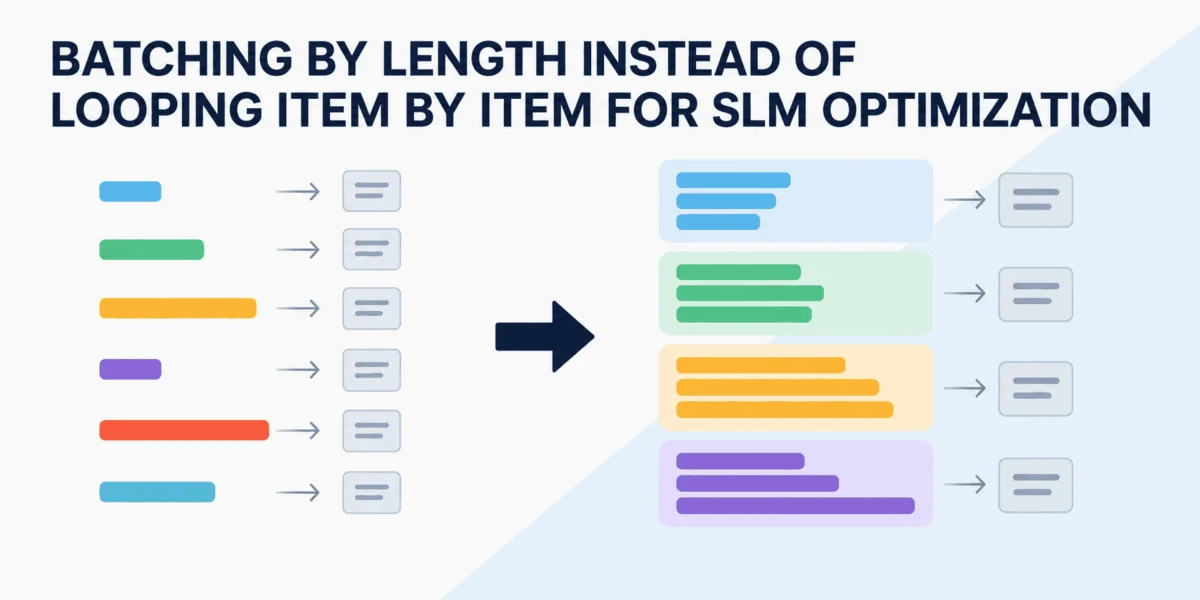
To overcome this, engineers traditionally turn to batching. By grouping multiple requests into a single forward pass, the model can reuse its weight-stream across several sequences, amortizing the cost of reading those weights from memory. However, naive batching introduces its own problem: padding. Because tensors in a batch must share a uniform dimension, all sequences must be padded to match the length of the longest item in that specific batch. In datasets with high variance—where a few long documents are mixed with many short, punchy tickets—this leads to "padding waste," where the model spends significant cycles calculating zeros that contribute nothing to the final output.
Chronology of the Optimization Workflow
To address this, we implemented a three-stage optimization strategy, using a simulated workload of 600 support tickets categorized by billing, technical, or account-related intent.
Phase 1: The Baseline (The "One-by-One" Loop)
Our baseline assessment involved a serial processing loop. Utilizing the Qwen2.5-0.5B-Instruct model in float16 precision, we processed 600 tickets sequentially. The results were telling: the system achieved a throughput of approximately 4.2 items per second. Over the course of the benchmark, the total execution time reached 144.35 seconds. This approach serves as the "ground truth" for correctness but highlights the massive opportunity cost of serial processing.
Phase 2: Identifying the "Padding Tax"
Before re-engineering the pipeline, we analyzed the token length distribution of our tickets. The dataset featured a "long-tail" distribution: while the median length was 94 tokens, the maximum reached 449. If one were to force every item into a single global batch size, the model would process approximately 3.7 times the necessary number of tokens, with the majority being null padding. This realization prompted the shift to a more surgical approach.
Phase 3: Length-Sorted Batching
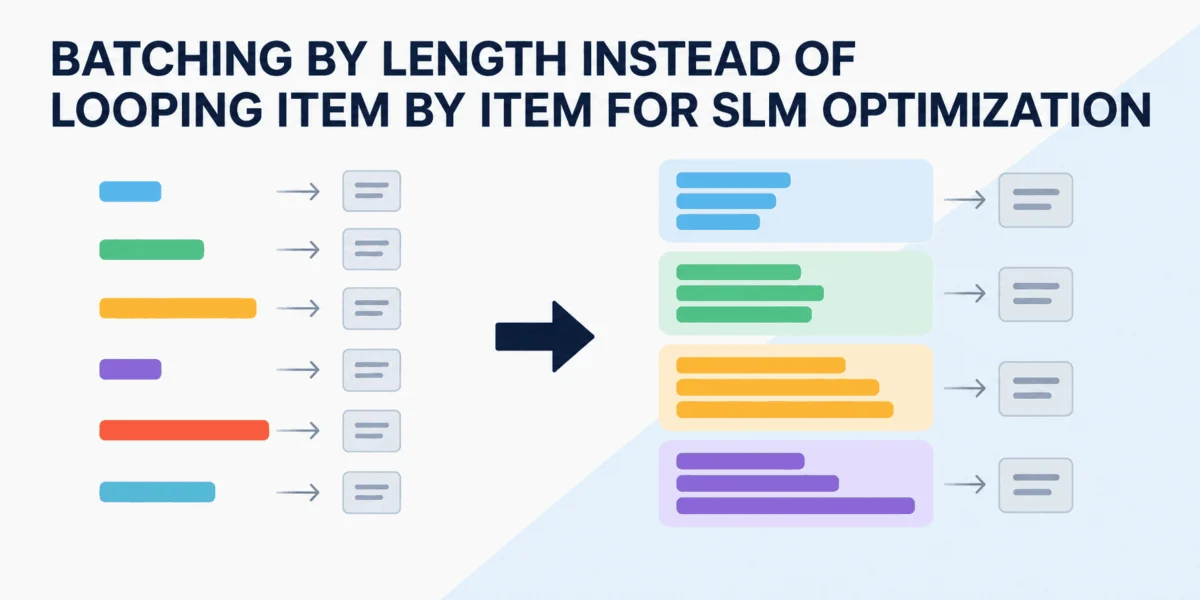
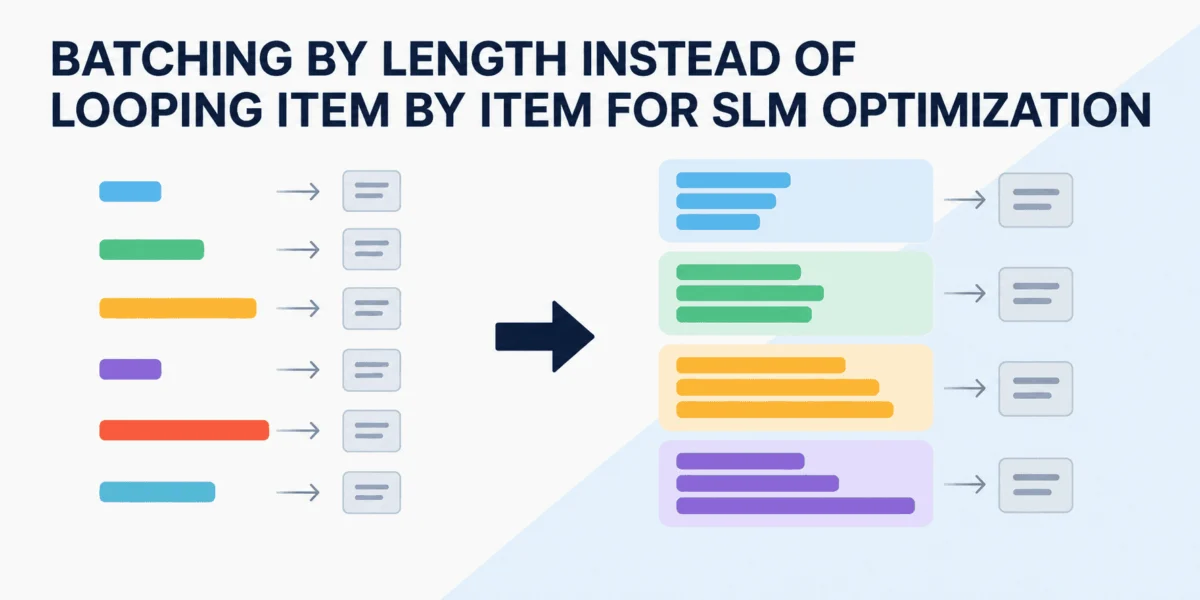
The final, optimized implementation involved sorting the input queue by token length prior to forming batches. By grouping similarly sized tickets together, each batch only needs to pad to its "local maximum." If a batch contains only short tickets, the padding overhead remains minimal. This approach effectively keeps the hardware saturated with useful data while keeping memory-to-compute ratios balanced.
Supporting Data: Efficiency Metrics
The performance gains observed through length-sorted batching are significant. When we transitioned from the sequential loop to length-bucketed batching, the throughput increased from 4.2 items/second to 7.5 items/second—a performance improvement of nearly 79%.
| Metric | Sequential Processing | Length-Sorted Batching |
|---|---|---|
| Total Execution Time | 144.35s | 79.60s |
| Throughput | 4.2 items/sec | 7.5 items/sec |
| Padding Overhead | N/A | 7.6% |
| Accuracy (Agreement) | Baseline | 100% (Matches Baseline) |
The most critical data point here is the padding overhead. By sorting the items, we reduced the padding to just 7.6% of the total token count. In a naive, non-sorted batching scenario, this overhead could easily balloon to over 30% or 40%, depending on the variance in the input data. The ability to verify these results against the sequential "gold standard" ensures that these performance gains come with zero loss in model accuracy.
The Intersection of Prefix Caching and Batching
While length-sorted batching provides a massive boost, it introduces complexity when combined with other optimizations like Key-Value (KV) caching. In our previous article, we discussed reusing the prompt prefix (e.g., system instructions) to save time.
However, when batching, the KV cache must be managed with precision. If the cache is designed for a batch size of one, it must be expanded to accommodate the full batch dimension, and then properly cropped back. These techniques do not automatically "compose" for free; they require deliberate engineering. Developers must verify that the batch-aware cache does not introduce artifacts or errors in the model’s attention mechanism, ensuring that the speedup remains performant without sacrificing the integrity of the model’s output.
Implications for Production AI
The findings from this series underscore a vital lesson for the AI community: optimization is as much about data logistics as it is about neural architecture. As we move toward a future where SLMs perform the bulk of narrow, repetitive automation tasks, the ability to manage the flow of information becomes a competitive advantage.
1. Hardware Longevity and Sustainability
By reducing the amount of wasted computation (padding), developers can lower the energy consumption of their inference pipelines. On edge devices like the M2 MacBook Air, reduced compute cycles translate to lower power consumption and less thermal throttling, allowing for more consistent performance over long periods.
2. The Fallacy of "Smart" Optimization
A recurring theme in this series is that no optimization should ever change the output of the model. If a technique increases speed but alters the logic or classification result, it is not an optimization—it is a regression. The strict validation used in our benchmarks (comparing outputs against the unoptimized baseline) is the gold standard that any production system must adopt.
3. Democratization of AI
By focusing on 0.5B-parameter models and standard hardware, this series demonstrates that high-performance AI is not reserved for those with massive GPU clusters. With intelligent data scheduling—such as length-based batching, KV caching, and output space constraints—sophisticated, fast, and accurate automation is accessible to anyone with a standard workstation.
Conclusion: A Blueprint for Efficiency
In conclusion, our three-part exploration has provided a clear roadmap for SLM optimization. By constraining the output space, reusing prompt prefixes with KV caches, and implementing length-sorted batching, we have transformed a slow, memory-bound process into a highly efficient, production-ready pipeline.
These techniques serve as a reminder that the "small" in Small Language Models refers to the parameter count, not the potential. When handled with the right orchestration strategies, SLMs can provide the speed and reliability necessary for the next generation of intelligent, automated enterprise applications. As the field continues to evolve, the winners will be those who master the subtle art of making the hardware work as hard—and as efficiently—as the models themselves.