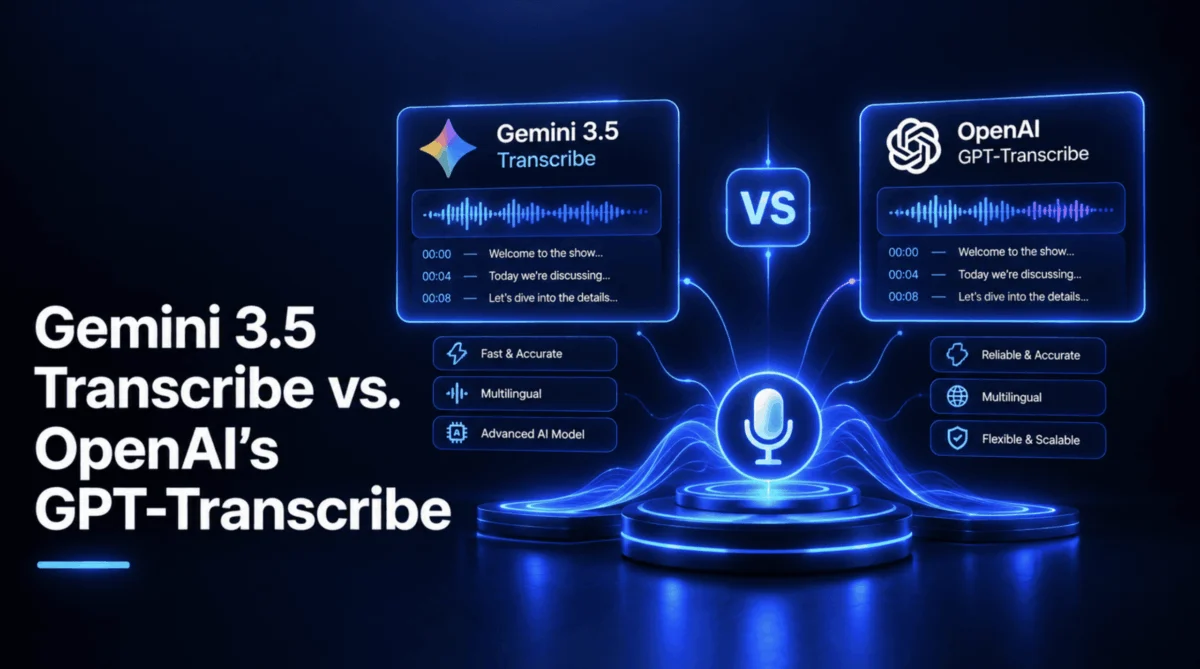
In the rapidly evolving landscape of generative artificial intelligence, the utility of a model is often measured not just by its creative prowess, but by its ability to bridge the gap between human communication and machine-readable data. On July 28, 2026, and August 26, 2026, respectively, OpenAI and Google dropped their latest answers to the persistent challenge of automated speech recognition (ASR).
The release of OpenAI’s GPT-Transcribe followed by Google’s Gemini 3.5 Transcribe just four weeks later marks a significant inflection point in the industry. For developers and enterprises, this close succession offers a rare opportunity: a side-by-side evaluation of two state-of-the-art models that are not separated by generations of architecture, but by design philosophy. Both companies have adopted a bifurcated approach, splitting their offerings into models optimized for real-time streaming and those tailored for high-accuracy, pre-recorded audio processing.
The Chronology of Modern Transcription
To understand the current state of play, one must look at the trajectory of the preceding models. OpenAI’s legacy, built on the venerable Whisper architecture, set the industry standard for open-source and API-based transcription. However, by early 2025, the limitations of Whisper—namely its inability to integrate seamlessly with newer multimodal architectures—became apparent.
OpenAI’s transition to the gpt-4o-transcribe model in March 2025 signaled a shift toward native integration with the GPT-4o architecture. GPT-Transcribe, released in July 2026, is the logical evolution of this path, designed to be more efficient and performant than its predecessors.
Google’s response, Gemini 3.5 Transcribe, serves as the successor to Chirp 3. Google has historically focused on massive-scale speech processing, leveraging its vast infrastructure to optimize latency. By launching Gemini 3.5 Transcribe in late August 2026, Google aimed directly at the inefficiencies that currently plague enterprise transcription workflows—specifically the need for multiple, chained model calls to achieve speaker identification and timestamping.
Supporting Data: Accuracy and Benchmarking
When comparing transcription models, the primary metric is the Word Error Rate (WER). A lower WER indicates higher fidelity to the original audio.
Google’s Performance Metrics
Google has leaned heavily on independent benchmarks from Artificial Analysis. For Gemini 3.5 Transcribe, the reported WER is a highly competitive 4.0% for streaming use cases and an impressive 2.6% for non-streaming, pre-recorded audio. When tested against the FLEURS multilingual benchmark—a more rigorous test than standard datasets—Google reported 5.50% (streaming) and 5.04% (non-streaming).
The efficiency gains are equally notable. Google claims a 70% improvement in time-to-final-transcription compared to Chirp 3, a leap that translates to significant cost and latency savings for companies processing millions of hours of call center audio.
OpenAI’s Benchmarking
OpenAI’s approach to performance reporting has focused on the evolution from their original whisper-1 model. In their own internal testing against the Common Voice dataset across 22 languages, GPT-Transcribe achieved a WER of 19.27%, nearly halving the 40.37% error rate of the original whisper-1. While the raw WER might appear higher than Google’s, OpenAI emphasizes the model’s cost-efficiency, noting a 25% price reduction per minute over its immediate predecessor.
Official Strategies and Model Architectures
Gemini 3.5: The All-in-One Powerhouse
Google’s strategy with Gemini 3.5 Transcribe is integration. The model is not merely a transcription engine; it is a multimodal tool.
- Gemini-3.5-transcribe-live: Optimized for the Live API, offering sub-second latency for continuous streams.
- Gemini-3.5-transcribe: The heavy-lifter for pre-recorded files, capable of multi-speaker attribution (diarization) and word-level timestamps out of the box.
The inclusion of these features—diarization and timestamps—without requiring a secondary "post-processing" model is a massive value proposition. Furthermore, the ability to delegate follow-up tasks (such as using a separate Gemini model to summarize the meeting or analyze an attached file) creates a cohesive ecosystem for developers.
OpenAI’s GPT-Transcribe: The Lean Specialist
OpenAI’s GPT-Transcribe is designed for precision and modularity. It excels in domain-specific tasks through the use of keyword and language hints. By allowing users to provide context, OpenAI helps the model navigate complex jargon or code-switching scenarios more effectively than a "blind" transcription model.
However, there is a clear trade-off. OpenAI’s architecture remains modular. If a developer requires speaker diarization, they must utilize the gpt-4o-transcribe-diarize model. If they need high-fidelity timestamps, they may still find themselves reaching for the older whisper-1. This modularity offers flexibility for those who do not need the extra features, but it adds architectural complexity for those who do.
Implications for Developers and Enterprises
The Case for Gemini 3.5
For enterprise applications—specifically those involved in legal, medical, or corporate meeting transcription—Gemini 3.5 Transcribe is the current frontrunner. The ability to distinguish between "Speaker 1," "Speaker 2," and "Speaker 3" natively means that an application can move from raw audio to a structured, speaker-attributed transcript in a single API call. This reduction in overhead is not just about convenience; it is about reducing the latency and cost associated with multiple API requests.
The Case for GPT-Transcribe
OpenAI continues to dominate in environments where speed, cost-efficiency, and simple, high-quality transcription are paramount. At $0.0045 per minute for file transcription and $0.017 per minute for streaming, OpenAI has positioned its product as an accessible, high-performance commodity. Its strength lies in its simplicity and the developer-friendly nature of the OpenAI API, which remains the gold standard for ease of integration.
Technical Implementation: A Comparative Look
Using Gemini 3.5 for Multi-Speaker Meetings
The following Python snippet demonstrates how Gemini 3.5 handles a complex request. By using the genai client, developers can pass raw audio bytes and a prompt, receiving a structured output that includes timestamps and speaker labels immediately:
from google import genai

client = genai.Client(api_key="YOUR_GOOGLE_API_KEY")

with open("meeting_recording.mp3", "rb") as f:
    audio_bytes = f.read()

# Gemini 3.5 handles diarization and timestamps natively
response = client.models.generate_content(
    model="gemini-3.5-transcribe",
    contents=[
        "text": "Transcribe this meeting with speaker labels and timestamps.",
        "inline_data": "mime_type": "audio/mp3", "data": audio_bytes,
    ],
)
print(response.text)
Using GPT-Transcribe for Real-Time Captioning
OpenAI’s approach to streaming via WebSockets is designed for low-latency, continuous output. This is ideal for live events where partial, incremental text is required to maintain synchronization with the speaker:
import asyncio
import websockets
import json

async def stream_captions(audio_chunks):
    uri = "wss://api.openai.com/v1/realtime?intent=transcription"
    headers = "Authorization": "Bearer YOUR_OPENAI_API_KEY"

    async with websockets.connect(uri, extra_headers=headers) as ws:
        await ws.send(json.dumps(
            "type": "transcription_session.update",
            "session": "input_audio_transcription": "model": "gpt-live-transcribe",
        ))

        for chunk in audio_chunks:
            await ws.send(json.dumps(
                "type": "input_audio_buffer.append",
                "audio": chunk,
            ))
            # Receive delta events for real-time display
            message = await ws.recv()
            event = json.loads(message)
            if event.get("type") == "conversation.item.input_audio_transcription.delta":
                print(event["delta"], end="", flush=True)
The Future of Voice-to-Text
The rivalry between Google and OpenAI reflects a broader trend in the AI industry: the move away from "one size fits all" models toward highly specialized, task-specific, yet integrated solutions.
Google’s Gemini 3.5 Transcribe represents the "all-in-one" future, where the model understands the context of the audio—who is speaking, when they are speaking, and what the content implies—enabling immediate downstream analysis. OpenAI, meanwhile, remains committed to the "builder’s toolkit" philosophy, offering highly efficient, reliable primitives that developers can combine to create complex systems.
As these models continue to iterate, the barrier to entry for high-quality, real-time, and multi-speaker transcription is collapsing. The ultimate winner in this competition is the developer, who now has the power to choose between a feature-rich, integrated intelligence and a lean, high-speed engine, depending on the unique demands of their specific use case. Whether for global communication, accessibility tools, or enterprise data extraction, the standard for speech-to-text has never been higher.