In the current landscape of artificial intelligence, the industry is dominated by Large Language Models (LLMs). From ChatGPT to Claude, these models are celebrated for their ability to draft essays, debug code, and engage in fluid conversation. However, the obsession with generative text has obscured a fundamental reality: most enterprise AI use cases do not require an essay. They require a definitive "Yes" or "No," a classification, or a logical routing decision.
Enter Decision AI, a paradigm shift that strips away the bloat of generative text to focus exclusively on high-speed, probabilistic decision-making. As proprietary solutions like Jev by TypeSafe AI emerge alongside a thriving ecosystem of open-source models, developers are beginning to realize that the future of efficient AI isn’t just about "talking"—it’s about choosing.
The Core Concept: What Is Decision AI?
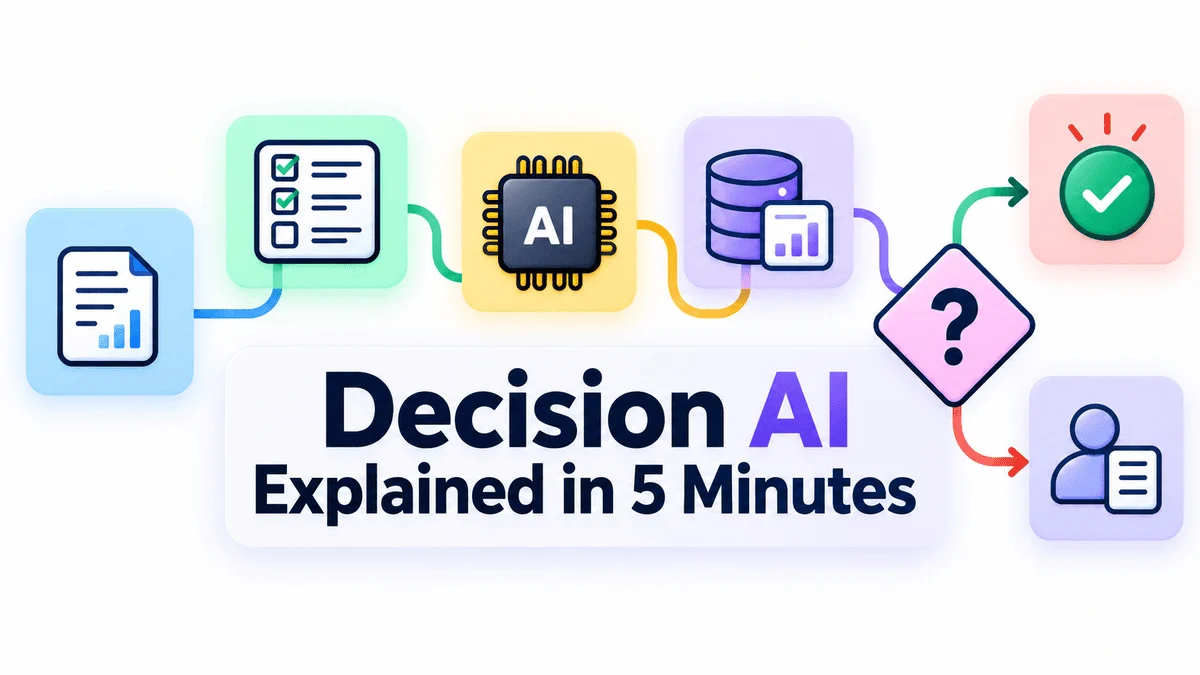
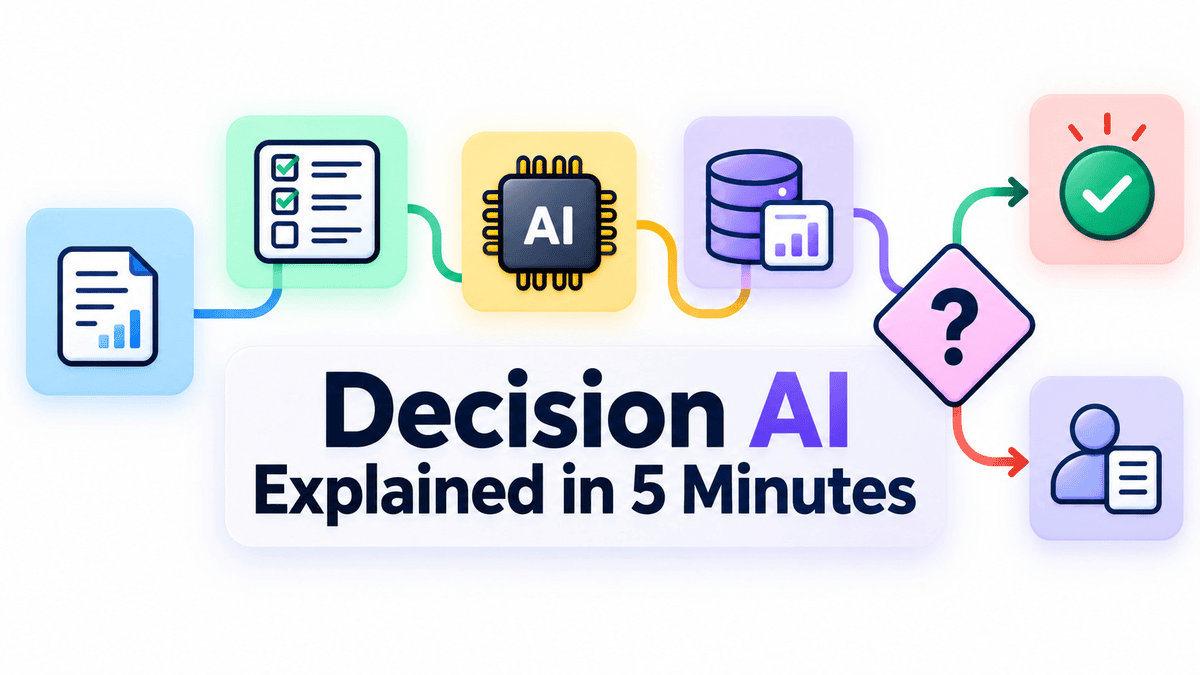
At its essence, Decision AI represents a specialized branch of machine learning where the objective is not to create content, but to provide structured, actionable outputs. Traditional LLMs are trained to predict the next token in a sequence, often resulting in long-winded, resource-heavy text generation. Decision AI models, conversely, are optimized to evaluate inputs against a predefined set of labels or outcomes and return the associated probability for each.
Consider a high-volume customer support environment. When a user submits an email stating, "I was charged twice for my order," a standard LLM might draft a polite apology and attempt to resolve the issue. While useful, this is computationally expensive and slow. A Decision AI model simply maps the input to a "Billing" category and returns an 85% confidence score. This result is immediately machine-readable, allowing for instant routing to the correct department without the need for complex prompt engineering or text parsing.
Chronology of Development: From Generative Bloat to Precision Routing
The journey to Decision AI has been rapid, evolving alongside the maturation of the transformer architecture.
- Phase 1: The LLM Monopoly (2022–2023): The industry was fixated on the "chat" interface. Developers forced LLMs to act as classifiers by asking them to "output only the word ‘Billing’ or ‘Shipping’." This was inefficient, as the model still performed the heavy lifting of calculating probabilities for an entire vocabulary of millions of tokens just to pick one.
- Phase 2: The Emergence of Specialized Heads (Late 2023): Researchers began pruning the generative layers of LLMs, replacing them with custom "prediction heads." This allowed models to skip the text-generation stage and output probabilities directly.
- Phase 3: The TypeSafe Catalyst (2024): The introduction of Jev by TypeSafe AI formalized the concept of "System One" models—a nod to Daniel Kahneman’s dual-process theory of human cognition, where "System One" is fast, instinctive, and automatic.
- Phase 4: Open-Source Democratization (Current): With the integration of decision-making endpoints into
llama.cppand Ollama, the technology has moved from proprietary APIs to local, private hardware, sparking a wave of new research into lightweight, high-performance decision models like Laya and Kev.
Supporting Data: Efficiency Metrics
The primary driver behind the adoption of Decision AI is performance. By eliminating the autoregressive generation loop, Decision AI achieves:
- Latency Reduction: By bypassing token-by-token generation, these models typically run 5x to 10x faster than their generative counterparts.
- Deterministic Output: Because the output is constrained to a set of predefined labels, the "hallucination" problem is effectively neutralized. The model cannot output a grammatically incorrect or irrelevant response; it can only assign a probability to the choices provided.
- Cost Efficiency: Running a 7-billion parameter model for a classification task is costly in terms of VRAM and compute cycles. Smaller, specialized decision models can often run on edge devices or CPU-only servers, drastically reducing cloud infrastructure costs.
| Metric | Traditional LLM (Classification) | Decision AI Model |
|---|---|---|
| Inference Time | 200ms – 800ms | 10ms – 30ms |
| Output Format | Unstructured String | Structured JSON/Probabilities |
| Compute Load | High (Full Attention/Generation) | Low (Single Forward Pass) |
| Reliability | Variable (Prompt-dependent) | High (Probabilistic) |
The Mechanics: How LLMs Become Decision Engines
The technical magic behind Decision AI lies in the manipulation of logits. When a transformer processes an input, it generates a vector of raw scores (logits) for every possible token in its vocabulary.
In a generative model, a softmax function is applied to these logits to create a probability distribution, and a sampler chooses the next word. In a Decision AI model, we ignore the vast majority of the vocabulary. We isolate only the logits corresponding to our desired outcomes (e.g., "Billing", "Shipping", "Technical"). We apply the softmax function exclusively to these relevant indices. The result is a clean, normalized probability score that tells the application exactly how confident the model is in each category.
This "prediction head" approach allows for multi-tasking in a single forward pass. A single query can simultaneously classify a ticket, determine its sentiment, and flag it for human urgency, all with a single computational hit.
Implications for Industry and Developers
The shift toward Decision AI has profound implications for how we build software.
1. The "Agentic" Workflow
We are entering an era of "Agentic Orchestration." Instead of using a single "God-model" to handle everything, developers are architecting systems where small, fast Decision AI models act as "gatekeepers." These models decide if a query is simple enough to handle via a database lookup or if it requires the heavy-duty compute of a flagship LLM. This "routing" strategy is the key to sustainable AI costs at scale.
2. Local Privacy and Sovereignty
By utilizing llama.cpp to run models like Laya or OpenJev locally, organizations can process sensitive data—such as financial transactions or medical records—without ever sending data to a third-party API. This removes the compliance hurdles associated with GDPR or HIPAA when using cloud-based AI services.
3. Real-Time Responsiveness
In sectors like high-frequency trading, real-time fraud detection, or gaming, latency is the difference between success and failure. Decision AI’s ability to return a classification in milliseconds makes it the only viable choice for applications that operate in the "reflex" loop of a digital system.
Future Outlook: The Reliability Challenge
While the promise is significant, the future of Decision AI rests on the maturity of its reliability frameworks. A probability score is only as good as the model’s calibration. If a model claims 95% confidence but is wrong 20% of the time, it is "overconfident."
Future development must focus on calibration techniques—ensuring that the probability outputs map accurately to real-world error rates. Furthermore, the industry needs standardized evaluation benchmarks specifically for decision-making, separate from the benchmarks used for creative writing or reasoning.
As we move forward, the most successful AI applications will not be those that boast the most complex chatbots, but those that utilize the most efficient decision-makers. By stripping away the performative nature of generative text, Decision AI is bringing the industry back to what matters most: the ability to make the right choice, every time, with maximum speed and minimum overhead.
The era of "talking AI" is giving way to the era of "acting AI," and the transition is already happening on your local machine.