In the rapidly evolving landscape of Large Language Models (LLMs), the industry has hit a paradoxical wall. While base models have become increasingly proficient at generating text, solving math problems, and writing code, they often stumble when tasked with autonomous, multi-step workflows. An AI agent is not merely a chatbot; it is a system that must comprehend intent, identify appropriate tools, parse complex outputs, and maintain state over hours of operation. When models fail in these long-horizon tasks, they often "hallucinate" or drift from their original goals, leading to costly errors and operational fatigue.
Abacus.AI, a leader in applied AI research, has identified this as a fundamental training challenge rather than a simple prompting issue. To address this, they have unveiled the Smaug model family—a trio of open-weight models fine-tuned specifically for agentic endurance. By applying a consistent, rigorous training methodology to three distinct base architectures, Abacus.AI has demonstrated that reliability can be engineered, provided developers understand where their models’ specific "gaps" lie.
The Core Problem: Why Agents Break
General-purpose language models are frequently evaluated on their ability to provide a singular, high-quality response. However, enterprise-grade agents operate in a different paradigm. They must interact with APIs, navigate databases, and process multiple documents across a sustained session.

Abacus.AI encountered these limitations firsthand. Their own agentic tasks—which frequently span hours of execution—were plagued by context decay and tool-use failures. The models would simply "run out of steam," losing track of the initial directive after several iterations.
The research team concluded that current industry trends—such as relying on prompt engineering or weight-tweaking to fix flaws—were insufficient. Instead, they proposed a structural fix: fine-tuning the models to handle agentic logic natively. The result is the Smaug line, which treats agentic performance as a first-class citizen in the training process.
Chronology of the Smaug Development
The development of the Smaug line was driven by a desire to prove that a unified training "recipe" could yield measurable gains across diverse model architectures. The process followed a deliberate three-phase approach:
- Curation of Agentic Traces: Abacus.AI gathered a corpus of human-curated, real-world agentic trajectories. These were combined with high-quality synthetic data focused on "hard cases"—scenarios designed to trigger failure modes in standard models.
- Filter-First Training: A critical component of the methodology was the rigorous filtering of training data. The team deliberately excluded instances that allowed models to "game" the benchmark scores (format compliance) at the expense of genuine reasoning. The goal was to preserve the model’s "mind" while sharpening its ability to follow tool-use instructions.
- Cross-Architecture Application: The team applied this identical methodology to three disparate base models—DeepSeek V4 Flash, Qwen3.8-27B, and Kimi K3. By doing so, they established a benchmark for how different scales and architectures respond to the same optimization pressure.
The Smaug Lineup: Supporting Data and Analysis
The Smaug family is designed for specific enterprise use cases, categorized by their position on the capability-efficiency curve.
1. Smaug Flash (The Enterprise Workhorse)
- Base: DeepSeek V4 Flash 0731
- Target: High-speed, cost-effective, "always-on" enterprise agents.
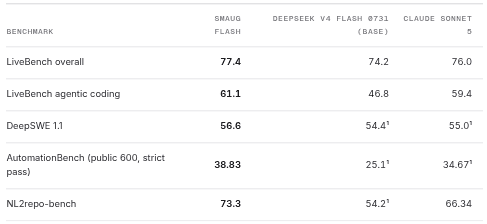
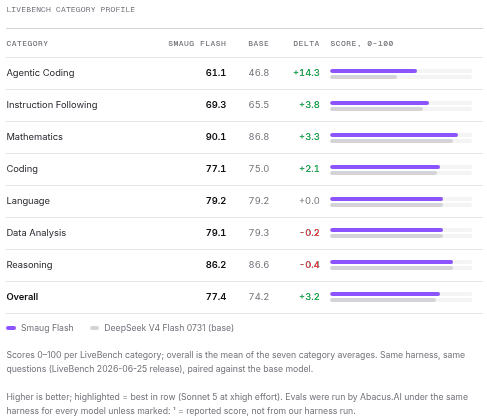
- Performance: This model saw the most dramatic improvements. In LiveBench agentic coding, it surged from 46.8 to 61.1—a 14.3-point jump. It also saw a massive 19-point gain in NL2Repo-Bench.
The data indicates that Smaug Flash addresses the specific failure mode of its base: confusion in long-context tool use. While it saw minor dips in pure reasoning, these are considered acceptable trade-offs for a model purpose-built to maintain context in automated pipelines.
2. Smaug Mini (The Multimodal Specialist)
- Base: Qwen3.8-27B
- Target: Multimodal, compact, one-off tasks that fit on a single GPU.
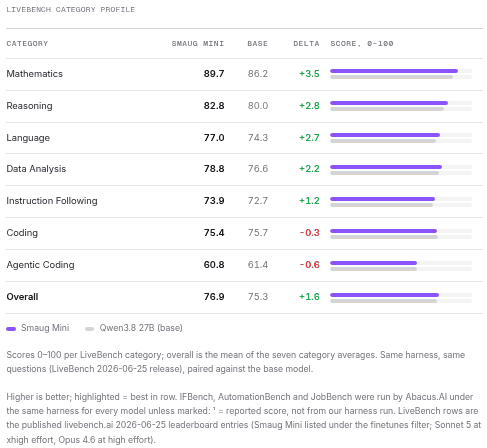
- Performance: Despite being the smallest, Smaug Mini outperformed several "frontier" closed models. It achieved a 17.1-point gain in JobBench and significantly outperformed competitors like Claude Sonnet 5 and GPT-5.6 Luna on IFBench (Instruction Following).
The "twist" with Smaug Mini is that it actually saw a slight decrease in its agentic coding score compared to its base. However, this highlights a critical nuance: the base model was already strong in coding, so the fine-tuning redirected its capacity toward mathematics and reasoning, where it gained 3.5 and 2.8 points, respectively.
3. Smaug Agentic (The Frontier Scale Expert)
- Base: Kimi K3 (2.8T Parameters)
- Target: Long-horizon coding and massive-scale logic.
- Performance: The benchmark deltas here are modest, but the behavioral improvement is profound. Abacus.AI reports that the model achieved a median of 78 agent steps per task across 113 coding challenges, resulting in zero timeouts and zero infrastructure errors over seven hours of continuous operation.
Official Perspective and Methodology
Abacus.AI’s research stance is clear: "Most fine-tuning silently overwrites the reasoning of a model for the sake of task compliance—you get the format, but you lose the mind."
The official documentation emphasizes that the Smaug models are not intended to be "all-rounders" that top every leaderboard. Instead, they are instruments designed for specific workflows. By being transparent about where the models do not improve—such as the Smaug Agentic’s slight dip in Terminal-Bench—Abacus.AI invites developers to evaluate these models based on real-world stability rather than vanity metrics.
The methodology relies heavily on LiveBench, a platform designed to combat data contamination. By using fresh data from sources like math contests and new academic abstracts, LiveBench ensures that models are solving problems they haven’t seen before, rather than retrieving memorized answers.

Practical Implications for AI Development
For organizations looking to deploy AI agents, the Smaug results provide a blueprint for selection:
- For Long-Context Reliability: If your agent needs to interact with an API 50 times in a row without breaking, Smaug Flash is the clear winner. Its ability to close the "capability gap" in long-horizon tasks is the most significant result of the research.
- For Resource-Constrained Environments: Smaug Mini offers a "frontier-beating" capability at a 27B parameter scale, making it ideal for deployments where GPU memory is at a premium but high-level instruction following is required.
- For Mission-Critical Stability: Smaug Agentic is the choice for high-stakes environments where the cost of a "runaway" model or an infrastructure error is high. Its value is not in how fast it answers, but in its ability to stay the course over extended durations.
The Verdict on Benchmarks
The most important takeaway for practitioners is that benchmark scores are not proxies for reality. The performance profile of the Smaug family proves that a model can lose ground in one category while gaining critical reliability in another. Developers should prioritize metrics such as task completion ratios, latency at scale, and reproducibility over generic leaderboard rankings.
Ultimately, the Smaug line represents a transition in the AI industry: moving away from the era of "bigger is always better" and toward the era of "purpose-built is best." By understanding the specific failure modes of their base models, Abacus.AI has created a set of tools that do not just talk—they act, endure, and execute with a level of consistency that current frontier models struggle to maintain.
As we look toward the future of autonomous systems, the success of the Smaug methodology suggests that the next generation of AI will be defined not by how much information it can store, but by how reliably it can navigate the complex, multi-step realities of the enterprise.