The opinions expressed here by Trellis expert contributors are their own, not those of Trellis or its editors.
For the better part of a decade, the global sustainability movement has been obsessed with a singular, inward-looking objective: corporate accountability. We have constructed an elaborate ecosystem of frameworks, ESG reporting standards, and net-zero roadmaps designed to scrutinize climate delivery. Yet, as the artificial intelligence (AI) revolution accelerates, this architecture is showing signs of critical failure. We have become experts at measuring climate progress, but we have failed to build the systemic capacity required to enable it.
The current tension between the AI boom and the climate agenda is not merely a policy hurdle; it is a fundamental contradiction in how we approach global decarbonization. When individual companies are tasked with solving systemic infrastructure constraints—such as grid capacity and clean energy availability—in isolation, they inevitably fail. The AI explosion has brought this reality into sharp focus, exposing a "fragmentation trap" that threatens to derail both the technology race and the net-zero transition.
The Chronology of a Collision: How AI Outpaced the Grid
The collision between AI development and climate commitments did not happen overnight, but its trajectory has been steep and unforgiving.
- 2015–2020: The Era of Ambitious Commitments. Following the Paris Agreement, major technology firms set aggressive, long-term net-zero goals. These commitments were largely based on the assumption of a stable, decarbonizing energy grid and manageable operational growth.
- 2021–2022: The Onset of the AI Boom. Generative AI began its meteoric rise. Hyperscalers (Amazon, Google, Microsoft) pivoted their capital expenditure focus toward massive data center expansion.
- 2023–2024: The Power Gap Emerges. Electricity demand began to decouple from energy efficiency gains. As AI compute requirements skyrocketed, these companies found that their clean energy procurement strategies could no longer keep pace with the sheer volume of power needed to fuel GPUs.
- 2025–2026: The Reckoning. Recent reports from the industry indicate rising electricity-related emissions. The market has begun asking a pointed, existential question: Can corporate climate commitments survive the AI boom?
Supporting Data: The Cost of Fragmentation
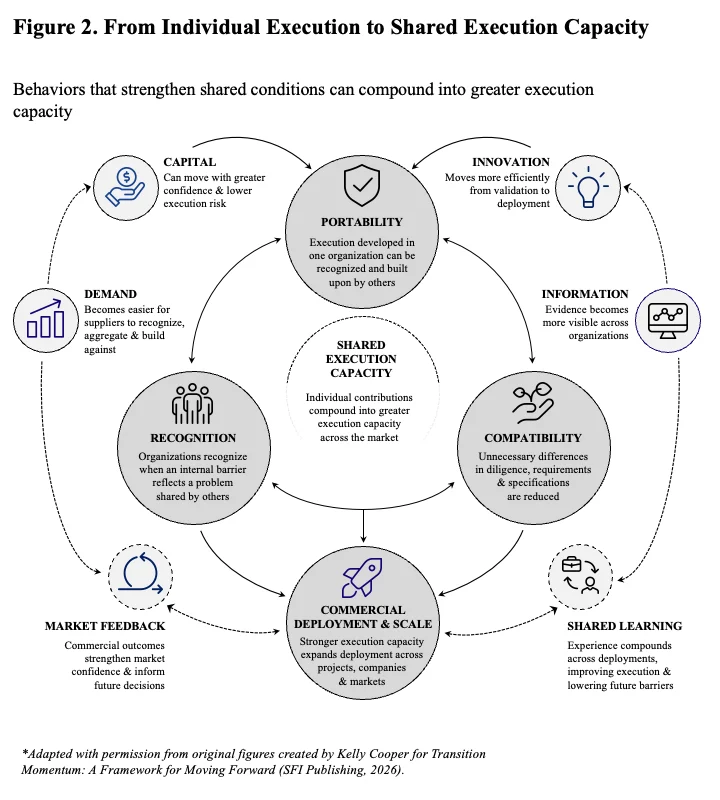
The data paints a sobering picture of how fragmented, individualistic corporate strategies are failing to meet the moment. Current research, drawing from a pool of over 200 practitioners across various climate-impact sectors, reveals a consistent pattern:

- Duplicate Effort: Companies are spending billions on redundant due diligence and project-specific procurement models that fail to scale.
- Disconnected Capital: Massive amounts of private capital are available for climate transition, yet they remain siloed from the projects that need them due to a lack of standardized, "bankable" execution pathways.
- The "Workaround" Economy: Because durable, shared infrastructure is missing, firms are increasingly relying on informal, ad-hoc solutions to secure power, often defaulting to fossil-fuel-backed generation simply because it is the only way to ensure "first-mover" advantage in the AI race.
This fragmentation is not just an environmental issue; it is a massive destruction of economic and institutional value. Every time a company is forced to reinvent the wheel, capital is wasted, deployment timelines slip, and the overall confidence in corporate climate action erodes, leaving firms vulnerable to political backlash and public scrutiny.
The Accountability Trap: A Flawed Design
Our current sustainability standards are designed to evaluate the internal performance of a company. We measure scope 1, 2, and 3 emissions as if the company exists in a vacuum. However, the hardest delivery constraints today—grid connectivity, transmission infrastructure, and renewable energy storage—sit entirely outside the organizations being held accountable.
When critical infrastructure is scarce, companies naturally pivot to "rational commercial behavior," competing aggressively for whatever resources are available. In the context of AI, power is no longer just an input; it is a strategic asset. When every major player in the tech sector attempts to solve this, independently, they drive up costs and create localized bottlenecks.
By continuing to prioritize accountability over execution, we have inadvertently created a system that incentivizes "green-hiding" and defensive reporting rather than the collective, systemic overhaul required for a true energy transition.
Official Responses and the Pivot Toward Coordination
The realization that individual effort is insufficient has triggered a quiet but significant shift in how regulators and industry leaders are responding to the AI energy crisis. We are seeing the early stages of a "shared capacity" model.
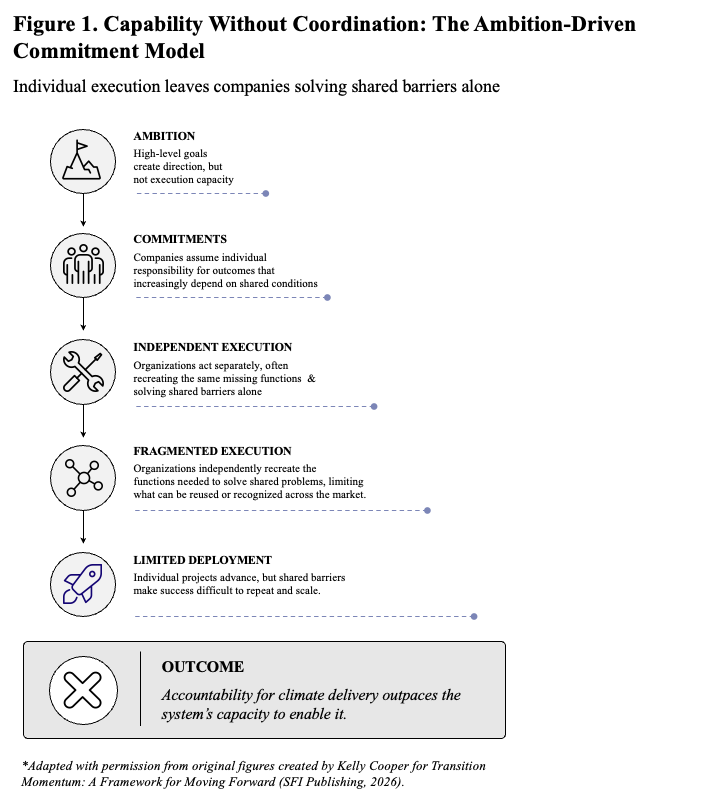
Governments and infrastructure operators are beginning to recognize that they cannot wait for the market to magically solve grid congestion. New coalitions are emerging, focusing on:
- Common Rule-Setting: Establishing standardized interconnection protocols that reduce the time-to-market for clean energy projects.
- Coordinated Procurement: Moving away from bespoke, individual power purchase agreements (PPAs) toward collective buying groups that can incentivize the development of new, large-scale generation capacity.
- Infrastructure Sharing: Developing data center clusters that share localized microgrids or thermal management systems, reducing the overall footprint and energy demand on the broader public grid.
These efforts suggest a growing consensus: the only way to scale the AI revolution without violating climate promises is to treat energy infrastructure as a shared public-private good rather than a proprietary competitive advantage.
Implications: Moving From Navigation to Reduction
For the modern sustainability practitioner, the message is clear: stop navigating fragmentation and start reducing it. The goal is to move from a culture of "how do I reach my net-zero target?" to "how can I contribute to the infrastructure that makes net-zero possible for everyone?"
1. Defining the Shared Problem
Companies must perform an honest audit of their operations. Are you solving a unique challenge, or are you simply rebuilding a function that the rest of the market is missing? If five companies are all building bespoke due diligence frameworks for the same type of wind farm, they are contributing to systemic drag.
2. Stopping Unnecessary Fragmentation
Challenge the "bespoke culture." In finance, engineering, and procurement, organizations often insist on unique specifications that add no real value but prevent the scaling of third-party solutions. Standardizing inputs—whether they are data reporting formats or energy infrastructure requirements—is the fastest way to lower the barrier to entry for clean energy providers.
3. Strengthening the Systemic Loop
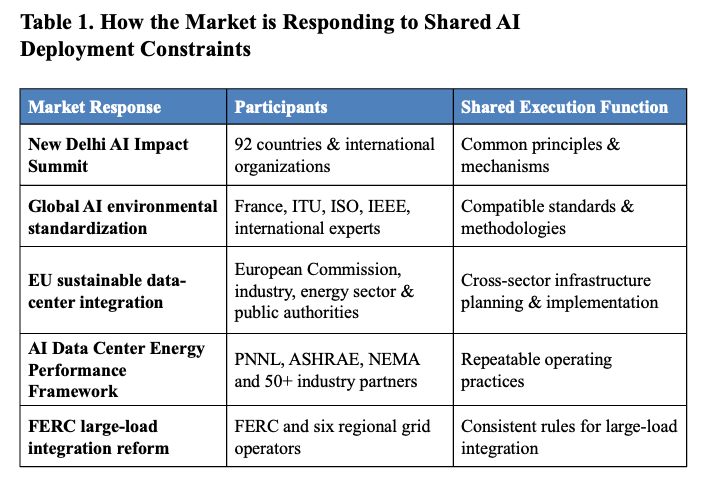
Favor solutions that create "public goods." When investing in energy infrastructure, ask: Will this only get us through the next quarter, or will it make the next deployment easier for everyone? Prioritize approaches that are interoperable, scalable, and built on open-source methodologies.
4. Cross-Boundary Execution
The most successful companies of the next decade will be those that effectively partner with their competitors to build common infrastructure. By aligning on a single diligence process or a unified standard, companies can unlock capital that is currently sitting on the sidelines, waiting for a less risky, more standardized environment.
Conclusion: Building the Other Half of the System
The last decade was about defining the architecture of ambition—the commitments, the disclosures, and the reporting metrics that brought the climate crisis to the boardroom table. But we have reached the limit of what ambition alone can achieve.
The AI boom has provided a brutal, high-speed laboratory for the failure of fragmented execution. It has shown us that when the commercial stakes are high enough, markets will find a way to coordinate—but often only after they have hit a wall of their own making.
The next frontier of sustainability is not about setting more aggressive targets. It is about building the "other half" of the system: the infrastructure, the standardized markets, and the collaborative execution capacity that turns climate commitments into physical reality. If we can mobilize markets to build this capacity for the sake of artificial intelligence, there is no reason we cannot do the same for the planet. The challenge is no longer about how we account for our impact; it is about how we collectively build the systems that make a net-zero future possible.