Global telecom capital expenditure is undergoing a seismic shift, moving beyond the expansive 5G coverage rollouts of recent years into a new frontier defined by fiber optic expansion, the evolution of 5G-Advanced, and the burgeoning demands of AI infrastructure, cloud platforms, data centers, and sophisticated network automation. As the industry collectively recalibrates its investment strategies for 2026 and beyond, a clear divergence is emerging: while headline capex figures might show moderation in some regions, the underlying allocation of capital signals a profound transformation in the very definition of telecom infrastructure.
This strategic pivot is not a mere adjustment; it represents a fundamental reorientation, driven by the insatiable appetite for data, the transformative power of artificial intelligence, and the critical need for robust, high-capacity connectivity. Operators are no longer solely focused on blanket coverage; the emphasis is now on deepening network capabilities, enhancing intelligence, and building the foundational infrastructure for the next wave of digital innovation.
The Shifting Sands of Global Telecom Investment
The landscape of global telecom capital expenditure (capex) is entering a pivotal new phase in 2026. The era of widespread 5G coverage deployment, which has dominated investment strategies for the past several years, is giving way to a more nuanced and diversified approach. Operators are strategically reallocating significant portions of their budgets from the broad rollout of 5G infrastructure towards a confluence of critical areas: the continued expansion and densification of fiber optic networks, the development of more advanced 5G-Advanced capabilities, the build-out of essential AI infrastructure, the scaling of cloud platforms, the exponential growth of data center capacity, and the implementation of advanced network automation.
This transition, as highlighted by industry analysis from sources like the Dell’Oro Group, signifies a maturing of the 5G deployment cycle in many key markets. While the initial push for ubiquitous 5G coverage has largely been achieved, the industry is now keenly focused on optimizing and enhancing existing networks while simultaneously investing in the next generation of digital services. The composition of spending, rather than the overall volume, is undergoing a dramatic transformation.
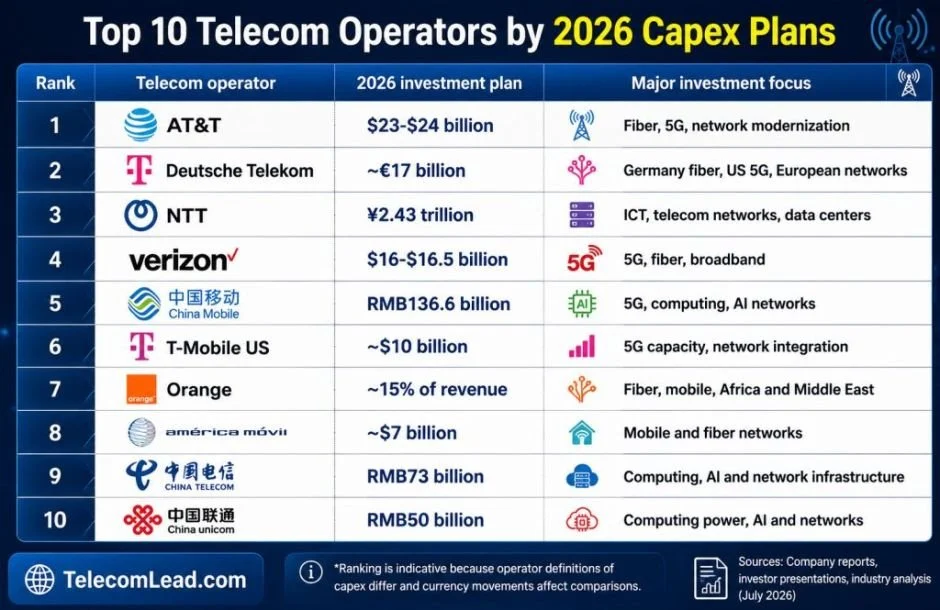
The leading telecommunications giants are already signaling this strategic shift through their projected investment plans. AT&T, for instance, is positioned as one of the world’s largest telecom investors in 2026, with an ambitious annual capital investment forecast of $23 billion to $24 billion. This substantial commitment underscores its dual focus on both fiber expansion and wireless infrastructure modernization. Deutsche Telekom is also a major player, anticipating cash capex of approximately €17 billion, reflecting its continued investment across its European and North American operations.
China Mobile stands out with its plan for RMB136.6 billion in capital expenditure, a figure that, while representing a decrease from previous years, masks a significant internal reallocation. The company is sharply increasing its investment in computing and AI networks, signaling a decisive move towards future-proof infrastructure.
It is crucial to acknowledge the inherent complexities in comparing these figures. Telecom groups often employ different accounting definitions for capital expenditure. AT&T reports "capital investment," while Deutsche Telekom uses "cash capex before spectrum." Orange utilizes "eCAPEX," and several Asian operators consolidate capital investment across a broader range of businesses beyond traditional telecom networks. Currency fluctuations also play a role in international rankings when figures are converted into a common currency like the US dollar. Despite these variations, the overarching trend towards a diversified investment portfolio is undeniable.
Major Players Charting the New Course: Key Investment Figures for 2026
The individual investment strategies of major telecommunications companies paint a vivid picture of this evolving landscape. While overall capex may be moderating in some mature markets, the allocation within these budgets reveals a decisive pivot towards next-generation technologies.
1. AT&T: A U.S. Investment Powerhouse Driving Fiber and Wireless Modernization
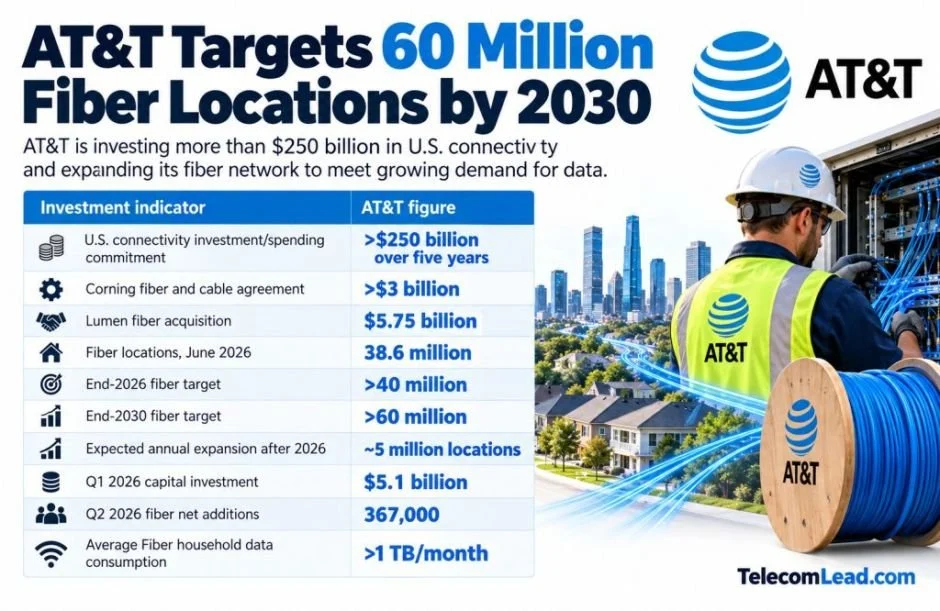
AT&T is poised to be a leading global telecom investor in 2026, projecting an annual capital investment of $23 billion to $24 billion. This substantial commitment, outlined in its 2026-2028 capital investment outlook, reflects a strategic dual-pronged approach: aggressive fiber optic expansion and the ongoing modernization of its wireless infrastructure. The company’s acquisition of Lumen’s mass-market fiber business for $5.75 billion further solidifies its commitment to bolstering its fiber footprint.
This network strategy is part of AT&T’s ambitious $250 billion US connectivity investment commitment through 2030, a broad initiative designed to address escalating connectivity demands and network requirements. In contrast to the broader trend of moderating capex observed by analysts, AT&T is actively increasing its investment, particularly in Fiber-to-the-Premises (FTTP) and 5G network upgrades. This stands in stark contrast to competitors like Verizon, which intends to reduce capex, and T-Mobile US, which expects spending to remain flat or decline. The capital intensity of US telecom was 13.6% in 2025, below the global average of 15.9%, highlighting AT&T’s exceptional investment trajectory within its domestic market.
2. Deutsche Telekom: European Giant Balances Legacy and Innovation
Deutsche Telekom anticipates cash capex of approximately €17 billion for 2026, excluding spectrum investments. This places the European telecommunications behemoth among the world’s foremost network investors. Investment will continue to be strategically deployed across Germany, the United States (through its consolidated T-Mobile US operations), and other key European markets.
The company’s investment strategy is notable for its comprehensive scope, integrating traditional mobile and fiber expansion with significant investments in cloud infrastructure, digital transformation, automation, and core network modernization. While capital expenditure is expected to see a slight decline in 2027 as the heightened investment phase related to the UScellular integration winds down, analyst consensus indicates a steady investment level for Deutsche Telekom over the coming years, with projections around €16.79 billion for FY2026, €16.63 billion for 2027, and €17 billion for 2028.
3. NTT: Japan’s Tech Conglomerate Broadens the Definition of Telecom Capex
Japan’s NTT plans consolidated capital investment of approximately ¥2.43 trillion in FY2026, an increase from ¥2.326 trillion in FY2025. NTT’s investment profile is exceptionally broad, extending beyond the purview of a traditional mobile operator. The group encompasses telecom networks, enterprise ICT infrastructure, a significant data center portfolio, and global technology businesses.
During the first quarter of FY2026 alone, NTT’s capital investment reached ¥511.8 billion, a notable increase from ¥456.5 billion in the same period of the previous fiscal year. This investment is distributed across its various business segments: the Integrated ICT Business accounted for ¥197 billion, Global Solutions for ¥168 billion, Regional Communications for ¥96.6 billion, and other operations, including real estate and energy, for ¥50.1 billion. NTT’s investment strategy clearly illustrates the expanding definition of telecom capex, moving beyond radio access and fiber networks to encompass critical digital infrastructure like data centers and enterprise solutions.
4. Verizon: Disciplined Investment in Capacity and Broadband
Verizon projects capital expenditure of $16 billion to $16.5 billion for 2026. This investment will support its mobile network, 5G capacity enhancements, fiber expansion, and overall broadband strategy, aiming to strengthen its competitive position in both mobile and fixed broadband markets.
Verizon’s capex strategy is marked by a more disciplined approach compared to the peak of its nationwide 5G rollout. This reflects a wider industry trend among mature 5G operators: a shift from broad geographic coverage to a focus on network capacity, robust fiber backhaul, operational efficiency, and revenue monetization. Fixed Wireless Access (FWA) is a particularly strategic component, enabling Verizon to generate additional revenue from its existing spectrum and 5G infrastructure, originally deployed primarily for mobile customers.
5. China Mobile: AI and Computing Drive Future Investment
China Mobile plans capital expenditure of RMB136.6 billion in 2026, a decrease of approximately 9.5% from its 2025 investment of RMB150.9 billion. However, this headline figure belies a significant internal strategic shift. The company is dramatically increasing its investment in computing networks (by 62.4%) and AI networks (by 19.8%). Collectively, computing and AI networks are projected to account for over 37% of its investment across its principal network categories.
By 2025, China Mobile’s intelligent computing capacity had already reached an impressive 92.5 EFLOPS, with computing service revenue approaching RMB90 billion, representing an increase of over 11%. The surge in intelligent computing service revenue, up by a remarkable 279%, underscores the company’s commitment to this burgeoning sector. China Mobile’s strategy serves as a clear testament to the telecom industry’s capex transition, where overall investment may decline, but AI-related infrastructure investment is experiencing dramatic acceleration.
6. T-Mobile US: Maximizing Returns from Established 5G Network
T-Mobile US anticipates approximately $10 billion in cash purchases of property and equipment for 2026, including capitalized interest. Unlike AT&T, much of T-Mobile’s nationwide 5G coverage build-out has been completed. Consequently, its investment focus is shifting towards enhancing network capacity, integrating assets acquired from the UScellular transaction, and maintaining its leading 5G performance advantage.
Despite some upward revisions to its financial guidance following the first quarter of 2026, T-Mobile has maintained its capital expenditure expectation. The company’s focus on generating returns from its existing network investment is further emphasized by its projected postpaid net account additions of 950,000 to 1.05 million and Core Adjusted EBITDA of $37.1 billion to $37.5 billion in 2026.
7. Orange: Strategic Investment in Growth Markets
Orange has set its 2026 eCAPEX target at approximately 15% of revenue. In the first half of 2026, the company spent €3.2 billion, representing 15.2% of its revenue. This investment saw a 2.7% increase, primarily driven by higher spending in Africa and the Middle East. Excluding these dynamic markets, Orange’s eCAPEX declined by 2.4%, representing approximately 14% of revenue.
Orange’s investment strategy encompasses fiber expansion, mobile capacity, 5G deployment, enterprise infrastructure, and the rapid expansion of its networks in Africa and the Middle East. The geographic divergence in investment underscores a key trend: mature European networks may see some infrastructure spending reductions, while markets with robust subscriber and data growth continue to demand significant network expansion.
8. America Movil: Sustained Investment Across Latin America
America Movil is targeting approximately $7 billion in annual capital expenditure through 2028. This investment is set to support its mobile networks, 5G expansion, fiber, and broadband infrastructure across its extensive operations in Latin America. The company’s investor outlook indicates that capex is expected to remain between 14-15% of revenue in 2026 and subsequent years.
America Movil anticipates service revenue to grow at an average of 4-5% annually between 2026 and 2028. For the company, sustained investment across its diverse Latin American markets remains critical, driven by rising mobile data consumption, increasing fiber adoption, and the ongoing expansion of 5G services, all of which necessitate continuous network capacity enhancements.
9. China Telecom: Shifting Towards Computing Infrastructure
China Telecom expects to invest approximately RMB73 billion in 2026, a decrease of 9.2% from RMB80.4 billion in 2025. Similar to China Mobile, China Telecom is reducing conventional telecom network investment while substantially increasing capital allocation towards computing infrastructure. Computing infrastructure is projected to constitute approximately 35% of its total capex in 2026, with investment in computing capacity rising by 26%.
In contrast, network infrastructure investment is expected to decline by 26%, representing around 41% of total capital spending. An additional 24% will be directed towards integrated information services and supporting infrastructure. This strategic shift makes China Telecom another significant example of how telecom capex is transitioning from traditional connectivity towards AI, cloud, and computing infrastructure. The figures demonstrate that while overall capex may be declining, the demand for computing-intensive infrastructure is accelerating.
10. China Unicom: Focus on Computing Power Amidst Declining Capex
China Unicom forecasts approximately RMB50 billion in capital expenditure for 2026, a reduction from RMB54.2 billion in 2025. This continues a multi-year trend of declining capex, which has fallen from RMB74.2 billion in 2022 to RMB54.2 billion in 2025. However, the composition of investment is undergoing a sharp transformation. More than 35% of China Unicom’s 2026 capex will be allocated to computing power, underscoring the strategic importance of AI infrastructure.
In 2025, capex represented approximately 16% of service revenue, a decrease from 23% in 2022. This trajectory highlights how network maturity can free up capital for new infrastructure priorities. Instead of sustaining the high investment levels required during the peak 5G construction phase, China Unicom is increasingly directing resources towards computing and AI platforms.
AI and Computing Emerge as the New Engines of Telecom Capex
The aggregated investment plans for 2026 signal a fundamental and irreversible shift in global telecom investment priorities. The era of a uniform, industry-wide race to achieve nationwide 5G coverage is drawing to a close. Operators in mature 5G markets are now actively reducing conventional wireless spending, reallocating these significant capital resources towards fiber optic networks, the foundational elements of AI computing, scalable cloud infrastructure, extensive data center build-outs, the more advanced capabilities of 5G-Advanced, and the efficiency gains offered by network automation.
This transformation is occurring in parallel with a broader, accelerated surge in AI infrastructure and data center capital expenditure. Hyperscalers and technology companies worldwide are rapidly expanding their computing infrastructure to support the exponential growth of AI workloads.
China provides perhaps the most compelling evidence of this profound transition. China Mobile, while reducing overall capex by 9.5%, is simultaneously increasing its investment in computing networks by a substantial 62.4%. Similarly, China Telecom is cutting total investment by 9.2% but boosting computing infrastructure investment by 26%. China Unicom, despite reducing overall capex, is dedicating over 35% of its spending to computing power. These figures powerfully indicate that declining headline telecom capex does not necessarily translate into diminished demand for technology suppliers. Instead, the addressable market is shifting dramatically, moving from traditional radio-access expansion towards servers, accelerators, advanced optical networking, high-capacity routers, robust data center infrastructure, sophisticated cloud platforms, and AI-enabled network systems.
AT&T’s Divergent Path in the U.S. Market
The United States presents a distinct investment narrative. AT&T’s projected annual capital investment of $23 billion to $24 billion significantly surpasses T-Mobile US’s approximately $10 billion. This disparity is driven by AT&T’s aggressive strategy, which combines aggressive fiber optic expansion with a comprehensive modernization of its wireless network. Verizon, with its planned 2026 capex of $16 billion to $16.5 billion, occupies an intermediate position.
This divergence highlights how operators at different stages of their infrastructure development cycles can adopt vastly different spending strategies, even within the same national market. T-Mobile, having largely completed its nationwide 5G coverage, is now focused on maximizing returns from its established infrastructure. In contrast, AT&T perceives significant opportunities in expanding its fiber footprint while simultaneously upgrading its wireless capabilities.
Implications for Telecom Equipment Vendors: A Shifting Opportunity Landscape
The evolving landscape of telecom capex carries significant implications for equipment vendors. The central message is a nuanced one: while global telecom capex may experience a decline in 2026, the overall investment opportunity is not diminishing; rather, it is transforming. Billions of dollars are being redirected from conventional radio coverage towards fiber optic infrastructure, high-capacity transport networks, advanced IP routing, cloud platforms, data centers, AI computing, and intelligent network solutions.
This transition is likely to broaden the competitive arena. Traditional telecom network suppliers are increasingly finding themselves either competing with or collaborating with companies from the cloud, semiconductor, server, optical networking, and data center technology sectors. As operator infrastructure becomes more computing-intensive, the lines between traditional telecom and adjacent technology domains are blurring.
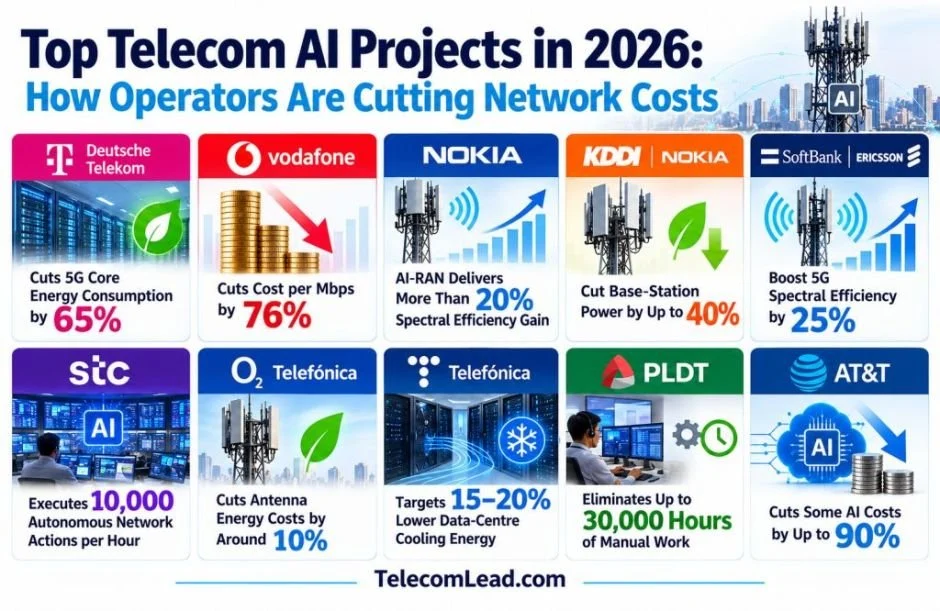
For established players like Ericsson, Nokia, Huawei, and ZTE, continued investment in Radio Access Network (RAN) technologies remains crucial, particularly in developing 5G markets and as 5G-Advanced deployments gain momentum. However, the shifting spending priorities of operators are elevating the importance of automation solutions, core network capabilities, private network deployments, cloud-native platforms, and AI-driven network management systems.
Companies like Cisco and Ciena are well-positioned to benefit from increased demand for IP routing and optical capacity, driven by the escalating traffic demands generated by AI and data center operations. Furthermore, the expansion of telecom computing infrastructure presents new avenues for semiconductor, server, and accelerated computing suppliers.
The most critical takeaway from the 2026 telecom capex plans is not simply that overall spending might be slowing. It is that the very definition of telecom infrastructure investment is undergoing a profound and irreversible transformation. The initial phase of 5G deployment was largely characterized by investments in spectrum, radio equipment, antennas, and coverage expansion. The next investment phase is increasingly centered on seamlessly connecting these networks to the vast potential of fiber optics, the scalability of cloud platforms, the processing power of data centers, and immense pools of computing capacity.
For telecom technology suppliers, understanding where operators are directing their capital expenditure in 2026 will likely prove far more significant than simply tracking whether headline global telecom capex figures are rising or falling. The future of telecom infrastructure is being built, and it is a future deeply intertwined with AI, fiber, and the cloud.