For small-scale manufacturers, the path to enterprise resource planning (ERP) adoption is rarely a sudden strategic decision. It is, more often than not, a survival response to the mounting pressures of scaling a business. A comprehensive study of 70 customer case studies by MRPeasy provides a definitive look into why these organizations move away from manual workflows, the friction they encounter during the transition, and the operational dividends they reap on the other side.
The research spans a diverse cross-section of the manufacturing landscape, including electronics, medical devices, aerospace, precision components, and automotive manufacturing. By examining these diverse sectors, the data highlights a universal truth: the "spreadsheet ceiling" is a common threshold that, when breached, necessitates a move toward more robust, integrated digital infrastructure.
The Anatomy of Operational Friction: Why ERPs Matter
Most small manufacturers do not wake up with a desire to implement complex software; they wake up with a realization that their current systems are failing. The research reveals that the tipping point is usually triggered by a combination of unsustainable administrative burdens and a lack of real-time operational visibility.

The Primary Drivers for Adoption
According to the study, the decision to pivot to an ERP is fueled by five key pain points:
- Lack of Operational Visibility (74%): Business owners and production managers often find themselves "flying blind," unable to track work-in-progress or pinpoint inventory bottlenecks.
- Outgrowing Spreadsheets (54%): The primary tool for many startups, spreadsheets eventually become data silos that are prone to human error and difficult to scale.
- Administrative Burden (52%): Manual data entry and cross-referencing between disparate tools consume valuable hours that could be better spent on core manufacturing tasks.
- Disconnected Toolsets (37%): Managing inventory in one application, accounting in another, and production schedules on a whiteboard creates massive inefficiencies.
- Lead Time Instability (35%): Inconsistent tracking leads to missed deadlines and a damaged reputation with clients.
As Andy Nancollis, Co-founder and Chief Design Officer at Motion Impossible, a UK-based camera dolly manufacturer, noted: “We needed a better way to handle it. The complexity of our new product compared to the older models was simply overwhelming for a spreadsheet-based system.”
Chronology of the Transition: From Chaos to Control
The lifecycle of an ERP implementation in the small-manufacturing sector typically follows a predictable trajectory. Before reaching out to vendors, most companies rely on a "Frankenstein’s monster" of legacy tools: accounting software combined with Excel, paper-based tracking, or proprietary databases that only one person in the office understands.

Phase 1: The Breaking Point
The transition begins when manual management can no longer keep pace with order volume or product complexity. At this stage, the manufacturer experiences "operational chaos," where inventory discrepancies lead to production stalls and late deliveries.
Phase 2: Selection and Data Preparation
The research indicates that the most significant barrier to a successful launch is not the software’s technical architecture, but the state of the company’s internal data. Successful implementations require rigorous cleaning of Bills of Materials (BOMs), customer databases, and inventory records before the migration begins.
Phase 3: Go-Live and Optimization
Post-implementation, the benefits begin to manifest. It is rarely an overnight fix; rather, it is a gradual alignment of team processes with the new system. As teams become more proficient, they begin to leverage the ERP not just for data storage, but for strategic decision-making.

Supporting Data: Quantifying the Impact
The study provides granular insights into the tangible outcomes of ERP adoption. While the primary drivers are reactive—solving existing problems—the results are overwhelmingly proactive, leading to significant growth and efficiency.
Key Performance Benefits
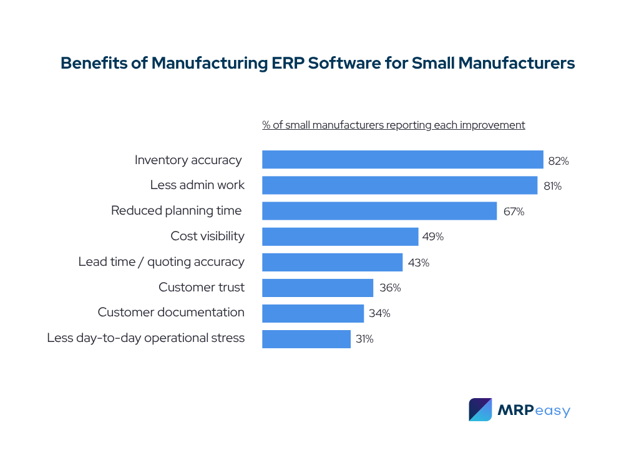
- Customer Trust: 36% of manufacturers reported an increase in client trust, directly linked to better communication and improved documentation.
- Administrative Efficiency: Companies noted a massive reduction in the time spent on manual data entry, allowing for scaling without a corresponding increase in overhead.
- Strategic Scalability: The ability to grow revenue while keeping administrative headcount stable was a recurring theme. Chris Landen, Managing Director at Exacta Technologies, reported that his company achieved over 100% revenue growth and tripled their employee count—from 25 to 70—without needing to proportionally scale their administrative burden, thanks to the efficiency gained through their ERP system.
Implementation Hurdles: The Reality of Digital Transformation
Despite the clear benefits, moving away from legacy systems is not without challenges. The research highlights the most common obstacles faced by small manufacturers during the implementation phase:
- Data Preparation (35%): The most significant hurdle. Many companies find that their existing data is messy, incomplete, or incorrectly formatted for a modern database.
- Change Management (27%): Employees who have been using the same manual processes for years often resist new workflows.
- Resource Constraints (20%): Small teams often struggle to dedicate the necessary time to learn a new system while simultaneously running day-to-day production.
- Defining Processes (18%): The implementation process often forces a company to standardize workflows they had previously left informal, which can be an uncomfortable, though necessary, evolution.
Interestingly, technical issues such as integration with existing hardware or software were cited by only 4.3% of respondents, suggesting that the "hard" technology is rarely the problem—the "soft" challenges of human behavior and data hygiene are the real gatekeepers.

Implementation Timelines: Breaking the "Oracle Myth"
A common deterrent for small businesses considering an ERP is the fear of long, expensive, and disruptive implementation cycles often associated with enterprise-tier giants like SAP or Oracle. However, the study paints a different picture for modern, cloud-based ERP solutions.
The median implementation times found in the research include:
- Micro-Manufacturers: Often deploy in under two weeks.
- Mid-sized Small Manufacturers: Typically complete the transition in 1–3 months.
- Complex/Larger Small Manufacturers: May require 3–6 months for deep process alignment and data migration.
Jonathan Greenwald, VP of Operations and Manufacturing at KCL Manufacturing, noted that his team was able to go live in just two weeks with zero external handholding, proving that the barrier to entry has lowered significantly for the modern, cloud-native firm.

Implications for the Future of Manufacturing
The implications of this research are clear: digital transformation is no longer a luxury reserved for multinational corporations. For small manufacturers, it is a prerequisite for long-term survival in an increasingly complex global supply chain.
The Shift Toward "Adaptive" ERPs
The findings suggest that the future of ERP for small manufacturers lies in flexibility. Manufacturers are looking for systems that "grow with them." As noted by Stephen Plumridge of Cantium Scientific, the value of a system is found in its iterative potential: "We’ve grown with it, and it’s grown with us. Realizing what we can do with it, we’ve put more and more into the system."
Strategic Takeaways for Business Leaders
- Don’t wait for a crisis: Proactive adoption of an ERP before a company hits its breaking point can prevent the loss of customer trust and market share.
- Clean your data now: The biggest obstacle to implementation is the quality of existing data. Even before choosing a vendor, companies should begin auditing their spreadsheets and inventory records.
- Focus on culture: The technology is the easy part. The hardest part is convincing the shop floor and administrative staff to embrace a new way of working. Leadership must prioritize change management as much as technical integration.
- Prioritize scalability over feature bloat: Small manufacturers should avoid overly complex enterprise systems that require dedicated IT teams. Instead, look for modular, cloud-based solutions that offer immediate visibility and room for future expansion.
In conclusion, the research into 70 manufacturing case studies serves as a roadmap for small businesses. By moving away from the chaos of spreadsheets and toward structured, integrated systems, manufacturers are not just solving today’s headaches—they are building the infrastructure required to scale, innovate, and compete in a modern, data-driven industrial economy. The transition is undeniably challenging, but as the data shows, the rewards of operational clarity and long-term scalability make it an essential evolution for the modern manufacturer.