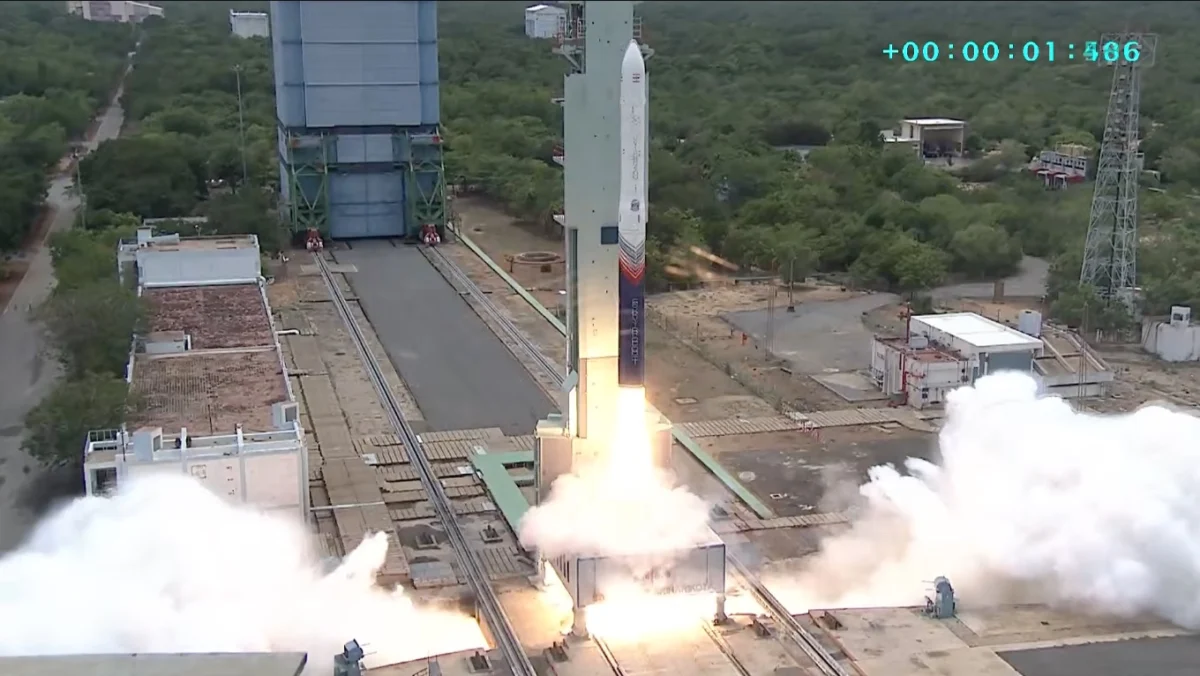
SRIHARIKOTA, India — In a milestone that fundamentally redefines the landscape of global commercial spaceflight, Skyroot Aerospace’s Vikram-1 rocket successfully lifted off on its inaugural flight on July 18, becoming the first privately developed Indian launch vehicle to successfully reach Earth orbit.
The landmark flight, designated "Mission Aagaman" (derived from the Sanskrit word for "arrival"), represents a paradigm shift for India’s domestic aerospace ecosystem. Historically, orbital launches from Indian soil were the exclusive domain of the state-run Indian Space Research Organisation (ISRO). With Vikram-1’s successful orbital insertion on its very first attempt, Skyroot Aerospace has not only broken this state monopoly but has also established India as a competitive hub for low-cost, commercial small-satellite launch services.
Chronology of Mission Aagaman
The path to orbit for Vikram-1 was marked by rigorous engineering milestones, a tense countdown, and a near-flawless ascent through the upper atmosphere.
The launch sequence began in the early morning hours of July 18 at the Satish Dhawan Space Centre (SDSC), India’s premier spaceport located on the barrier island of Sriharikota. The launch window was briefly threatened when, at the T-minus 5-minute mark, ground controllers detected a minor technical anomaly in the launch pad’s support systems, triggering an automatic hold.
Skyroot’s engineering team quickly resolved the issue, resuming the countdown after a 35-minute delay. At 2:35 a.m. Eastern, the flight control team gave the final "go" for launch.
Ascent and Stage Separation
Upon ignition, Vikram-1’s first-stage solid motor generated maximum thrust, lifting the rocket off the pad into the night sky. The vehicle maintained a highly stable trajectory, closely matching its pre-flight simulated path.
The rocket’s three solid-fuel stages fired in rapid succession:
The first stage provided the initial high-thrust impulse required to clear the dense lower atmosphere.
Following first-stage burnout and separation, the second and third solid stages ignited sequentially, continuously accelerating the vehicle and steering it toward its target inclination.
During the third-stage burn, the payload fairing was successfully jettisoned, exposing the payloads to the vacuum of space.
Orbital Insertion and Payload Deployment
After the depletion of the third solid stage, the rocket deployed its liquid-propellant kick stage, known as the Orbit Adjustment Module (OAM). Unlike solid motors, which burn continuously until fuel exhaustion, the OAM utilizes liquid propellants to allow for precise throttle control and restart capabilities.
The OAM fired its engines for approximately six minutes, executing the delicate orbital insertion maneuvers required to circularize the trajectory. Exactly 15 minutes after lifting off from Sriharikota, Skyroot officials confirmed that the upper stage had successfully entered its targeted 450-kilometer low Earth orbit (LEO), marking the formal completion of the launch phase.
Technical Architecture and Payload Profile
The success of Vikram-1 is rooted in its hybrid propulsion design, which balances the cost-efficiency of solid propellants with the orbital precision of liquid-propellant systems.
Vikram-1 is a multi-stage launch vehicle designed specifically to cater to the burgeoning small-satellite market. The first three stages utilize solid propellants, which are highly stable, require minimal launch pad infrastructure, and can be manufactured and stored at a lower cost than cryogenic or liquid-oxygen systems.
To overcome the lack of throttleability inherent in solid rockets, Skyroot integrated the liquid-fueled OAM as the final stage. This module acts as an orbital "bus," capable of performing multi-orbit insertions, correcting orbital deviations, and deploying multiple satellites into highly customized orbits.
Currently, Vikram-1 is rated to deliver up to 350 kilograms of payload into LEO. Skyroot is already developing an upgraded variant, designated Vikram-1U. This enhanced version will feature strap-on solid boosters, increasing the rocket’s overall lift capacity to 550 kilograms.
Mission Aagaman Payload Manifesto
As an inaugural demonstration flight, Mission Aagaman carried a diverse manifest of operational satellites, technology demonstrations, and symbolic cargo:
Primary Cubesats: The flight deployed two primary cubesats. The first was developed in-house by Skyroot to monitor vehicle telemetry and structural dynamics. The second was designed by Grahaa Space, an emerging Indian space-tech startup specializing in high-resolution, near-real-time earth observation.
Hosted Payloads: The vehicle carried hosted payloads from German space-structure specialist Dcubed and Indian aerospace firm Cosmoserve Space, designed to test novel materials and communication systems in the space environment.
Symbolic Cargo: In a nod to national pride and public engagement, the rocket also carried a collection of physical postcards signed by thousands of citizens across India, including a commemorative postcard signed by Indian Prime Minister Narendra Modi.
Corporate Financing and Scalability
To support the development of its launch architecture, Skyroot Aerospace secured a massive $60 million funding round in May. This capital injection was earmarked to transition the company from a research-and-development startup into a commercial launch provider.
The funds are currently being utilized to scale up the serial production of the Vikram-1 rocket, build out dedicated manufacturing facilities, and accelerate the development of Vikram-2—a larger, medium-lift launch vehicle designed to carry significantly heavier payloads to a variety of orbital inclinations.
Official Reactions and Political Backing
The successful launch of Vikram-1 triggered widespread celebrations within the Indian aerospace community, drawing immediate praise from the highest levels of government.
Immediately following the confirmation of orbital insertion, Skyroot co-founders Pawan Kumar Chandana and Naga Bharath Daka took a direct congratulatory telephone call from Prime Minister Narendra Modi.
In an emotional address from the launch site, Pawan Kumar Chandana, CEO of Skyroot, expressed his gratitude and awe:
"Absolutely no words. I think this is a historic moment not just for Skyroot but also for India and the entire global space sector. In the first attempt reaching orbit, I never thought it was possible, but the Skyroot team made it possible. India is proud to be the fastest-growing space tech ecosystem in the world, and now we achieved one of the biggest milestones ever in India’s space sector: the first private orbital rocket reaching orbit on the very first attempt. It still feels like a dream."
Before the launch, Chandana had maintained a cautious public stance, acknowledging the historically high failure rates of maiden rocket flights, which often hover around 50% for new aerospace startups. "We have done everything that could be done to test Vikram-1 on the ground," Chandana had stated prior to liftoff. "This is our first test flight, and we will be getting valuable data from it." The flawless execution of the flight exceeded even the company’s internal expectations.
State Support and Inter-Agency Collaboration
Chandana highly praised the collaborative efforts of ISRO and the Indian National Space Promotion and Authorization Center (IN-SPACe). Under recent federal mandates, ISRO has transitioned from being India’s sole launch provider to an active facilitator for private enterprises, granting Skyroot access to its world-class launch pads, tracking stations, and testing facilities at Sriharikota.
IN-SPACe, acting as the single-window regulatory clearance agency, was instrumental in streamlining the licensing, safety reviews, and airspace coordination required to authorize the flight. This close cooperation between public infrastructure and private enterprise is viewed as a model for future commercial aerospace initiatives in developing nations.
Strategic Implications for the Global Space Market
The success of Vikram-1 has profound implications that extend far beyond India’s borders, signaling a shift in the global supply chain for small-satellite launches.
Demystifying the First-Flight Success
Historically, reaching orbit on a debut flight is an incredibly rare achievement in the aerospace industry. Pioneering commercial companies like SpaceX, Rocket Lab, and Astra all suffered launch failures during their initial orbital attempts.
By achieving orbit on its first try, Skyroot has demonstrated the maturity of its engineering processes and validated the efficacy of using solid-propellant stages for rapid, reliable development. This success is expected to bolster investor confidence in India’s private space sector, paving the way for increased venture capital inflows.
India’s Regulatory Evolution and Commercial Competitiveness
The launch of Vikram-1 is the direct fruit of the Indian government’s 2020 space sector reforms. By deregulating the industry and allowing private entities to own, operate, and launch space systems, India has rapidly positioned itself as a low-cost alternative to Western launch providers.
Launch Provider
Vehicle Class
Country
Primary Propulsion Type
Status
Skyroot Aerospace
Vikram-1
India
Solid (Stages 1-3) / Liquid (OAM)
Operational (100% Success)
Rocket Lab
Electron
USA / NZ
Liquid (LOX / Kerosene)
Operational
Galactic Energy
Ceres-1
China
Solid (Stages 1-3) / Liquid (Upper)
Operational
Firefly Aerospace
Alpha
USA
Liquid (LOX / Kerosene)
Operational
With Vikram-1, India can now offer highly competitive pricing for dedicated small-satellite launches, directly challenging established players in the United States, Europe, and China. Skyroot’s access to highly skilled, cost-efficient engineering talent in Hyderabad—often referred to as India’s "Cyberabad" tech hub—gives it a distinct structural cost advantage over Western competitors.
The Road Ahead for Skyroot
With the historic first flight completed, Skyroot is turning its attention to establishing a reliable launch cadence. During a presentation at the Spacetide conference earlier this month, Ashwin Mahavadi, Senior Vice President for Business and Strategy at Skyroot, revealed that the company plans to conduct up to two more Vikram-1 launches before the end of the year.
These upcoming flights will serve to further validate the rocket’s systems, test different orbital inclinations, and begin clearing a growing backlog of commercial customer payloads. As Skyroot transitions into high-rate production, the global space community will be watching closely to see if the company can convert this historic technical triumph into a sustainable, highly profitable commercial launch enterprise.