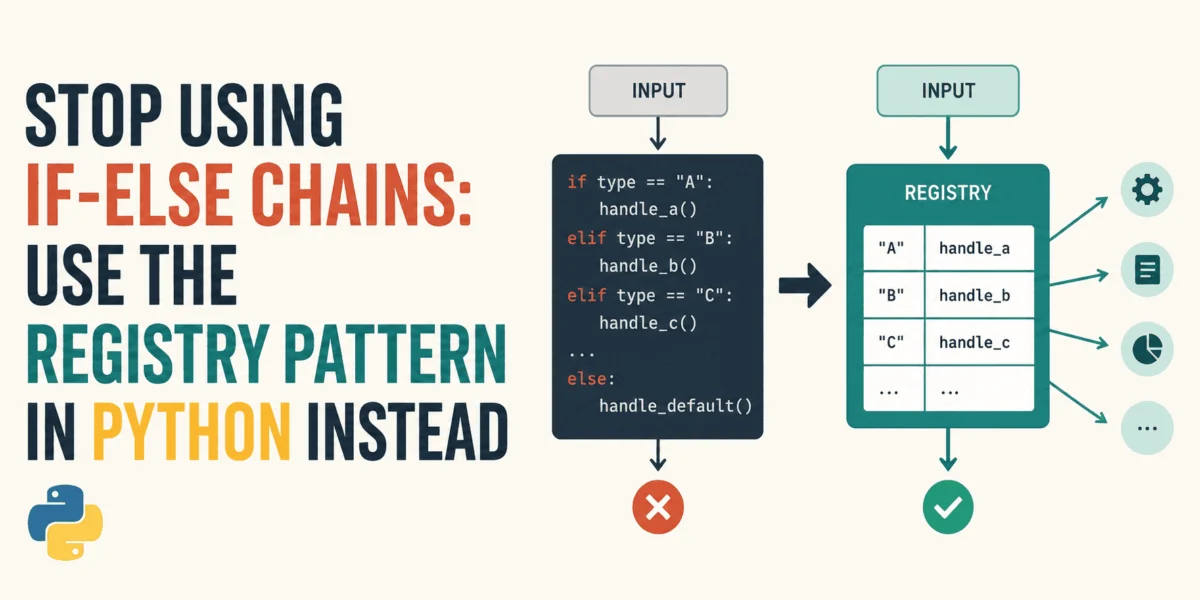
In the lifecycle of every professional software project, there comes a tipping point. It often starts innocently: a simple get_model function with two conditional branches. A year later, that same function has metastasized into a sprawling, 200-line monolith of if/elif/else statements. This "ladder" of logic is a notorious bottleneck, frustrating developers and creating a maintenance nightmare.
However, there is a structural remedy that transforms rigid codebases into flexible, plugin-ready architectures: the Registry Pattern. By shifting the responsibility of registration from a central dispatcher to the individual components themselves, developers can adhere to the Open/Closed Principle, ensuring code is open for extension but closed for modification.
The Anatomy of the Problem: Why If-Else Chains Fail
The traditional conditional chain is a common anti-pattern that creates technical debt through four primary failure modes:
- Violation of the Open/Closed Principle: Every time a new feature is added, you must reopen and modify the core dispatcher. This increases the risk of introducing regression bugs into previously stable logic.
- Increased Cognitive Load: Long, linear chains force developers to scroll through hundreds of lines of irrelevant logic to find the one case they care about.
- Tight Coupling: The dispatcher must know about every single implementation, creating a circular dependency loop where the core module is intimately aware of all its peripheral plugins.
- Merge Conflict Magnets: In collaborative environments, multiple developers working on different features will inevitably conflict in the same dispatcher file, leading to tedious and error-prone merge resolution processes.
The Registry Pattern resolves these issues by flipping the architecture. Instead of the "dispatcher" knowing about every option, each option "announces" itself to the registry.
A Chronology of Evolution: From Simple Dicts to Professional Registries
The journey to architectural maturity follows a predictable path. Understanding this evolution helps developers choose the right tool for their current project constraints.
Phase 1: The Dictionary Lookup
The first step away from procedural logic is the humble Python dictionary. By mapping strings to classes or functions, you eliminate the need for a linear scan. The lookup becomes $O(1)$, and the logic is significantly cleaner:
MODEL_REGISTRY =
    "logreg": LogisticRegression,
    "random_forest": RandomForestClassifier,
    "svm": SVC,

# Dispatch is now an instantaneous key-lookup.
While effective, this still requires manual maintenance of the dictionary—a "hand-maintained" registry that still requires editing a central file every time a new model is introduced.
Phase 2: The Decorator Pattern
To truly decouple the system, we move to a decorator-based approach. By defining a simple register function, we allow developers to "tag" new components right where they are defined. This means that a new payment handler can be added in a separate file, imported, and registered without ever touching the core payment_processor.py file.
Phase 3: The Reusable Registry Class
As the complexity of a system grows, so does the need for robustness. A dedicated Registry class provides collision detection (preventing two plugins from using the same key), organized storage, and standardized error messages. This transforms the registry into a first-class citizen of the application framework.
Supporting Data: When the Registry Pays Dividends
The utility of the Registry Pattern is most visible in systems where behavior is determined by data rather than hard-coded logic. Consider a text-processing pipeline:
pipeline = ["strip", "lowercase", "remove_digits"]
# The program logic is now data-driven, defined by a config file.
In this scenario, the registry allows the application to behave as a configuration-driven engine. You could, for instance, load the pipeline list from a YAML file, a database entry, or a CLI argument. This allows for dynamic orchestration of complex tasks without recompiling or modifying the underlying codebase.
Performance Implications
From a performance perspective, registry lookups are significantly faster than long conditional chains. While a small number of if/else statements are negligible, as the chain grows to dozens of branches, the Python interpreter must evaluate every condition sequentially. A dictionary lookup, however, uses hash-table optimization, maintaining constant time performance regardless of how many items are added to the registry.
Advanced Implementation: Auto-Registration with __init_subclass__
For object-oriented Python developers, there is an even more elegant solution: the __init_subclass__ magic method. Introduced in Python 3.6, this hook fires automatically whenever a class is subclassed.
This eliminates the need for decorators entirely. By defining a base class with a registry and an __init_subclass__ method, you can force every subclass to register itself upon definition. This is how many modern Python frameworks, including ORMs and API routers, manage plugins. It provides a "zero-boilerplate" experience for the end user of your library.
Implications for System Design
Adopting the Registry Pattern is more than just a stylistic choice; it is an architectural commitment to scalability.
Plugin Architectures
The Registry Pattern is the backbone of "Plugin-based" design. It allows developers to ship core software that can be extended by third-party contributors without those contributors having access to the core source code. By providing a Registry interface, you allow external modules to register their own implementations at runtime.
Testability
Testing a long if/else chain requires testing every possible path through the dispatcher. With a registry, you can test each component in isolation. You can also mock the registry itself during testing, allowing you to swap out real components for test-doubles without changing the dispatcher’s logic.
Official Perspectives: Best Practices and Caveats
While the Registry Pattern is powerful, it is not a silver bullet. Seasoned engineers emphasize several critical "watch-outs":
- Import Side-Effects: If you use module-level registration, be aware that the registration only occurs if the module is imported. If you have a large library, you may need to ensure your plugins are properly imported during the application’s initialization phase.
- Initialization Timing: Ensure that your registry is fully populated before your application starts processing data. Race conditions can occur if a component attempts to access a registry entry before the plugin defining that entry has been loaded.
- Over-Engineering: Do not replace a two-branch
ifstatement with a complex registry class. The goal is to improve maintainability; adding unnecessary complexity to trivial logic is a violation of the "Keep It Simple" principle. - Documentation: A registry is a "hidden" dependency. Because registration happens behind the scenes via decorators or subclasses, it can be difficult for a new developer to see the "whole picture." Comprehensive documentation and clear registry naming are essential.
Conclusion: The Path Forward
The transition from a "ladder" of conditional statements to a registry-based architecture represents a maturation in a developer’s approach to system design. By trading short-term convenience for long-term flexibility, you create software that is not only easier to maintain but also easier to evolve.
The next time you find yourself staring at a growing if/elif block, pause. Ask yourself: Does this dispatcher really need to know about every single case? If the answer is no, the Registry Pattern is waiting to help you build a cleaner, faster, and more modular system. Your future self—and your teammates—will thank you for the foresight.
Quick Reference: The Registry Checklist
- When to use: When you have >3 branches or when features need to be added by different teams/modules.
- When to avoid: When the logic is simple, static, and unlikely to change.
- Key Benefit: Decouples core logic from feature implementation.
- Best Tool: Use
__init_subclass__for class-based hierarchies and custom Decorators for functional pipelines.