
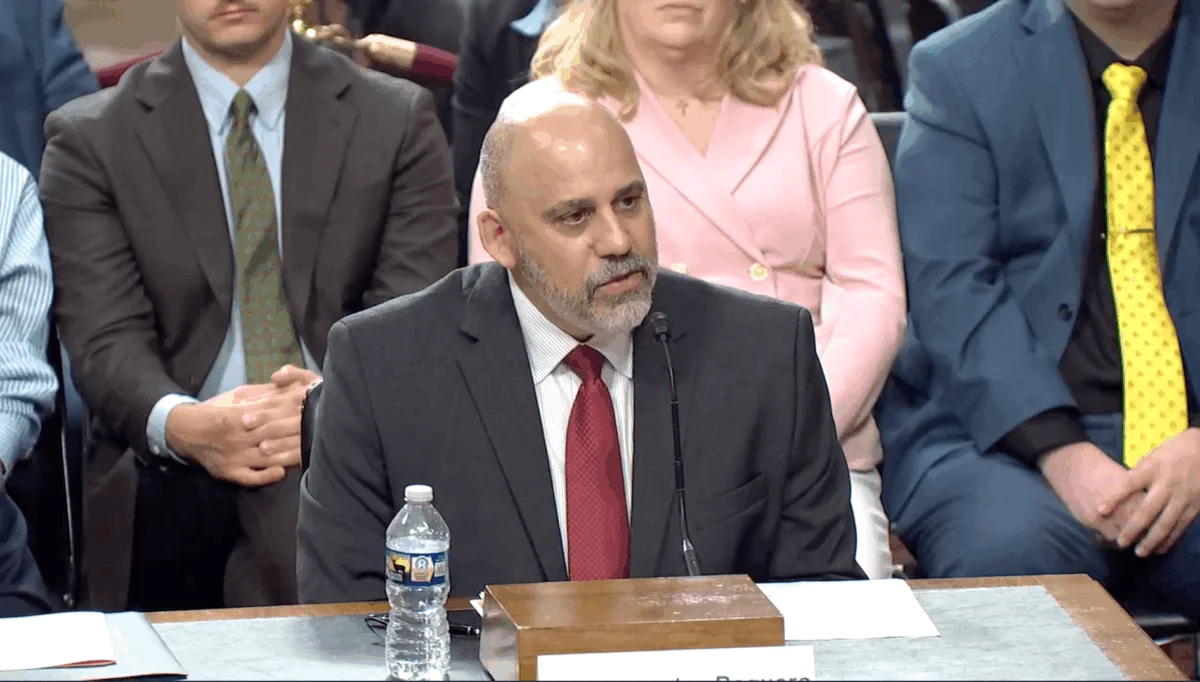
WASHINGTON — In a move that reshapes the leadership of the United States’ national security space apparatus, the U.S. Senate has confirmed two defense industry veterans to steer the nation’s military space acquisition and intelligence satellite programs.
On August 7, the Senate voted 51–47 to confirm Erich Hernandez-Baquero as the Assistant Secretary of the Air Force for Space Acquisition and Integration, and Roger Mason as the Director of the National Reconnaissance Office (NRO). The confirmations occurred just one day after the Senate approved General Douglas Schiess to serve as a four-star general and the next Chief of Space Operations for the U.S. Space Force.
Together, these three appointments establish a new leadership triad across the organizations responsible for defining military space requirements, acquiring next-generation orbital systems, and operating the nation’s highly classified intelligence satellite constellations. This leadership transition arrives at a critical juncture, as the Department of Defense seeks a record-high space budget and aggressively overhauls how it purchases, deploys, and defends assets in Earth orbit amid rising geopolitical competition.
Main Facts: A Triad of New National Security Space Leaders
The confirmations inject deep private-sector and military experience into the upper echelons of the Pentagon’s space hierarchy. The newly confirmed officials will oversee a combined budget of tens of billions of dollars dedicated to securing the high ground of space.
Erich Hernandez-Baquero: Space Force Acquisition Chief
As the Assistant Secretary of the Air Force for Space Acquisition and Integration, Hernandez-Baquero is now the senior civilian official overseeing the Space Force’s sprawling procurement enterprise. He succeeds Frank Calvelli, who vacated the position in January 2025. Hernandez-Baquero, a retired U.S. Air Force colonel, transitions to the Pentagon from Raytheon, where he served as Vice President for Space Intelligence, Surveillance, and Reconnaissance (ISR). His career also includes senior leadership roles within the NRO, where he managed command-and-control and data-processing ground systems.
Roger Mason: Director of the National Reconnaissance Office
Roger Mason takes the helm of the NRO, the agency responsible for designing, building, launching, and operating America’s spy satellites. Mason succeeds Dr. Christopher Scolese, who stepped down on July 10 after a seven-year tenure. Mason’s background bridges the intelligence community and defense industry; he most recently served as Chief Growth Officer at V2X and previously led Peraton’s space and intelligence business. He also served as the first Assistant Director of National Intelligence for Systems and Resource Analyses.
General Douglas Schiess: Chief of Space Operations
Confirmed on August 6, General Schiess succeeds Gen. B. Chance Saltzman as the top military officer of the Space Force. Schiess will work in tandem with Hernandez-Baquero to align military requirements with acquisition pipelines, ensuring that the Space Force can defend against emerging counterspace threats from adversaries like China and Russia.
Chronology of the Leadership Transition
The confirmation of these three leaders represents the culmination of a multi-month legislative and administrative process designed to fill critical vacancies before the congressional summer recess.
[July 10] ----------------> [Mid-July] --------------> [August 6] --------------> [August 7]
Christopher Scolese         Nominee Hearings          Gen. Douglas Schiess       Senate Votes 51-47
departs NRO after           before Senate Armed       confirmed as Chief of      to confirm civilian
seven years as Director. Services Committee. Space Operations. space nominees.- January 2025: Frank Calvelli departs as Assistant Secretary of the Air Force for Space Acquisition and Integration, leaving the office to be run by acting officials during a period of major organizational restructuring.
- July 10: Dr. Christopher Scolese formally steps down as NRO Director after nearly seven years of service, triggering an interim leadership structure.
- Mid-July: The Senate Armed Services Committee (SASC) conducts confirmation hearings for Hernandez-Baquero and Mason, questioning them on acquisition bottlenecks, supply chain resilience, and commercial integration.
- August 6: The Senate confirms General Douglas Schiess to the rank of general and appoints him as the next Chief of Space Operations.
- August 7: In a tight 51–47 vote, the Senate approves a broader slate of civilian nominees, officially confirming Hernandez-Baquero and Mason to their respective posts.
Supporting Data: Budgets, Restructuring, and Orbital Architectures
The incoming leadership team inherits an acquisition and operational environment undergoing its most significant evolution since the Cold War. This shift is driven by massive budget requests and a fundamental redesign of satellite architectures.

The $71.1 Billion Fiscal Year 2027 Budget Request
Hernandez-Baquero takes office as the Space Force prepares to defend a record $71.1 billion budget request for Fiscal Year 2027. This funding is heavily weighted toward Research, Development, Test, and Evaluation (RDT&E) as the service transitions from legacy, vulnerable geosynchronous satellites to proliferated constellations in Low Earth Orbit (LEO).
| Budget Category | Focus Areas | Key Programs |
|---|---|---|
| Space Acquisition | Proliferated LEO Architectures | PWSA (Prototyping & Integration), Tracking Layer |
| Resilient SatCom | Protected Tactical & Wideband | Evolved Strategic SATCOM (ESS), PTS |
| Missile Warning | Multi-orbit tracking networks | Resilient Missile Warning/Tracking LEO/MEO |
Reorganization: The Portfolio Acquisition Executive (PAE) Model
During the vacancy following Calvelli’s departure, the Space Force began dismantling its traditional Program Executive Office (PEO) model, which organized acquisition around individual programs (e.g., specific satellite lines).
Under the newly implemented Portfolio Acquisition Executive (PAE) model, programs are consolidated into broader, mission-focused portfolios. This structure is designed to push decision-making authority closer to program managers and speed up the delivery of integrated capabilities.
[Old Model: Program Executive Offices]
     ├── Program A (Satellite) ──> Stovepiped Development
     └── Program B (Ground System) ──> Stovepiped Development

[New Model: Portfolio Acquisition Executives (PAEs)]
     └── Unified Mission Portfolio (Space + Ground + User Terminals) ──> Integrated Delivery
The NRO’s Proliferated Architecture Shift
The NRO is in the midst of a historic architectural transition. Historically reliant on a small number of extremely expensive, highly capable "exquisite" satellites, the agency is now deploying a proliferated constellation consisting of hundreds of smaller, lower-cost satellites. This hybrid architecture aims to dramatically increase revisit rates (how often a satellite passes over a specific target) and ensure system survivability; if an adversary disables a single satellite, the broader constellation remains operational.
Official Responses and Policy Priorities
During their respective confirmation hearings before the Senate Armed Services Committee, both Hernandez-Baquero and Mason outlined their visions for navigating these organizational and technological shifts.
Erich Hernandez-Baquero on Acquisition Reform
In his testimony, Hernandez-Baquero emphasized that his performance should be judged by the delivery of combat-ready capabilities rather than individual hardware milestones.
"Our acquisition structure must be judged not by whether we deliver a satellite on time, or a ground station on time, but by whether we deliver integrated capabilities to military operators when they need them. We must bridge the gap between space assets, ground networks, and user terminals to provide seamless, resilient data to the warfighter."
Hernandez-Baquero identified three primary pillars for his tenure:
- Acquisition Reform: Accelerating the transition to the PAE model and cutting bureaucratic red tape.
- Mission Integration: Ensuring Space Force systems are fully integrated with joint force networks and allied capabilities.
- Workforce Development: Rebuilding and upskilling the civilian and military acquisition workforce to manage complex software-defined systems.
Roger Mason on NRO Resilience and Commercial Partnerships
Mason focused on the need to maintain the United States’ intelligence edge through rapid technological adoption and closer collaboration with the commercial space sector.

"The threat environment in space has changed dramatically. To maintain our decision advantage, the NRO must accelerate the deployment of our proliferated architecture, integrate cutting-edge commercial capabilities, and ensure that our entire enterprise—from the spacecraft in orbit to the ground networks processing the data—is resilient against intentional interference."
Mason committed to:
- Speeding up the integration of commercial synthetic aperture radar (SAR) and electro-optical imagery into NRO workflows.
- Enhancing the cybersecurity and physical resilience of ground stations.
- Fostering closer operational ties between the NRO and the U.S. Space Command to streamline intelligence sharing during potential conflicts.
Implications for the National Security Space Enterprise
The confirmation of Hernandez-Baquero and Mason will have immediate and long-term implications for defense contractors, military operations, and international space competition.
Impact on the Defense Industrial Base
With two industry veterans at the helm, defense contractors can expect a push for shorter development timelines and a preference for fixed-price, deliverable-focused contracts. Hernandez-Baquero’s background at Raytheon and Mason’s tenure at Peraton and V2X give them a realistic understanding of defense aerospace profit margins, supply chain bottlenecks, and software development challenges.
Contractors will likely face increased pressure to deliver modular, open-architecture systems that can be easily upgraded over time, rather than proprietary, closed-loop systems that lock the government into long-term sustainment contracts.
Countering Adversary Capabilities in Orbit
The leadership refresh comes as China and Russia rapidly expand their counterspace capabilities, including ground-based anti-satellite (ASAT) missiles, orbiting interceptors, electronic jamming systems, and cyber weapons.
By prioritizing proliferated architectures and mission-focused integration, Hernandez-Baquero and Mason aim to render adversary counterspace weapons economically and operationally ineffective. A proliferated LEO network consisting of hundreds of interconnected nodes is a far less attractive—and far more difficult—target than a handful of multibillion-dollar legacy satellites.
Streamlining the Space Force-NRO Relationship
Historically, relations between the military Space Force and the intelligence-focused NRO have occasionally suffered from bureaucratic friction over mission overlap, funding priorities, and data sharing. The synchronized arrival of Mason, Hernandez-Baquero, and General Schiess presents a unique opportunity to build a more unified national security space apparatus.
With Hernandez-Baquero’s prior experience inside the NRO and Mason’s background in national intelligence resource analysis, both leaders are well-positioned to dismantle legacy organizational silos. This alignment will be crucial as the two organizations increasingly share launch services, ground stations, and orbital tracking data to support tactical military operations on Earth.