
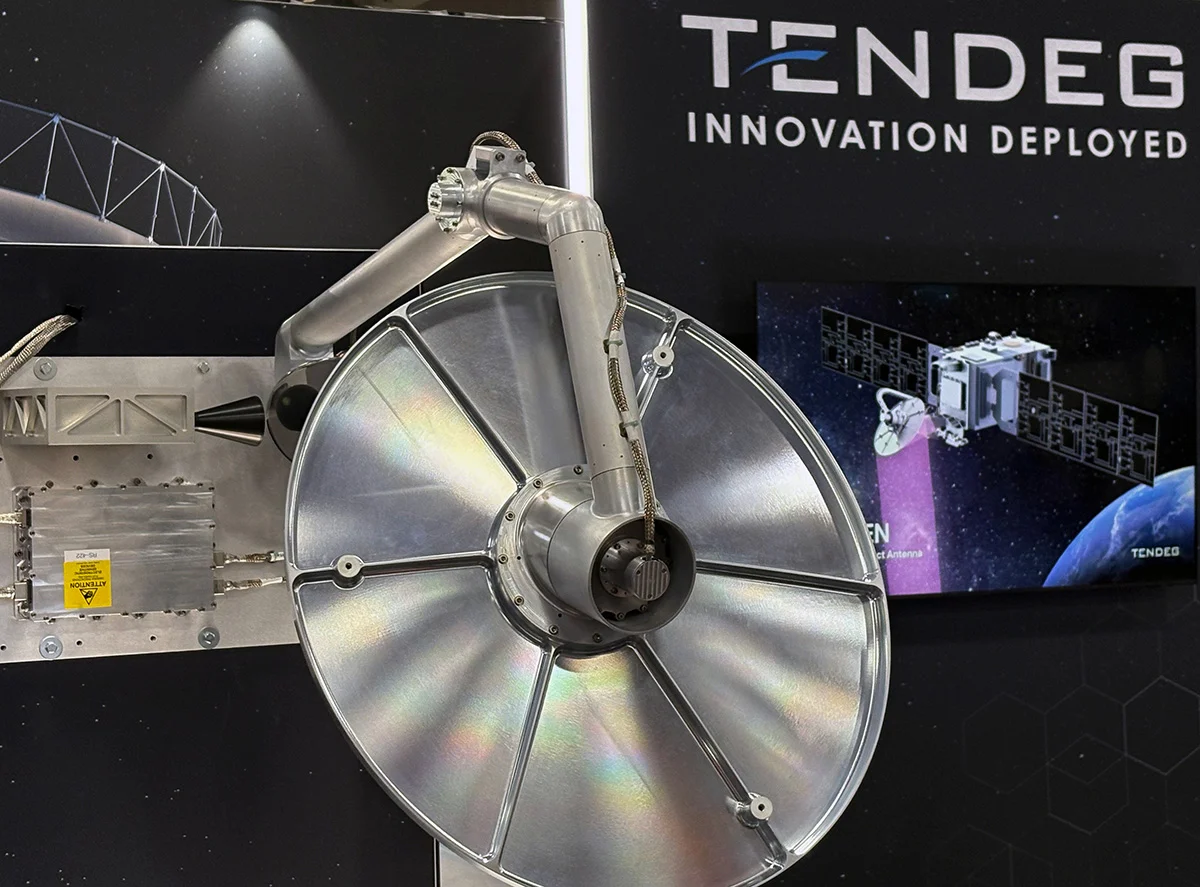
SALT LAKE CITY — August 25, 2026 — At the 40th Annual Small Satellite Conference, aerospace hardware manufacturer Tendeg officially announced the launch of NewTEN, a high-performance, two-axis steerable reflector antenna. Designed to address the strict physical and operational constraints of modern small satellites, the NewTEN antenna offers an advanced solution for spacecraft requiring high-data-rate communications, precise pointing capabilities, and rapid, scalable production.
The unveiling, which took place during the opening days of the premier industry conference in Salt Lake City, highlights a major shift in satellite component manufacturing. As the aerospace sector transitions from bespoke, custom-engineered spacecraft toward massive, proliferated constellations in Low Earth Orbit (LEO) and Medium Earth Orbit (MEO), the demand for standardized, high-rate production hardware has reached an all-time high. Tendeg’s NewTEN is positioned to meet this demand, offering a repeatable architecture that minimizes integration complexity while maximizing RF performance across multiple frequency bands.
Main Facts: The Engineering Behind NewTEN
The core innovation of the NewTEN antenna lies in its mechanical and radio frequency (RF) architecture. Unlike traditional steerable antennas that rotate the entire feed and reflector assembly—introducing significant mechanical complexity and RF signal loss—NewTEN pairs a compact, offset-fed reflector with a specialized two-axis pointing mechanism. This design allows the RF feed to remain entirely fixed to the spacecraft body.
By keeping the RF feed stationary, the antenna solves several critical engineering challenges:
- Simplified RF Routing: Eliminates the need for complex, heavy, and failure-prone RF rotary joints or flexible waveguides that typically degrade signal quality over time.
- Streamlined Spacecraft Integration: Reduces the physical footprint and structural modifications required to mount the antenna onto diverse spacecraft buses.
- Optimized Thermal Dissipation: Because the heat-generating active RF components remain statically attached to the main spacecraft structure, thermal energy can be conducted directly into the vehicle’s primary thermal management system, preventing localized overheating.
NewTEN is optimized for high-frequency operations, targeting communications from the X-band up through the Q/V-bands. This broad frequency compatibility makes it a highly versatile asset for a wide range of missions, including commercial broadband internet, civil Earth observation, and national security communications.
Chronology of Innovation: From Custom Engineering to Mass Production
The debut of NewTEN at the 40th Annual Small Satellite Conference represents a significant milestone in Tendeg’s operational timeline. To understand the development of this technology, it is useful to trace the sequence of events leading up to its public release:
1. The Proliferation Era and Industry Demand (2020–2025)
Over the first half of the decade, the space industry experienced an unprecedented surge in the deployment of small satellite constellations. Government agencies, such as the U.S. Space Development Agency (SDA), alongside commercial megaconstellation operators, began demanding hundreds of identical, high-reliability satellites. Tendeg recognized that traditional, custom-designed gimbaled antennas were a major bottleneck in the supply chain, requiring lengthy design cycles and highly specialized assembly processes.
2. Research, Development, and Scalability Focus (2024–2026)
In response to market feedback, Tendeg initiated the development of a standardized, low-SWaP (Size, Weight, and Power) steerable antenna. The engineering team focused on creating a design that could be manufactured repeatedly without requiring custom tooling for every new customer. During this period, Tendeg heavily invested in expanding and upgrading its manufacturing campus in Louisville, Colorado, optimizing the facility for high-rate production, assembly, and testing of deployable space structures.
3. The Unveiling at SmallSat 2026 (August 24, 2026)
On Monday, August 24, 2026, Tendeg officially introduced the NewTEN antenna to the global aerospace community at the Small Satellite Conference in Salt Lake City. The conference, celebrating its 40th anniversary, served as the ideal launchpad, bringing together thousands of spacecraft operators, military officials, academic researchers, and hardware suppliers.
4. Public Exhibition and Technical Engagement (August 25, 2026, and beyond)
Following the initial announcement, Tendeg placed the NewTEN hardware on public display at Booth 2019 in the exhibition hall. Throughout the week of the conference, company engineers and executives engaged with mission architects, conducting technical demonstrations and detailing how the NewTEN architecture can be integrated into upcoming satellite buses scheduled for launch in the late 2020s.
Supporting Data: Technical Specifications and Architecture
To appreciate the market positioning of NewTEN, it is necessary to examine the technical data and architectural principles that define its performance. Small satellites—typically ranging from CubeSats to ESPA-class spacecraft—operate under highly restricted resource envelopes. Every gram of mass and milliwatt of power must be rigorously accounted for.
Frequency Band Versatility
NewTEN is designed to operate across a exceptionally wide spectral range:
- X-Band (8–12 GHz): Commonly utilized for military communications, deep-space missions, and high-resolution synthetic aperture radar (SAR) data downlink.
- Ku/Ka-Band (12–40 GHz): The standard for commercial satellite broadband, requiring precise beam pointing to maintain high-throughput connections with ground terminals.
- Q/V-Band (40–75 GHz): The emerging frontier for high-capacity satellite feeder links. Because these extremely high frequencies suffer from severe atmospheric attenuation, they require highly directional, ultra-precise antenna pointing to maintain link viability—a capability that NewTEN’s two-axis gimbal is engineered to deliver.
The Physics of the Offset-Fed Reflector
In a traditional center-fed parabolic antenna, the feed horn sits directly in front of the reflector, partially blocking the path of incoming and outgoing radio waves. This blockage creates signal degradation, increases side-lobe interference, and reduces overall antenna efficiency.
NewTEN utilizes an offset-fed geometry, placing the RF feed horn out of the path of the main beam. This clear aperture maximizes the antenna’s gain-to-noise-temperature (G/T) ratio, ensuring that spacecraft can transmit more data using less electrical power.

Comparative Advantages of a Fixed RF Feed
The engineering decision to keep the RF feed stationary while moving only the reflector yields measurable operational benefits:
| Feature | Traditional Steerable Antennas | Tendeg NewTEN |
|---|---|---|
| RF Feed Position | Moves dynamically with the reflector | Static (Fixed to spacecraft bus) |
| RF Path Complexity | High (Requires rotary joints or flexible waveguides) | Low (Direct, rigid coaxial or waveguide routing) |
| Thermal Dissipation | Poor (Heat must travel through moving joints) | Excellent (Direct conductive path to satellite bus) |
| Mass & SWaP Profile | Heavy, complex mechanical gimbals | Optimized, low-SWaP configuration |
| Production Scalability | Low (Requires complex, manual alignment) | High (Common architecture, repeatable assembly) |
Official Responses: Executive Perspectives and Industry Alignment
The launch of NewTEN highlights Tendeg’s strategic pivot toward becoming a high-rate product supplier for major space programs. Company leadership emphasized that the product was designed specifically to eliminate the trade-offs that have long frustrated spacecraft designers.
Gregg Freebury, founder and CEO of Tendeg, highlighted the core philosophy behind the antenna’s development:
"Mission architects don’t have to choose between limited pointing access and complex custom gimbaled antennas. We developed NewTEN to provide a flexible low-SWaP solution that can be easily integrated and produced at scale."
Freebury’s comments point to a historical challenge in smallsat design: previously, mission planners either had to accept the limited coverage of a fixed body-mounted antenna (which requires rotating the entire spacecraft to point the antenna) or take on the high cost, mass penalty, and schedule risk of procuring a custom-built, one-off gimbaled system. NewTEN bridges this gap by offering a standardized, off-the-shelf product that delivers full two-axis steering without the traditional integration penalties.
By establishing a common architecture that can be adapted to different frequency bands (X through Q/V) without redesigning the underlying mechanical structure, Tendeg aims to significantly compress the procurement timeline for satellite prime contractors.
Strategic Implications: The Shift Toward Proliferated LEO Constellations
The introduction of the NewTEN antenna carries broad implications for the wider aerospace supply chain, particularly in how defense and commercial organizations plan future space architectures.
Supporting the Proliferated Warfighter Space Architecture (PWSA)
The U.S. Department of Defense, primarily through the Space Development Agency, is rapidly deploying hundreds of small satellites in low Earth orbit to provide resilient, low-latency communication and missile tracking capabilities. A critical requirement for these military constellations is interoperability and rapid replenishment.
By offering a highly repeatable, pre-engineered antenna platform like NewTEN, Tendeg provides defense contractors with a reliable component that can be integrated across different satellite tranches and vendors. The ability to operate in the X-band and high-frequency Q/V-bands aligns directly with the military’s push for secure, jam-resistant, high-bandwidth communication links.
The Industrialization of Space Manufacturing
For decades, space hardware manufacturing resembled an artisanal craft, where each satellite was treated as a unique work of art. The modern commercial space race has made this model obsolete. Companies like Tendeg are leading the transition toward true industrialization.
By designing NewTEN with manufacturing repeatability in mind, Tendeg can leverage its specialized Louisville, Colorado manufacturing campus to scale production rates in lockstep with constellation deployment schedules. This capability reduces lead times, lowers per-unit costs, and ensures that satellite operators can maintain their strict launch schedules without being delayed by custom component backlogs.
As small satellites continue to take on more complex missions—moving from simple technology demonstrations to backbone communications infrastructure—the hardware supporting them must evolve. With its innovative fixed-feed, two-axis steerable design, Tendeg’s NewTEN represents a major step forward in making high-performance, high-frequency satellite communications accessible, reliable, and mass-producible.
About Tendeg
Tendeg is a U.S. space manufacturer that designs, builds, and delivers deployable antennas and advanced structures for commercial, civil, and national security missions. From compact systems to large-aperture mesh reflectors, Tendeg develops precision flight hardware and repeatable product platforms at its Louisville, Colorado, manufacturing campus.
Media Contact
- Contact: Scott Slack
- Email: [email protected]
- Product Information & Technical Inquiries: www.tendeg.com/newten