The race to dominate the artificial intelligence era has triggered a massive, capital-intensive infrastructure boom. Amazon, Google, and Microsoft—the triumvirate of global cloud computing—are currently pouring a combined $750 billion into data center expansion across 2025 and 2026 alone. While this investment is essential for the high-performance computing required by generative AI, it has birthed an unintended, high-stakes conflict: the rapid expansion of digital infrastructure is fundamentally undermining the companies’ public-facing climate commitments.
The latest environmental sustainability reports from all three tech giants paint a sobering picture. Despite sophisticated sustainability rhetoric and aggressive renewable energy procurement, the core metric—carbon emissions—is trending in the wrong direction. Double-digit increases in emissions were the common theme in 2025, driven almost exclusively by an insatiable demand for electricity to power the next generation of data centers.
The Chronology of a Crisis: From Efficiency to Expansion
For much of the last decade, Big Tech enjoyed a "decoupling" effect: they grew their revenues and computing capacity while keeping their carbon footprints relatively flat through massive investments in wind and solar. That era has officially ended.
- 2019–2023 (The Efficiency Era): The giants focused on Power Usage Effectiveness (PUE) and renewable energy credits. During this period, incremental gains in hardware efficiency allowed for growth without a corresponding spike in environmental impact.
- 2024 (The Inflection Point): The explosion of generative AI models shifted the paradigm. The sheer intensity of GPU-based computing began to outpace the gains made in hardware efficiency.
- 2025 (The Year of the Surge): The "speed to power" mandate became the primary corporate objective. As demand for AI services reached a fever pitch, data center electricity consumption skyrocketed, resulting in the historic emissions leaps detailed in the latest sustainability disclosures.
- 2026–Beyond (The Infrastructure Pivot): The current focus has shifted from mere procurement of renewables to a desperate search for "around-the-clock" power, leading to massive investments in nuclear and long-duration battery storage to compensate for the intermittent nature of wind and solar.
Supporting Data: The Magnitude of the Appetite
The numbers released in mid-2025 suggest that the tech industry’s electricity consumption is beginning to rival that of entire nations.
Google’s Historic Surge
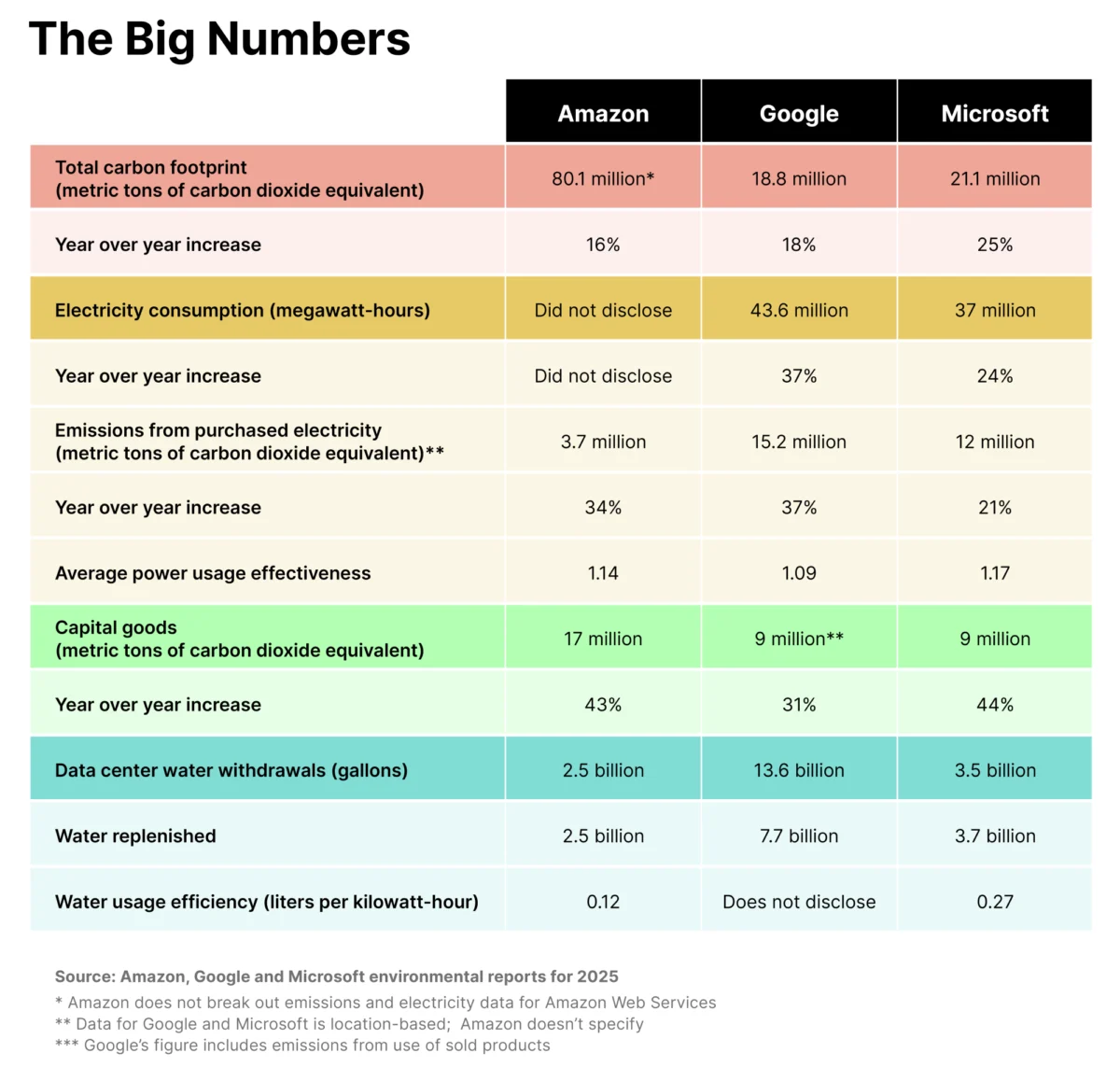
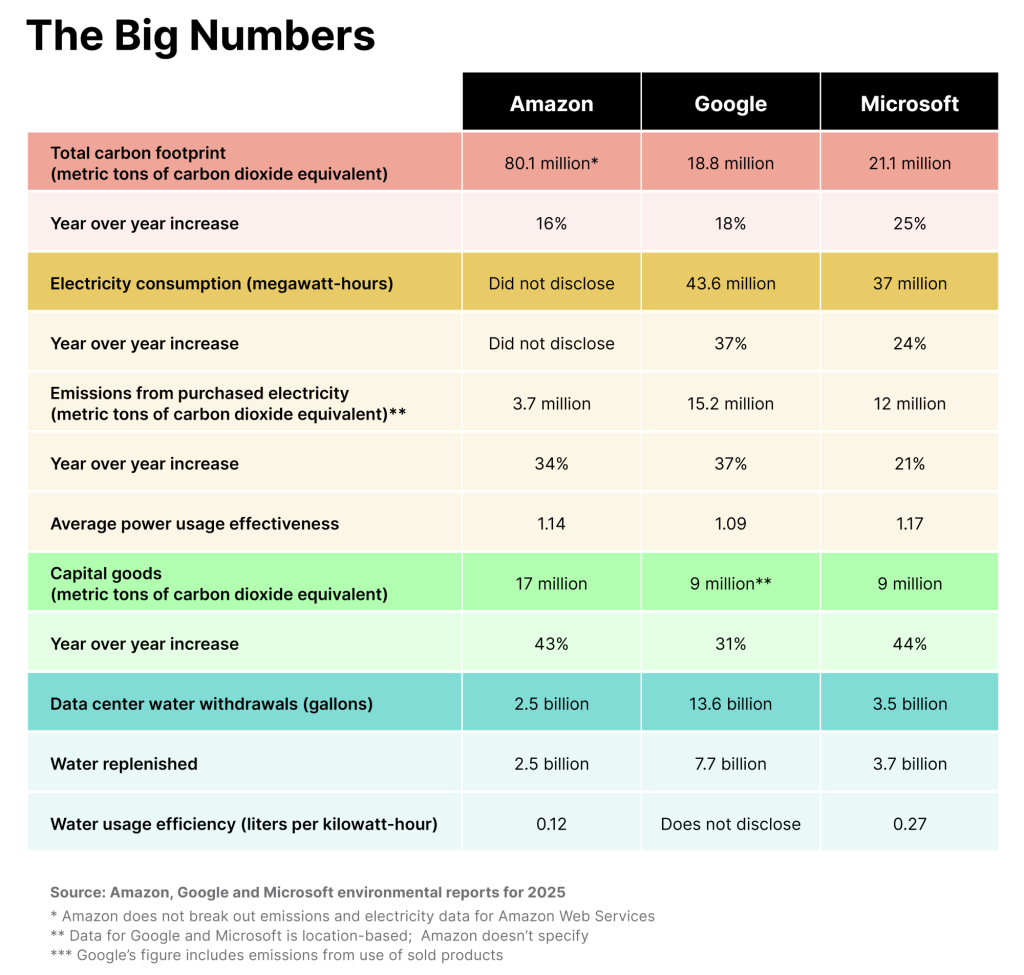
Google, which has historically been a leader in environmental transparency, saw its electricity consumption jump 37 percent in 2025 to 43.6 million megawatt-hours. To put this in perspective, this single-year increase is roughly equivalent to the total annual power consumption of the state of Washington. Since 2019, Google’s total power consumption has risen by 250 percent, a trajectory that is putting immense strain on its carbon-neutral pledges.
Microsoft’s Escalating Footprint
Microsoft, heavily tied to OpenAI’s infrastructure needs, reported a 24 percent increase in electricity consumption, reaching 37 million megawatt-hours. This has resulted in a 21 percent spike in location-based Scope 2 emissions.
Amazon’s Opaque Reporting
Amazon remains the most difficult of the three to track. While the company reported a 34 percent increase in Scope 2 emissions, it has declined to provide a clear breakdown of its overall electricity consumption. Furthermore, the company has not separated the environmental data for Amazon Web Services (AWS) from its sprawling retail logistics network, making it difficult to pinpoint the exact environmental cost of its AI cloud dominance.

Comparative Efficiency Metrics (PUE)
Data center efficiency is measured by Power Usage Effectiveness (PUE), where a lower number indicates that more power is used for actual computing rather than cooling and auxiliary systems:
- Google: 1.09 (The most efficient among the three)
- Amazon: 1.14
- Microsoft: 1.17
While these numbers are objectively impressive, they are insufficient to offset the sheer volume of new capacity coming online.
Official Responses and the "Bottleneck" Reality
In their 2025 environmental reports, the tech giants have adopted a more defensive posture, acknowledging the systemic failures of the energy grid rather than just their own consumption.
Google’s report, published on June 30, was particularly candid: "As the rapid evolution of AI is increasing our energy needs, the shift to clean energy is hitting major bottlenecks—like long delays in connecting new energy projects to the grid, fragmented power grids, and a shortage of reliable, around-the-clock clean power."
This sentiment is shared across the industry. The "bottleneck" narrative serves to shift the focus from the internal decision to prioritize AI speed above all else to the external limitations of national energy infrastructure. The companies argue that they are not the problem, but rather the catalyst for a much-needed overhaul of the global electrical grid.
Implications: A New Strategy for the Energy Transition
Despite the negative optics of their recent reports, the companies maintain that their 2030 net-zero goals remain intact. However, the path to achieving them has shifted dramatically. The industry is moving away from a reliance on simple wind and solar PPA (Power Purchase Agreement) strategies toward a more complex, capital-intensive energy portfolio.
The Nuclear Gamble
Nuclear energy has emerged as the linchpin of the tech industry’s recovery strategy. Because AI data centers require 24/7 power—unlike retail websites that can scale down during off-peak hours—intermittent renewables are no longer enough.
- Amazon has contracted for nearly 2 gigawatts of nuclear power and signed deals for two additional projects in 2026.
- Microsoft is actively funding next-generation fusion technology companies.
- Google has committed to significant nuclear capacity in Ohio.
- Meta, while not as reliant on data center revenue as the others, has become the industry benchmark, securing deals for up to 7.7 gigawatts of nuclear power.
The Storage Imperative
To address the intermittency of renewables, Big Tech is turning to long-duration energy storage. Amazon, by the end of 2025, had paired 15 solar projects with battery storage, totaling 2.3 gigawatts. Google is similarly investing in long-duration battery startups, aiming to solve the "dark doldrums" when wind and solar output drops.
The Asia-Pacific Frontier
The next theater for this conflict is Asia. Amazon is attempting to green its 2.2-gigawatt footprint in the Asia-Pacific region, a market still heavily reliant on coal and gas. Microsoft’s $230 million investment in the Southeast Asia Clean Energy Facility represents a strategic attempt to build the infrastructure they need from the ground up, rather than relying on existing, carbon-heavy grid operators.
Conclusion: The Price of Innovation
The tech giants are currently engaged in a high-stakes balancing act. They are attempting to fuel a revolution in artificial intelligence while simultaneously transitioning the global grid toward sustainability. The 2025 reports demonstrate that these two goals are currently in direct opposition.
The "speed to power" model has forced these companies to confront a reality that was ignored in the earlier days of the cloud: infrastructure is physical, and physics is unforgiving. If the tech industry intends to maintain its climate credibility, it will need to do more than purchase renewable energy credits. It will need to become an active, primary investor in the physical reconstruction of the energy grid—a task that is significantly more expensive, more complex, and more time-consuming than any software upgrade.
The coming years will determine whether this massive investment in nuclear and storage is enough to reverse the 2025 emissions surge, or if the "AI gold rush" will force a permanent re-evaluation of what corporate environmental responsibility looks like in the age of extreme computing. For now, the world is watching, as the tech giants attempt to power the future without burning down the present.