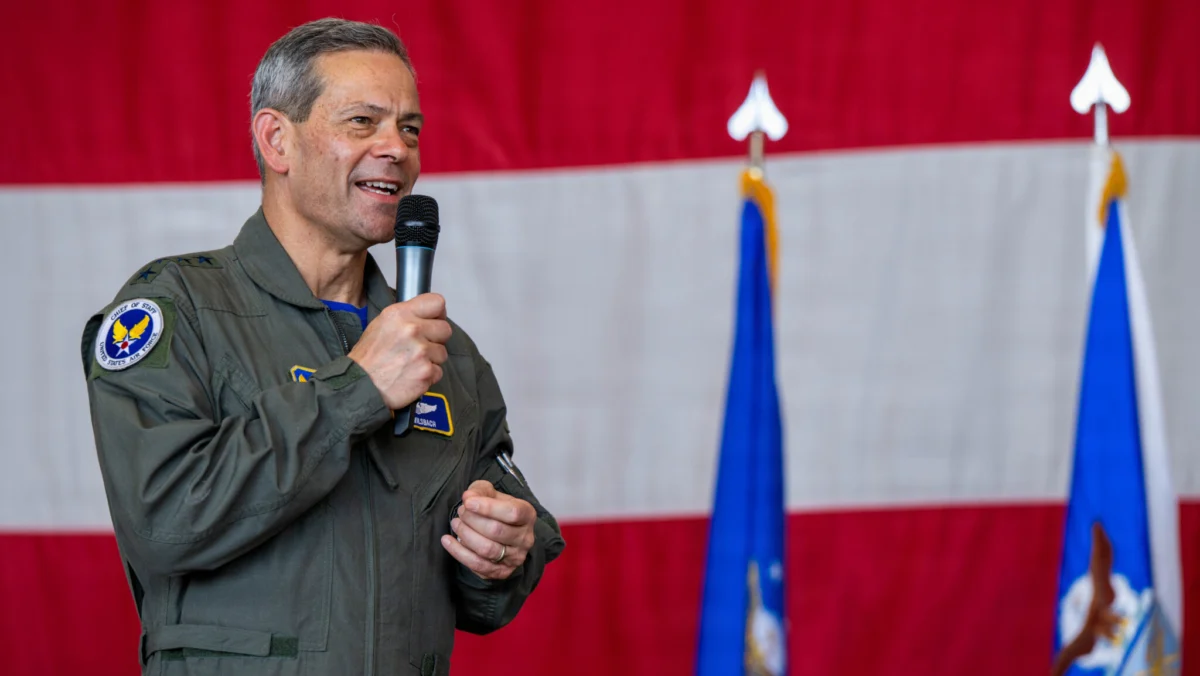
LONDON — Less than a year into his tenure as US Air Force Chief of Staff, General Kenneth Wilsbach finds himself navigating one of the most volatile periods in American military history. From the immediate pressures of an active, escalating conflict with Iran to the long-term, complex challenges of industrial base stagnation and program concurrency, Wilsbach’s command is defined by a rapid pivot toward a new, more dangerous operational reality.
In a wide-ranging interview with Breaking Defense, Wilsbach addressed the shifting priorities of the Trump administration, the operational lessons being extracted from the ongoing Middle East conflict, and the status of critical platforms—from the T-7A Red Hawk to the long-delayed F-35 Block 4 upgrades.
A Period of Unprecedented Flux
The Air Force’s current trajectory is a marked departure from the previous administration. Following his confirmation, General Wilsbach oversaw a strategic reversal of the “reoptimization” efforts championed by the Biden administration, signaling a return to more traditional organizational structures deemed more suitable for high-intensity, peer-to-peer conflict.
This administrative pivot occurred against a backdrop of global instability. The Trump administration’s decision to launch a large-scale, ongoing operation against Iran has fundamentally altered the Air Force’s resource allocation. With the conflict reigniting following the collapse of a brief ceasefire, the Pentagon is moving toward a historic fiscal posture. The White House recently unveiled a staggering $1.5 trillion defense budget proposal, banking on $350 billion in savings through reconciliation—a gamble that has triggered intense debate on Capitol Hill regarding the feasibility of such a massive injection of funds while simultaneously managing industrial base bottlenecks.
The Evolution of Base Defense: A New Career Field
Perhaps the most urgent takeaway from the conflict in the Middle East is the vulnerability of static airfields. With reports surfacing that high-value assets, including an AWACS jet, have been destroyed on the ground by adversary strikes in Saudi Arabia, the Air Force is forced to rethink how it secures its "power projection" hubs.
When asked about the survivability of Collaborative Combat Aircraft (CCA) and manned fighter platforms in these contested environments, General Wilsbach was blunt.
“One of the outcomes from a recent Corona meeting was that we were going to start up a new career field for the Air Force: point defense,” Wilsbach stated.
He explained that the lessons from the Ukraine-Russia conflict—specifically the proliferation of one-way attack munitions (OWAMs) and low-cost drones—have exposed a critical gap in airfield security. "We’ve come to the realization that we have to create a new career field and have experts in the ability to defend your airfield from all of these threats," Wilsbach said. The mandate for this new cadre of airmen is comprehensive: they must manage defense against ballistic missiles, cruise missiles (including potential stealth variants), and the full spectrum of drone threats, from palm-sized reconnaissance units to heavy attack drones.
The Economics of Hardening
The conversation around base defense inevitably turns to the "hardening" of shelters—a topic on which Wilsbach has historically expressed skepticism. When prompted on whether his views have evolved, he remained firm: the economics simply do not support traditional, static hardening.
“I don’t want to spend a lot of money on hardening shelters. Unless you’re going to send something 100 feet or more underground, we can blow it up, and so can they,” he noted. “The economics of building a shelter that is impervious to a strike doesn’t work.”
Instead, Wilsbach is advocating for a layered, active defense strategy. He suggests that the focus should be on "defending your airspace and ground space with systems that can defeat the incoming rounds." He is not opposed to all forms of protection, however, highlighting that "light protection"—such as simple netting to prevent small, inexpensive drones from approaching multi-billion-dollar aircraft—is a highly cost-effective solution. The long-term vision, he added, includes directed energy weapons, short-range kinetic interceptors, and robust non-kinetic electronic warfare capabilities to disrupt adversary control systems.
T-7A Red Hawk: Bridging the Training Gap
The Boeing T-7A Red Hawk program has faced significant scrutiny, particularly after a recent three-part investigation by Breaking Defense exposed a series of unreported technical and programmatic hurdles. Despite this, General Wilsbach expressed cautious optimism following his own flight in the aircraft.
“I was impressed with the aircraft,” he said, while acknowledging that the T-7 remains under flight envelope restrictions. “Every single airplane that we get that’s new has a flight envelope restriction. So, it was fairly limited and not representative of what we would need it to be in a training scenario.”
Wilsbach highlighted that the T-7 is "way easier to fly" than the aging T-38 Talon, which it is intended to replace. The strategic goal, though not yet finalized, is to transition to the T-7 as a single-platform trainer. By eliminating the need for pilots to transition between the T-6 and the T-38, the Air Force hopes to compress the training timeline and reduce costs, allowing for a more efficient pipeline of pilots capable of moving directly into advanced combat platforms.
F-35: Navigating Concurrency and Capability
The F-35 program remains the backbone of the Air Force’s tactical capability, yet it is currently plagued by the cascading effects of the TR-3 (Technology Refresh 3) and Block 4 upgrade delays. With some aircraft delivered without operational radars, questions remain regarding the combat readiness of the fleet.
General Wilsbach took a pragmatic stance on the issue. “Basically, there is not much effect because we have the ability to move tails around to put them in the right spots,” he said. He insisted that the operational deployment of the F-35, particularly in high-intensity scenarios like "Epic Fury," has been a success, characterized by high availability rates and strong performance.
However, he did not absolve industry partners of their responsibility. “We want Lockheed Martin and the subcontractors to step up and deliver TR-3 and Block 4 as quickly as possible with a stable platform that actually works,” Wilsbach added, specifically calling out Northrop Grumman regarding the delivery of the APG-85 radar.
Industry Response
In response to the General’s remarks, Lockheed Martin issued a statement defending the program’s progress: “Development on TR-3 was completed in 2025. We continue to build on this baseline through the Block 4 modernization program, which implements upgrades including additional weapons, electronic warfare capabilities, and improved sensor technology to ensure the warfighter can defeat any threat.”
The company emphasized that Block 4 represents the most significant evolution of the F-35 to date, involving over 70 major upgrades. They maintained that they are working in partnership with the Joint Program Office (JPO) to ensure the platform retains its competitive edge.
Implications for Future Airpower
The breadth of the challenges facing General Wilsbach suggests that the Air Force is at a precarious inflection point. The transition from the counter-insurgency focus of the previous two decades to the requirements of potential near-peer conflict has exposed deep-seated issues in industrial capacity, platform development, and infrastructure security.
The move to establish a point-defense career field is perhaps the most significant structural change, signaling that the Air Force no longer views airfields as sanctuaries. As the conflict with Iran continues to test the limits of US logistical and operational reach, the ability to rapidly integrate new technology—like the T-7A and the CCA program—while simultaneously fixing the deficiencies in the F-35’s software and hardware stack will determine the Air Force’s success in the coming years.
For Wilsbach, the mandate is clear: the Air Force must adapt, or it will be forced to learn the cost of vulnerability on the battlefield. As the $1.5 trillion budget proposal moves through the legislative meat-grinder, the General’s focus remains on balancing the immediate necessity of current combat operations with the long-term, expensive, and risky modernization required to maintain air dominance in an increasingly contested world.