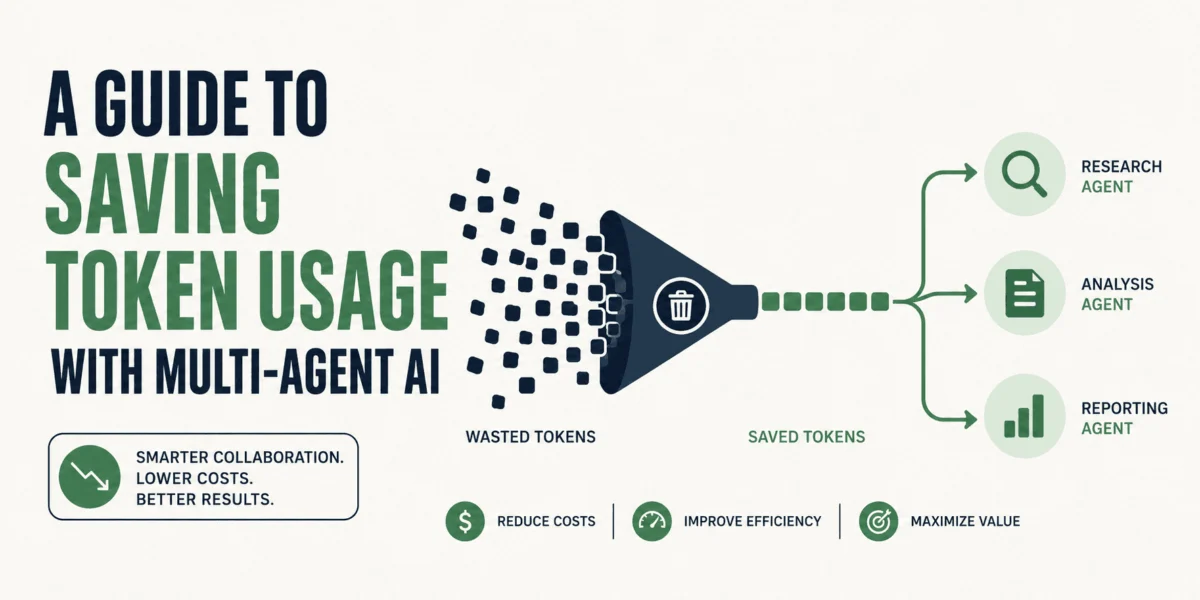
Introduction: The Hidden Cost of AI Intelligence
In the rapidly evolving landscape of generative AI, the shift from monolithic Large Language Models (LLMs) to multi-agent architectures represents a significant leap forward in capabilities. By stringing together specialized AI agents—each designed to handle specific sub-tasks—developers can now tackle complex, multi-step workflows that were previously insurmountable. However, this architectural sophistication brings a pressing challenge: the "Token Explosion."
As agents communicate, share memory logs, and process tool specifications, the volume of tokens consumed—the fundamental units of text processing—often balloons, leading to significant latency and ballooning operational budgets. For enterprises and individual practitioners alike, mastering the economics of token usage is no longer an optional skill; it is a prerequisite for scalable, production-grade AI. This article explores the strategic frameworks necessary to optimize multi-agent systems, ensuring that performance and cost-efficiency scale in tandem.
The Core Problem: Why Multi-Agent Systems Drain Budgets
To understand the necessity of token optimization, one must first recognize how these systems function. A multi-agent framework typically involves a "coordinator" or "orchestrator" agent that delegates tasks to specialized agents (e.g., a data analyst agent, a research agent, or a code-generation agent).
In this ecosystem, every interaction involves context window consumption. If an agent requires a comprehensive set of system instructions, history, and schema definitions to perform a task, the "context" sent to the LLM grows with every turn. When multiplied across multiple agents, the redundant processing of these instructions creates a massive bottleneck. The resulting latency—often measured in seconds—can degrade user experience, while the cumulative token usage can exhaust computing budgets long before a project reaches its full potential.
Four Pillars of Token Optimization
To combat the drain of token consumption, developers are adopting a set of best practices that prioritize efficiency without sacrificing the "reasoning" quality of the AI.
1. Static Instruction Caching (Prefix-Match Caching)
The most common source of waste is the redundant transmission of static system instructions. Modern LLMs are stateless by default, meaning they require the full "manual" of their persona and operational constraints to be re-sent with every prompt.
Prefix caching mitigates this by utilizing key-value stores to bookmark the "state" of the model. By caching the initial instructions or long-form reference documents, the system avoids re-processing them in every request. The model "remembers" the system prompt as a pre-loaded layer, requiring the engine only to process the specific, novel query. This not only slashes latency but significantly reduces the billable token count for every turn in a long-running conversation.
2. Semantic Caching: Intent-Based Recall
Semantic caching introduces a layer of "intelligence" into the storage process. Instead of relying on exact keyword matching, this approach uses vector embeddings—mathematical representations of meaning—to identify when a user is asking a question that has already been resolved.
If a user asks, "How do I reset my router?" and a previous user asked, "What are the steps to restart my wifi box?", a semantic cache recognizes the intent similarity. By fetching the answer from a vector database, the system can bypass the LLM entirely, saving the cost of inference and providing near-instantaneous responses.
3. Just-in-Time (JIT) Tooling
A frequent pitfall in agent design is "context stuffing." Developers often provide the agent with a massive, comprehensive list of all available APIs and tools at the start of every session. This "bloated context" forces the model to sift through irrelevant data, increasing the token usage per inference.

JIT Tooling, or "lazy loading," takes a leaner approach. The agent is initially provided only with a high-level directory of capabilities. Only when the agent identifies a specific task—such as querying a SQL database—does it fetch the detailed documentation and parameters for that tool. This ensures that the context window remains lightweight and focused, reserving precious token bandwidth for the actual task at hand.
4. Task Escalation: Cost-Efficient Model Routing
Not all tasks are created equal. A common mistake is using a high-parameter, compute-intensive model (like GPT-4 or Claude 3 Opus) for trivial tasks like simple data formatting or text classification.
Effective multi-agent architectures implement a "routing layer." This layer acts as a triage center, analyzing the complexity of an incoming prompt. Simple tasks are routed to lightweight, open-weight models (e.g., Llama 3 or Mistral) running locally or on inexpensive inference endpoints. Only complex tasks requiring deep logical reasoning or multi-step orchestration are escalated to the heavy-hitting models. This tiered approach allows for massive cost savings while maintaining high-quality performance.
Chronology of AI Efficiency Evolution
The focus on token efficiency has shifted in parallel with the maturity of LLMs:
- 2022–2023 (The Era of Abundance): The initial surge of ChatGPT focused on capabilities. Token usage was a secondary concern as developers focused on proving "it works."
- Early 2024 (The Era of Multi-Agent Complexity): As developers moved to build agents that could "do" things rather than just "talk," the limits of context windows became glaringly obvious.
- Mid-2024 to Present (The Era of Optimization): The focus has shifted to "Production-Ready AI," where developers are now implementing caching layers, vector databases, and router architectures as standard components of the development stack.
Supporting Data: The Economic Impact
While specific budget figures vary by enterprise, industry analysis indicates that companies transitioning from monolithic prompts to optimized multi-agent architectures see:
- 40–60% reduction in latency through the use of prefix caching.
- 30–50% decrease in monthly API costs by implementing model routing (moving 70% of traffic to smaller, lower-cost models).
- Improved response accuracy due to reduced context-window noise, which helps prevent model "hallucination" caused by cluttered prompt inputs.
Official Industry Perspectives
Leading AI researchers and infrastructure providers, including those at Groq and OpenAI, emphasize that "Token Efficiency" is the key to mass adoption. As stated by industry experts, the future of AI is not about building bigger models, but about building more intelligent systems that use smaller models more effectively. By treating tokens as a finite, precious commodity, developers foster a discipline that results in more resilient and sustainable software architectures.
Implications: The Road Ahead
The implications of these strategies extend beyond just cost savings. By mastering token usage, developers can:
- Enhance User Experience: Lower latency makes AI agents feel more like real-time collaborators and less like batch-processing engines.
- Enable Local Execution: Efficient, smaller models are easier to host on-premises, addressing data privacy concerns for sensitive industries like finance and healthcare.
- Drive Sustainability: Lowering the compute requirements for AI tasks reduces the environmental impact of large-scale data center operations.
Conclusion: The Path to Scalability
Optimizing multi-agent AI is not merely a technical exercise; it is a fundamental pillar of AI engineering. By combining static caching, semantic recall, JIT tooling, and intelligent routing, practitioners can build agents that are faster, cheaper, and more effective. As we continue to refine these architectures, the focus must remain on creating systems that do more with less—ensuring that the intelligence of our AI agents is matched by the efficiency of their design.
Iván Palomares Carrascosa is an AI thought leader and practitioner, specializing in the deployment of large-scale LLM architectures. For more insights on the future of AI, follow his work on industry forums and professional development platforms.