In the rapidly evolving landscape of the UK’s fibre sector, the operational stakes have never been higher. As network footprints expand and subscriber bases grow, the industry is shifting its focus from raw infrastructure deployment to the relentless pursuit of service reliability. However, beneath the surface of this connectivity boom lies a structural vulnerability: the "operational gap."
For large-scale network operators, maintaining a 24/7 Network Operations Centre (NOC) staffed by seasoned specialists is a standard, albeit expensive, operating procedure. For the smaller and mid-sized players that comprise the backbone of the UK’s competitive fibre market, such an overhead is often prohibitive. This economic reality has forced many to rely on "best-effort" monitoring—a model where junior staff or automated alerts often fail to provide the immediate, expert intervention required to maintain modern service level agreements (SLAs).
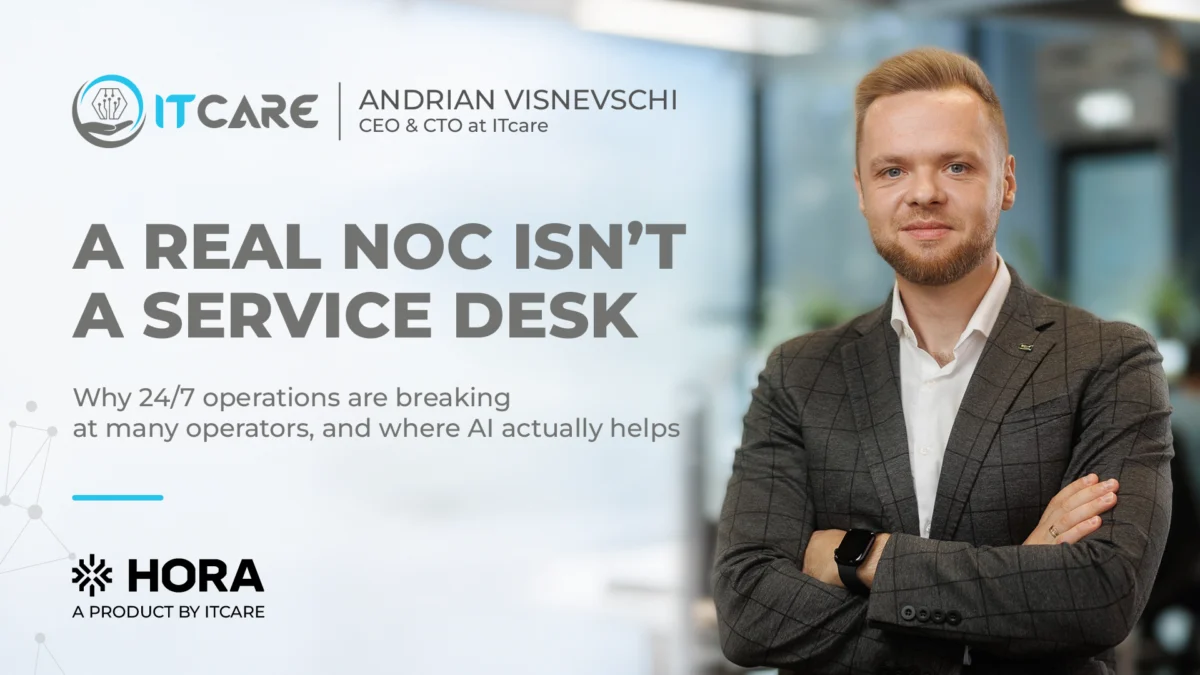
Andrian Visnevschi, CEO and CTO of ITcare, argues that this disconnect is not merely an operational inconvenience; it is a fundamental threat to the commercial viability of modern ISPs.
The Operational Gap: Why "Automated Alerts" are Failing
The current status quo for many mid-sized network operators is a reliance on reactive, fragmented monitoring. When a network incident occurs outside of standard 9-to-5 business hours, the response chain is often fragile.
"A lot of operators today simply don’t have 24/7 coverage," explains Visnevschi. "If something happens at 3:00 AM, the response is often just an automated notification from a tool like PagerDuty. In the best-case scenario, a junior staff member sees it and escalates it to a senior engineer. In the worst case, that alert is missed or ignored."
The logistical friction of this process—waking up, finding a stable internet connection, logging into fragmented systems, and beginning a manual investigation—leads to a significant increase in the Mean Time to Repair (MTTR). In a market defined by customer choice and high expectations for uptime, these delays translate into churn, reputational damage, and an erosion of the network’s commercial value.
"A lot of operators are struggling to survive in the new race for service quality," Visnevschi notes. "There is huge pressure to provide enterprise-grade reliability without letting operational costs rise sky-high."
HORA: Unifying the Network Lifecycle
Recognizing the limitations of existing management tools, ITcare developed HORA—an AI-driven network operations platform designed to act as a "single source of truth." Unlike traditional dashboard-heavy systems that require engineers to toggle between five or six different interfaces, HORA aggregates inventory data, topology, traffic flows, BGP metrics, and configuration backups into a single, cohesive pane of glass.
The Anatomy of the HORA Platform
- Inventory & Topology: Real-time visibility into the physical and logical state of the network.
- AI-Correlated Root Cause Analysis: Using machine learning to parse logs and metrics, HORA identifies the source of an outage before an engineer even starts their investigation.
- Controlled Change Management: Automating the creation of change requests and, crucially, updating network documentation automatically—solving the perennial issue of engineers neglecting to update records.
- Platform Agnosticism: Designed to be "slotted over" existing network management systems, HORA is on-premise by design, allowing it to integrate seamlessly into diverse, multi-vendor environments.
The efficiency gains are measurable. Within ITcare’s own NOC, the implementation of HORA has reduced the median investigation time for network incidents from 28 minutes to under four—a sevenfold increase in speed.
The Philosophy of "Human-in-the-Loop"
Despite the buzz surrounding Autonomous Networking and Level 4 (L4) AI integration, Visnevschi maintains a measured, almost conservative approach. He warns that the industry’s rush toward full automation—where an AI handles incidents without human oversight—is fraught with risk.
"We’ve all heard horror stories about AIs connecting to databases, erasing data, or generating invalid configurations," says Visnevschi. "In HORA, the AI acts as an advisor, not a commander. It proposes a change, but a senior engineer must review and approve it. Nothing touches a device without that human validation."
This philosophy stems from the complexity of modern network architecture. As soon as a vendor changes or an architecture is updated, an "autonomous" system that is hard-coded to a specific environment will inevitably fail. By keeping expert humans in the loop, ITcare ensures that the "intelligence" of the system is adaptive, scalable, and, above all, safe.
Implications for the Competitive Fibre Landscape
The implications of this model are significant for the UK fibre market. As operators move from the "build" phase to the "operate" phase, the ability to scale efficiently without ballooning headcount will become the primary competitive differentiator.
1. Scaling Without Overhead
By pairing senior, round-the-clock engineers with tools like HORA, operators can scale their networks significantly without needing to increase their operational staff proportionally. The tool handles the routine, repetitive tasks—the "drudgery" of network management—leaving the high-level troubleshooting to the human experts.
2. The End of the "Service Desk" NOC
Visnevschi is clear about the distinction between a call-center-style service desk and a true NOC. "A real NOC isn’t a service desk. Our engineers log into the device, find the problem, and fix it at 3 AM," he states. For the operators who outsource their NOC to ITcare, this means the difference between a minor blip and a prolonged service outage that affects thousands of subscribers.
3. Future-Proofing Through Modularity
Because HORA is built to handle the "troubleshooting chain"—the universal steps that engineers take regardless of whether they are working on a fibre ISP, a cloud provider, or a data center fabric—it provides a future-proof foundation. It allows operators to change their hardware vendors without having to overhaul their entire operational stack.
A Balanced Path Forward
The narrative of the telecommunications industry has long been dominated by the dream of "self-healing" networks. While this dream remains a long-term aspiration, the immediate reality is that the best results come from a symbiotic relationship between human expertise and machine intelligence.
ITcare’s approach demonstrates that the key to network excellence isn’t replacing the engineer, but enhancing their capacity. By providing a platform that offers full network visibility, automated documentation, and AI-assisted root cause analysis, ITcare is enabling operators to meet the modern demand for reliability.
As Andrian Visnevschi concludes, the race for service quality is the next frontier of the UK’s fibre revolution. "Our customers get senior engineers on shift around the clock, and HORA makes each of them faster. It’s not about replacing the human; it’s about making sure that when the network needs a fix, it gets the best expertise available, the moment it matters."
In a world where downtime is measured in lost subscribers and damaged brand equity, this hybrid approach—where AI provides the speed and humans provide the judgment—appears to be the most sustainable model for the next generation of network operations.