
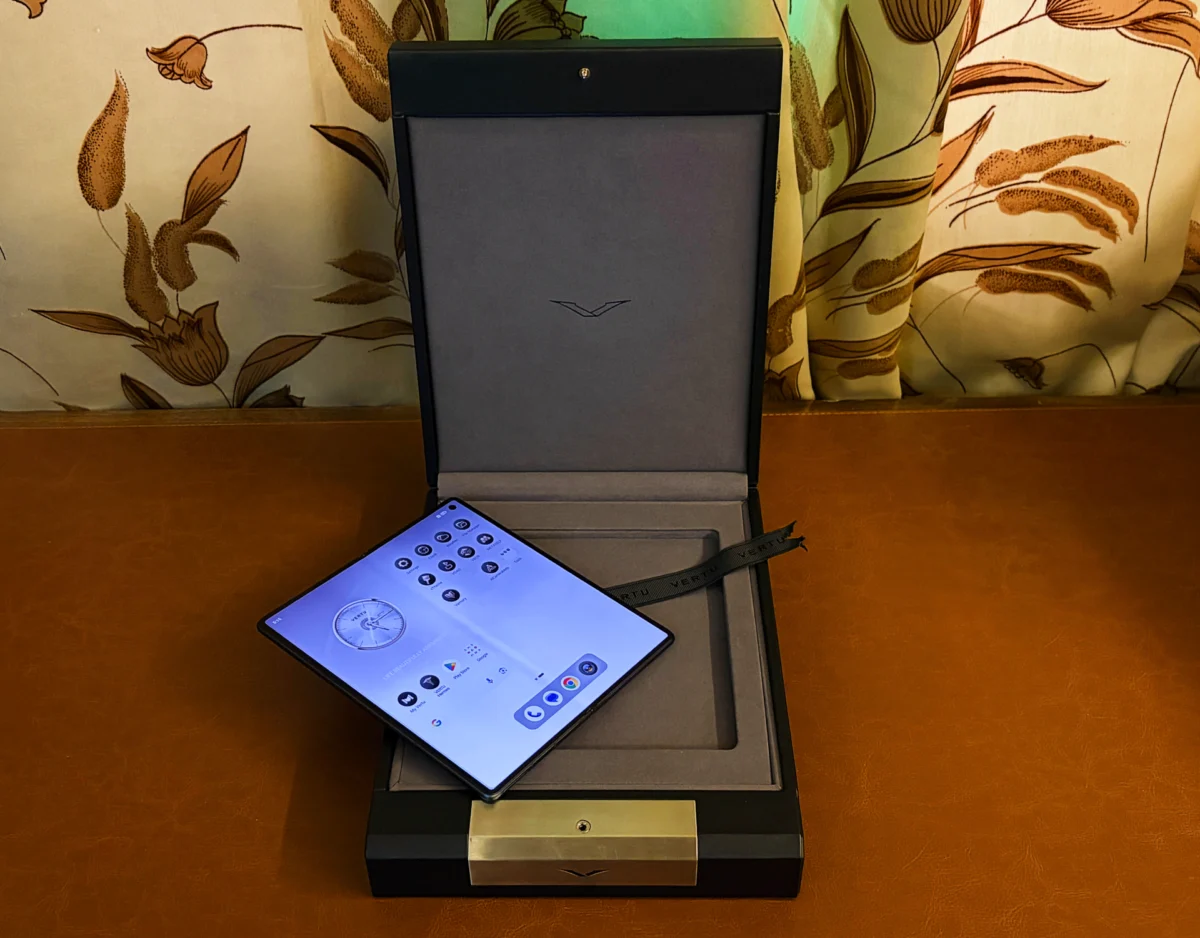
In an era where the smartphone industry has descended into an "AI arms race," major manufacturers are scrambling to shoehorn generative features into every facet of the user experience. Yet, while Samsung, Apple, and Google fight for the pockets of the mainstream consumer, the UK-founded luxury brand Vertu has chosen a markedly different path. Vertu is not selling chips, clock speeds, or pixel counts; it is selling the ultimate commodity for the modern C-suite executive: time.
The Vertu Alphafold, a premium foldable smartphone starting at a staggering $6,880, is the company’s latest attempt to marry high-end craftsmanship with high-stakes digital utility. It is not designed for the mobile gamer or the social media influencer. It is designed for the chief executive who views a phone not as a toy, but as a command center.
Main Facts: Luxury Meets the "Hermes" AI Agent
At its core, the Alphafold is a physical manifestation of a "digital concierge." While the chassis is wrapped in genuine calfskin leather with hand-finished titanium accents, the true engine of the device is the Hermes Agent. Built upon the open-source Hermes project—a framework currently turning heads in the venture capital circuit for its advanced reasoning capabilities—the agent is intended to be more than a chatbot.

Unlike the standard AI assistants found on mass-market devices, which primarily function as reactive search engines or creative writing tools, the Hermes Agent is designed for multi-step, autonomous workflows. It is programmed to manage files, orchestrate actions across disparate applications, maintain long-term memory of professional conversations, and, when the digital threshold is reached, bridge the gap to a human concierge service.
Chronology of the Experience: Testing the Executive Workflow
To evaluate the Alphafold, I shifted my review methodology. I abandoned the typical benchmarks of Geekbench scores and camera sensor comparisons. Instead, I spent several days living the life of an executive, subjecting the device to the stressors of high-level business management: contract analysis, itinerary planning, and the rapid-fire automation of routine administrative tasks.
Day 1: The Airport Simulation
The first test involved a common "airport rush" scenario. I tasked the Hermes Agent with a multi-part command: message a contact regarding a 20-minute delay, navigate to the airport, enable "Do Not Disturb" mode, and set a reminder for a follow-up call in 15 minutes.

The Alphafold performed admirably on the execution of settings, immediately silencing the phone and opening the navigation app. However, it faltered on the logic of the reminder, setting a time for 9:08 p.m. despite the request occurring at 2:32 a.m. By comparison, Samsung’s Galaxy Z Fold 7, running Google’s Gemini, took a more conservative, conversational approach. It asked for clarification regarding the destination and the preferred reminder app. While the Alphafold was more "autonomous," it lacked the precision required for high-stakes executive management.
Day 2: The Business Trip
I asked the agent to organize a business trip from Mumbai to Pune. When it identified that no direct morning flights were available, the agent reached its operational limit and offered a "Contact Butler" button. While the human-in-the-loop feature is a distinct advantage, the AI’s inability to pivot to alternative travel modes—such as a train or a private car—without user intervention highlighted a lack of the "proactive" intelligence one would expect at this price point.
Day 3: Document Analysis and Persistence
The final stress test involved local file management. I uploaded a complex quarterly financial spreadsheet. Initially, the Hermes Agent provided an excellent, concise summary. However, when I returned to the chat 48 hours later, the device had purged the context, claiming it could no longer access local files. The Galaxy Z Fold 7, while also requiring an initial upload, maintained the state of the conversation, allowing for deep-dive follow-up questions days later.

Supporting Data: The Hardware Origins
The physical build of the Alphafold is undeniably premium, featuring a tactile, sophisticated finish that distinguishes it from the cold, mass-produced glass of standard foldables. However, the internal architecture presents a more complex narrative.
During the testing process, striking similarities emerged between the Alphafold and the $1,100 ZTE Nubia Fold. Dimensions, hinge mechanics, and even the placement of audio components suggested a shared lineage. When confronted with these observations, Vertu confirmed that the Alphafold was developed through a strategic supply-chain partnership with ZTE/Nubia.
Vertu maintains that it is responsible for the "luxury overlay"—the software experience, quality control, and the proprietary AI layer. This reflects a long-standing strategy for the company: repurposing proven, reliable hardware platforms and elevating them through superior materials and bespoke service tiers. Whether this justifies a 600% price markup over the base hardware is a question of brand value rather than technical performance.

Official Responses and Security Implications
For the target demographic of the Alphafold, security is the non-negotiable cornerstone of the value proposition. Executives cannot risk corporate espionage or the leakage of sensitive financial data.
Vertu has attempted to address these concerns with a two-pronged approach:
- The A5 Security Chip: A dedicated hardware-level module designed to encrypt communications and safeguard digital credentials.
- Data Sovereignty: Vertu claims that all conversations with the Hermes Agent are encrypted and, crucially, are not used to train public AI models. For large-scale enterprise deployments, the company offers private infrastructure options, ensuring that sensitive data never leaves the organization’s firewall.
While the "A5" chip’s efficacy could not be independently audited in this review, these features are essential for Vertu’s credibility. The firm’s willingness to offer private cloud instances for corporations is a significant differentiator that aligns with the requirements of the C-suite.

Implications: Is the "AI-First" Luxury Phone a Viable Category?
The Alphafold sits at an uncomfortable intersection of luxury branding and experimental technology. The implications of this device for the wider market are twofold:
1. The Return of the Human-AI Hybrid:
Vertu is acknowledging a truth that Silicon Valley often ignores: AI is not currently perfect. By offering a "Concierge" fallback, they are admitting that the best AI assistant is one that knows when to give up and call a human. This hybrid model may well be the future of premium service.
2. The "Brand Premium" Dilemma:
The Alphafold’s struggle to justify its price tag highlights the difficulty of selling "status" in an age where "utility" is the primary driver of technology. When a $1,800 Samsung foldable can perform 90% of the same tasks with greater software stability, the remaining $5,000 must be justified by something tangible. Currently, that justification rests on the bespoke software and the concierge service.

Verdict: An Ambitious Prototype at a Luxury Price
The Vertu Alphafold is a fascinating, if flawed, proof of concept. As an "AI-first" device, it pushes the boundaries of what an on-device agent can do, frequently taking more initiative than its competitors. However, this autonomy often comes at the cost of accuracy.
For the average consumer, the device is an impossible sell. For the executive who already employs a human assistant and wants a "digital twin" that can handle 2:00 a.m. document requests with the promise of enterprise-grade security, the Alphafold offers a unique, albeit unpolished, experience.
Ultimately, the Alphafold feels like an "early adopter" device wrapped in the skin of a mature luxury product. As Vertu continues to iterate on the Hermes Agent and refines its software, it may find a niche in the high-net-worth market. But for now, the gap between the Alphafold’s price and its current performance is simply too wide to ignore. With the next generation of mainstream foldables looming, the window for Vertu to prove its value is closing rapidly.