The era of corporate sustainability as a broad, aspirational mandate appears to be hitting a formidable wall. New research conducted by BSR and GlobeScan reveals a tectonic shift within the C-suites of the world’s largest organizations. According to a survey of sustainability professionals at companies generating over $1 billion in annual revenue, corporate social responsibility is entering a "constrained and selective" phase, marked by a significant retreat from previously established ESG (Environmental, Social, and Governance) targets.
The data suggests that the optimistic, expansionist phase of corporate sustainability—which defined the early 2020s—is being replaced by a pragmatic, risk-averse approach. As businesses navigate a landscape of tightening capital, heightened regulatory scrutiny, and a shifting political climate, the question is no longer "how much can we achieve," but rather "what can we afford to keep?"
The Core Findings: A Shift Toward Prudence
The survey, which canvassed 124 sustainability professionals throughout April and May 2026, presents a sobering outlook for those who champion aggressive corporate climate and social action.
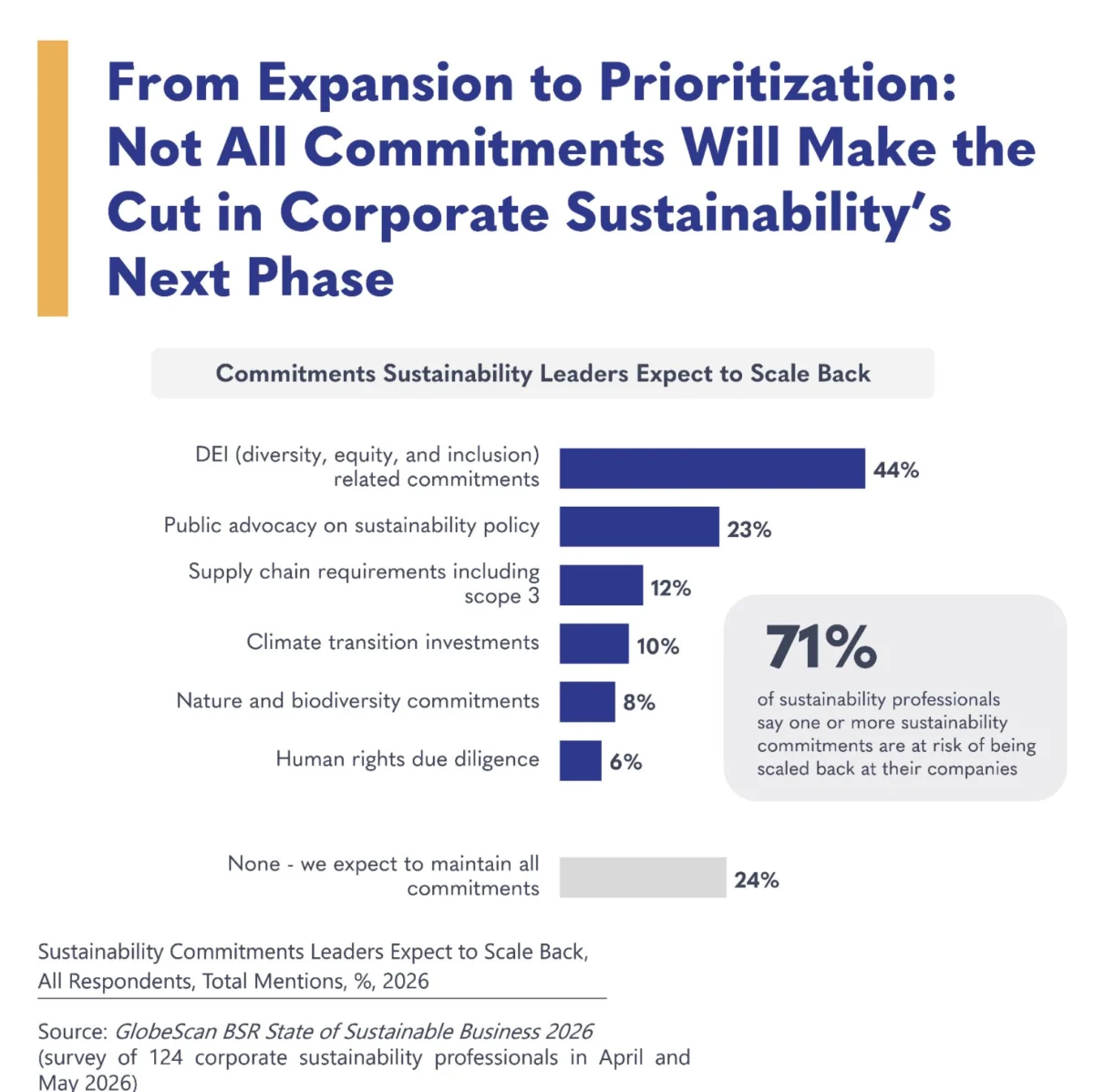
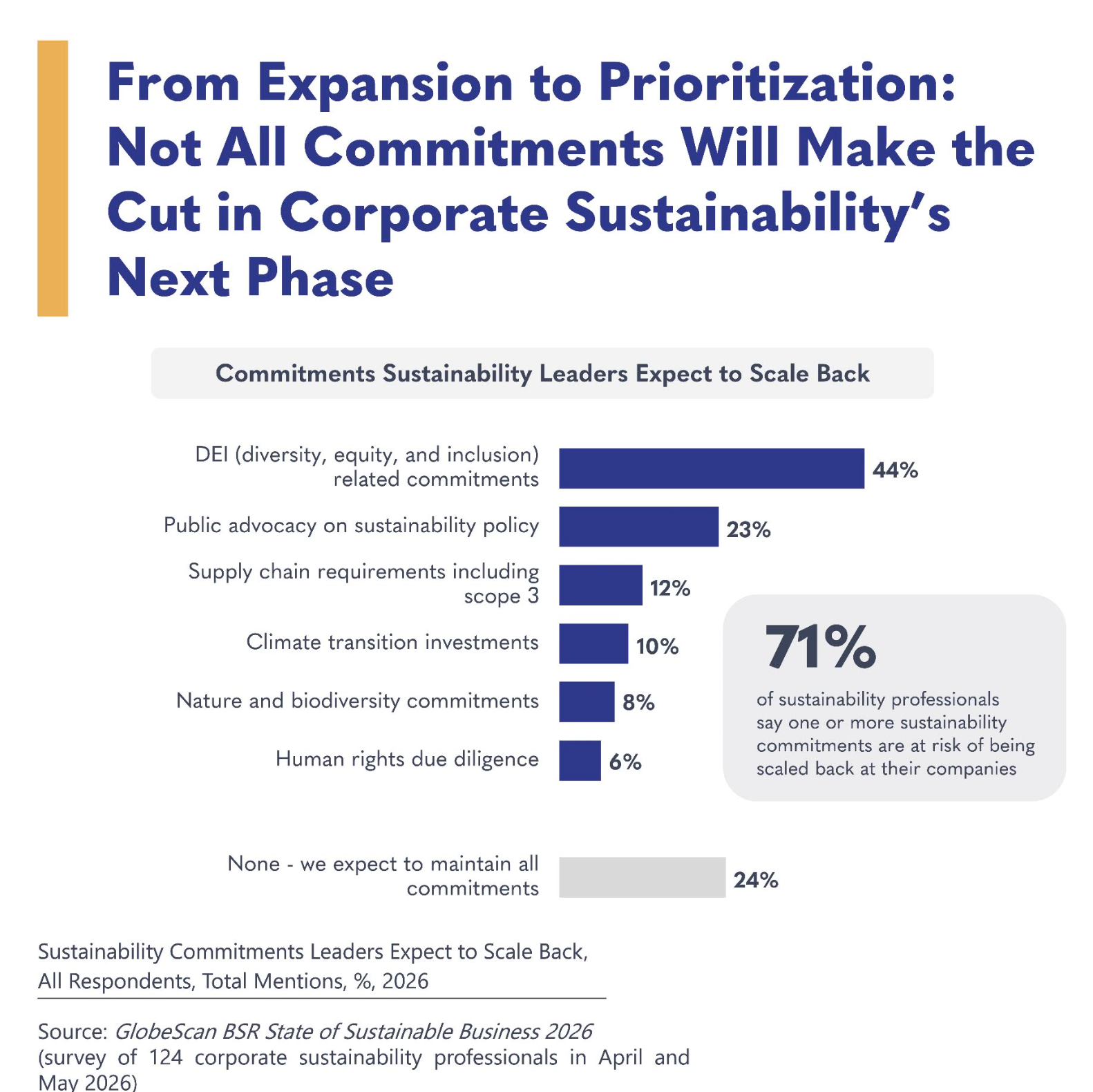
The headline figure is stark: 71 percent of sustainability professionals report that at least one of their company’s sustainability commitments is at risk of being scaled back or abandoned entirely. In sharp contrast, fewer than 25 percent of respondents indicated that their organizations intend to maintain all current commitments.
This retrenchment is not uniform. When asked to identify which areas are most vulnerable, respondents pointed to specific pillars of ESG that have become lightning rods for political and social debate.
- DEI (Diversity, Equity, and Inclusion) Initiatives: 44 percent of professionals cited DEI commitments as the most likely to be rolled back.
- Public Advocacy: 23 percent noted that their company’s willingness to take a public stance on sustainability-related policy is being curtailed.
- Operational Commitments: Supply chain requirements, climate transition investments, human rights due diligence, and biodiversity goals were flagged less frequently as "at risk," suggesting that while "soft" social initiatives are being cut, "hard" operational and regulatory-linked compliance remains more resilient.
Chronology: From Decade of Change to Decade of Constraint
To understand the current pivot, one must look at the trajectory of corporate sustainability over the last ten years.
The Rise of the ESG Mandate (2016–2022)
For much of the past decade, sustainability was driven by a powerful confluence of factors: low interest rates, strong investor demand for ESG-linked assets, and a growing expectation from Gen Z and Millennial employees that their employers take a stand on social issues. During this period, "purpose-driven" business models were the gold standard. Corporations rushed to sign net-zero pledges and publicize aggressive DEI targets, often viewing these as essential components of brand health and talent retention.
The Turning Point (2023–2025)
The momentum began to stall as global economic volatility, inflationary pressures, and high interest rates forced CFOs to scrutinize every line item. Simultaneously, a geopolitical backlash against "woke capitalism," particularly in the United States, began to influence boardrooms. The narrative shifted from viewing sustainability as a "value-add" to viewing it as a potential liability or a "distraction" from core profit-seeking activities.

The Current Reality (2026)
As of mid-2026, we have arrived at a "pragmatic reset." Regulatory requirements have increased in complexity—notably in the EU and parts of the U.S.—forcing companies to spend more on reporting and compliance rather than transformative, high-impact projects. The result is a tightening of the scope, where sustainability teams are being forced to prioritize business-critical activities over broader, values-based advocacy.
Supporting Data and Sector Vulnerability
The BSR and GlobeScan data highlights a critical bifurcation in corporate strategy. Why are DEI and public advocacy targets the first to go, while supply chain and climate investments remain relatively stable?
The answer lies in the nature of "business value." Supply chain and climate transition investments are increasingly tied to mandatory disclosures, carbon taxes, and operational resilience. If a company fails to map its Scope 3 emissions or ensure human rights compliance in its supply chain, it faces tangible legal and financial penalties.
Conversely, DEI initiatives and public advocacy on policy are often perceived by skeptical boards as "optional" or "discretionary." In a climate where executives are facing intense scrutiny from activist shareholders and political interest groups, the temptation to cut programs that lack a direct, linear line to quarterly earnings is immense. The data confirms that sustainability departments are no longer operating in a vacuum; they are being forced to compete for capital against core operational needs in an environment of fiscal scarcity.
Official Perspectives: The View from the Front Lines
James Morris, who leads GlobeScan’s San Francisco office, frames this transition as a evolution rather than a total collapse. "The findings suggest that many companies are moving from expanding sustainability agendas to prioritizing a smaller set of commitments," Morris notes.
The professional community is currently grappling with a "do more with less" mandate. For the sustainability professional, the challenge of 2026 is no longer about setting ambitious, long-term goals; it is about justifying the existence of current programs in a way that resonates with the CFO.
"Success will increasingly depend on integrating these priorities deeply into core business strategy and operations," Morris adds. "Organizations will need to clearly demonstrate how sustainability contributes to performance, resilience, and growth."
Implications: The Future of the Sustainability Profession
The implications of this shift are profound for the future of the corporate world.
1. The Death of Performative Sustainability
The era of the "sustainability press release" is likely coming to an end. With stakeholders becoming more sophisticated and regulators cracking down on greenwashing, companies are becoming gun-shy. This is a positive development for those who value substance over optics, as it forces companies to move beyond surface-level pledges.
2. Integration as a Survival Strategy
Sustainability professionals must now become business strategists. If a sustainability project cannot be linked to risk mitigation, cost reduction, or revenue growth, it is increasingly unlikely to survive the next budget cycle. The "sustainability department" of the future may not exist as a silo; instead, these functions will likely be absorbed into the finance, operations, and human resources departments to ensure they are "embedded" in the business.
3. The Regulatory Divergence
As corporations pull back on voluntary commitments, they are simultaneously leaning into mandatory ones. We are seeing a shift where companies do the bare minimum required by law to avoid litigation and fines. This creates a "floor" for sustainability performance, but it may effectively lower the "ceiling" for innovation and voluntary leadership.
4. The Talent Challenge
For sustainability practitioners, the landscape is becoming more demanding. It requires a skillset that is less about communication and stakeholder engagement, and more about data analytics, legal literacy, and financial modeling. Professionals who can articulate the "business case" for sustainability will become the most valuable assets in the firm.
Conclusion: A More Pragmatic Path Forward
The research from BSR and GlobeScan serves as a wake-up call. The "easy" growth phase of corporate sustainability has concluded. Companies that are scaling back their commitments are doing so under the guise of fiscal responsibility, but they risk losing the trust of a generation of consumers and employees who remain deeply committed to the principles of ESG.
However, the "pragmatic phase" need not be a death knell for sustainability. Instead, it represents an opportunity for the field to mature. By focusing on the material, the measurable, and the operationally essential, companies can build a more durable foundation for long-term value.
Companies that survive this current wave of retrenchment will be those that have successfully moved sustainability from the periphery to the core of their decision-making processes. As we look toward the remainder of the decade, the winners will be those who translate their commitments into tangible, bottom-line results—not because it is trendy, but because it is essential for the long-term survival of the enterprise. The era of aspiration is over; the era of implementation has begun.