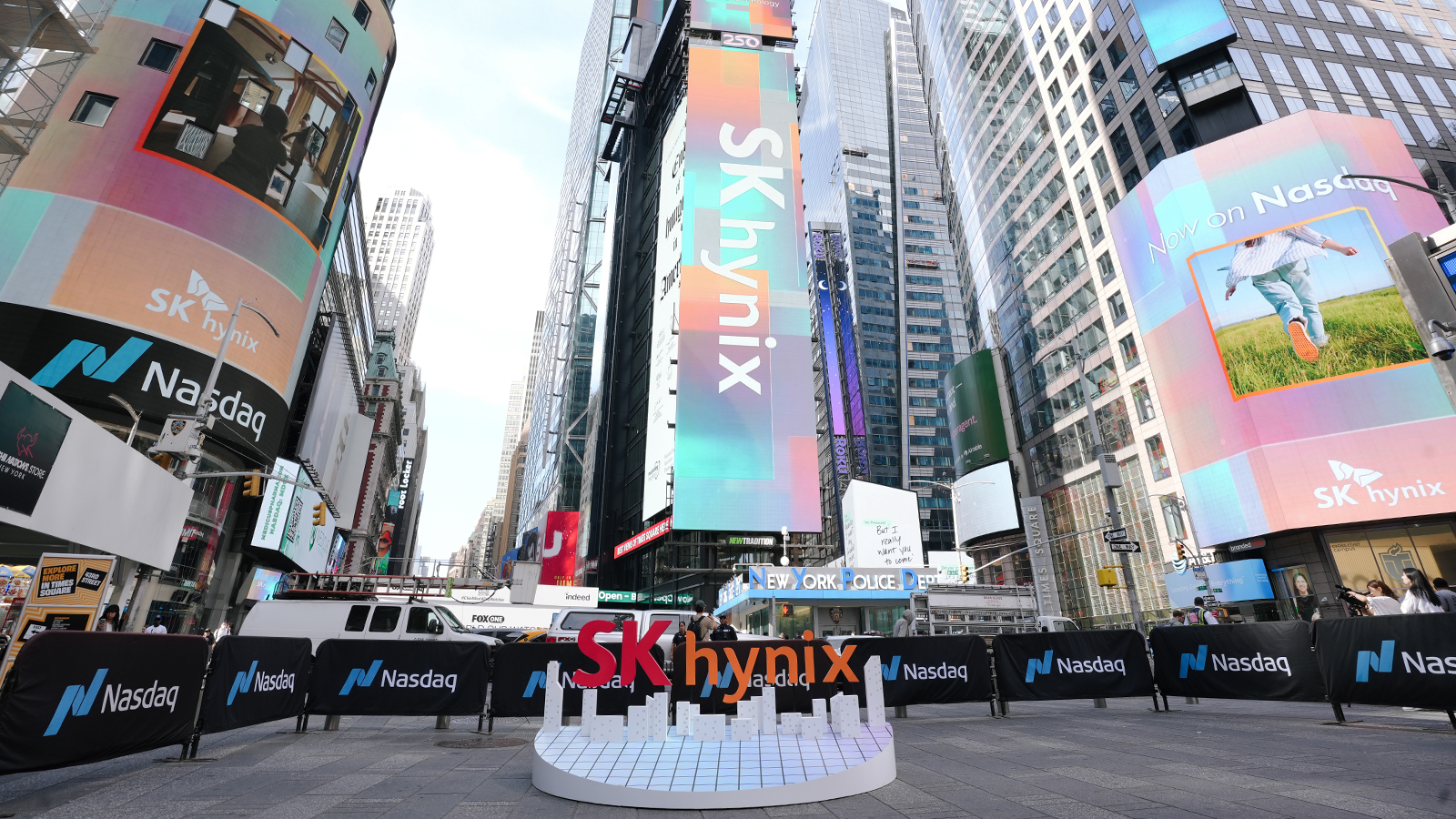
The global semiconductor landscape is currently undergoing its most significant transformation since the invention of the integrated circuit. At the epicenter of this seismic shift is South Korean memory titan SK Hynix, which recently cemented its strategic ambitions by completing the largest U.S. share sale by a foreign entity in history. By raising $26.5 billion through its debut on the Nasdaq, the company has secured the financial ammunition necessary to fuel an unprecedented era of domestic and global expansion.
This capital infusion is not merely a corporate milestone; it is a clear indicator that the "AI Supercycle"—the insatiable demand for high-performance memory necessitated by artificial intelligence—has effectively rewritten the rules of the semiconductor industry.
Main Facts: A Historic Nasdaq Debut
SK Hynix’s entry into the U.S. capital markets was nothing short of a blockbuster. The American depositary receipt (ADR) listing saw immediate investor fervor, with shares surging 13% on their inaugural day of trading. This market validation pushed the enterprise’s valuation to a staggering $1.2 trillion, reflecting Wall Street’s confidence in the firm’s ability to dominate the high-bandwidth memory (HBM) and next-generation NAND sectors.
The $26.5 billion raised is earmarked for a gargantuan, long-term corporate roadmap. SK Hynix has committed to a total domestic investment strategy of 1,100 trillion South Korean won (approximately $733 billion) over the coming years. This capital is being deployed immediately into the construction of cutting-edge fabrication plants, the acquisition of advanced lithography and deposition equipment, and the scaling of specialized machinery designed to push the boundaries of memory density and speed.

Chronology of the Expansion
The current frenzy of investment is the result of a multi-year convergence of supply constraints and technological breakthroughs.
- 2023–2024: The generative AI boom shifts from experimental research to enterprise deployment. Demand for HBM—the critical high-speed memory required for GPU-based AI training—outstrips supply by a significant margin.
- Early 2026: Micron Technology accelerates its U.S.-centric investment strategy, committing $250 billion through 2035 to expand manufacturing in New York and Idaho. Simultaneously, it breaks ground on a $9.3 billion expansion in Hiroshima, Japan.
- July 2026: SK Hynix officially lists on the Nasdaq, raising $26.5 billion to finalize its massive domestic capacity roadmap.
- Late 2026: Samsung Electronics prepares to bring its P4 fabrication plant in Pyeongtaek to full capacity, with phase-based expansions for P5 facilities slated to run through 2030.
- 2028 and Beyond: Analysts project that the current wave of "mega-fabs" will achieve full-scale, yield-stabilized output, potentially meeting the sustained demand of the next generation of AI-integrated consumer electronics and robotics.
Supporting Data: The Anatomy of Demand
The logic driving these capital expenditures is anchored in the shift from general-purpose computing to AI-accelerated workloads. Dwight Morse, a principal solutions architect at SiliconExpert, explains that the demand trajectory has moved from training to inference and storage.
"The main driver behind memory demand has been artificial intelligence," Morse noted. "It started with HBM supporting the training of models and has spread to NAND for the storage of tokens. It’s likely that these facilities will be operating at full capacity for the foreseeable future."
Supporting this, data from SEMI (Semiconductor Equipment and Materials International) highlights that AI is consuming a disproportionate share of total memory capacity. Unlike previous memory cycles, where demand was largely tied to the cyclical upgrade of PCs and smartphones, the current cycle is anchored in structural infrastructure. Clark Tseng, senior director of industry research and statistics at SEMI, emphasizes that capital expenditure today is a direct response to a fundamental market shift: the necessity of building the physical "nervous system" for the AI era.

Official Responses and Strategic Vision
The leadership teams at the world’s leading chipmakers are unanimous: the era of "wait and see" is over. Kwak Noh-Jung, CEO of SK Hynix, has publicly framed the expansion as a matter of industrial urgency.
"The current supply shortage, coupled with surging demand, has made expanding production capacity essential," Kwak stated. He pointedly added that the industry has crossed a threshold: "The AI industry has moved beyond the training phase and entered an era in which AI services are being deployed at scale."
This sentiment is echoed across the Pacific by Micron CEO Sanjay Mehrotra. In the context of Micron’s $250 billion commitment, Mehrotra remarked, "As America celebrates its 250th anniversary, data and memory are foundational to the modern economy—and Micron is increasing our U.S. investments to meet that moment."
Perhaps most telling is the perspective of SK Group Chairman Chey Tae-won, who rejects the notion that the industry is overheating. In response to concerns about a potential market downturn, Chey remains bullish, noting that the rise of "physical AI"—autonomous robots and AI agents—will require an exponential increase in memory per unit. "We’re going to double our capacity within five years, and all my customers say, ‘That’s not enough, man. We need more,’" Chey said.

Implications: Risks, Vulnerabilities, and the New Order
While the industry is currently in a state of hyper-growth, the trajectory is not without significant risks.
The "AI Bubble" Contagion
The Bank for International Settlements (BIS) has warned that if the financial returns on AI tools fail to materialize in the form of actual corporate revenue, the subsequent pullback in tech spending could cause a systemic shock. If the "AI supercycle" slows, the massive debt and capital tied up in new fabs could create a global oversupply crisis, crashing memory prices and destabilizing the financial health of major manufacturers.
Geopolitical Supply Chain Realignment
The industry is also navigating a treacherous geopolitical landscape. Both SK Hynix and Samsung are aggressively restructuring their supply chains to minimize reliance on Chinese equipment manufacturers. This move is a defensive hedge against the potential for these suppliers to be added to the U.S. Department of Commerce’s Entity List. The transition requires sourcing critical materials, such as specialized photoresists and thermal processing equipment, from non-Chinese, often more expensive, alternatives.
The Cyclicality Question
Historically, the memory market is notorious for its "boom-and-bust" cycles. However, analysts at TrendForce and elsewhere argue that the nature of AI hardware has fundamentally altered this pattern. Because HBM and high-end server storage are so deeply integrated into the AI infrastructure stack, manufacturers are less susceptible to the standard consumer-electronics demand fluctuations. Tom Hsu of TrendForce suggests that while consumer markets (PCs and smartphones) are showing signs of price fatigue, the demand for AI-driven data centers is robust enough to absorb the new supply growth expected by 2028.

Conclusion: A Permanent Transformation
The recent actions by SK Hynix and its competitors signify more than just an increase in manufacturing footprint; they represent a fundamental commitment to the "intelligence-first" economy. By locking in billions of dollars in capital and securing global market participation via the Nasdaq, these firms are betting that the demand for AI-ready memory is not a temporary spike, but a permanent requirement for the functioning of the future global economy.
As these companies race to bring their massive fabrication projects online, the world will be watching closely to see if the promise of AI can justify the massive physical and financial infrastructure currently being built. If the vision of leadership like Chey Tae-won holds true, we are not just building factories—we are building the foundation of a new, automated era of human productivity.