The rapid expansion of the digital economy, fueled by the explosive growth of artificial intelligence and cloud computing, has brought a hidden environmental crisis to the surface: water. While public discourse surrounding data centers has largely focused on their massive electricity consumption and carbon emissions, a critical, often overlooked component of their footprint is the staggering volume of water required to generate the power that keeps them humming.
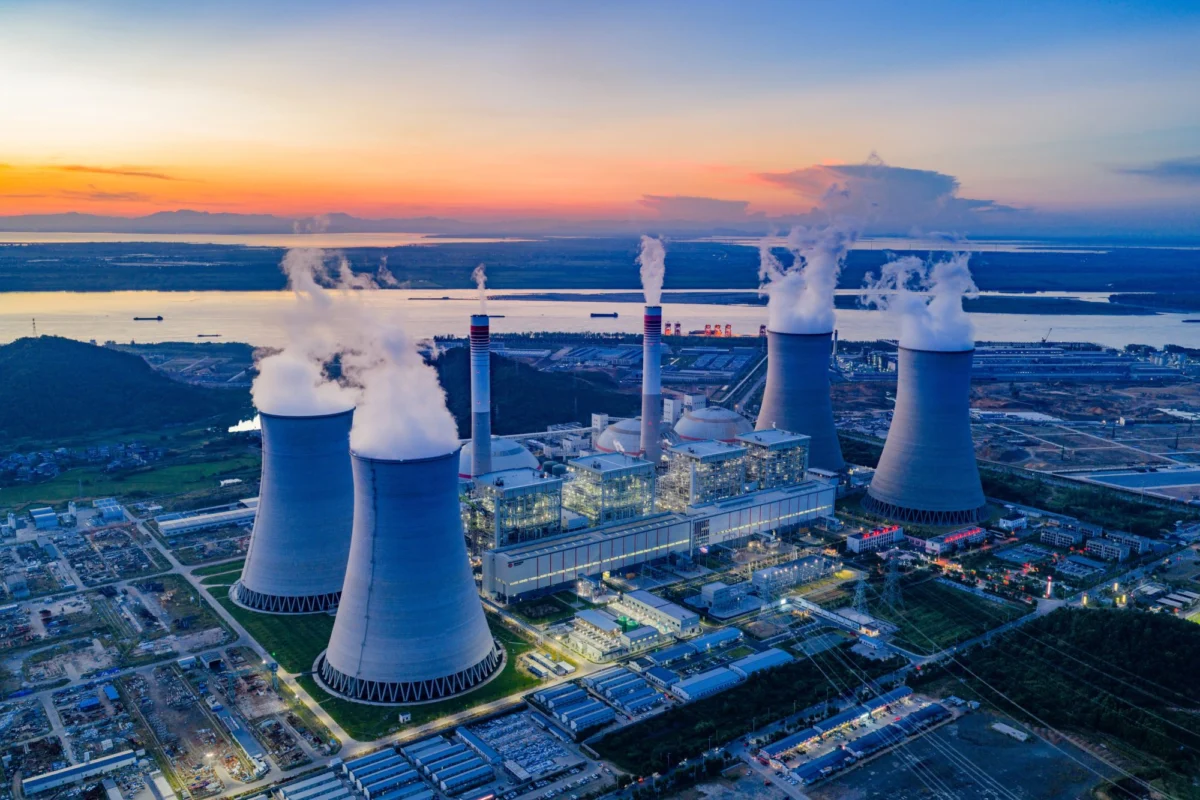
A landmark analysis published August 25 by the nonprofit organization Ceres, titled "Water Behind the Watts: The Hidden Risk of Powering Data Centers," reveals that the thirst of these facilities extends far beyond the liquid used for on-site cooling towers. Instead, the real "water hunger" lies upstream, within the power plants—nuclear, coal, and natural gas—that provide the electricity powering the digital infrastructure.
The Magnitude of the Hidden Crisis
When we consider the environmental impact of a data center, we often visualize the facility itself: rows of server racks cooled by massive industrial fans and water-chilling systems. However, this direct usage represents only a fraction of the total hydrological footprint.
The primary culprit is thermal electricity generation. Power plants, particularly those reliant on fossil fuels and nuclear energy, require immense quantities of freshwater for steam generation and cooling. According to Ceres, in just seven states that host more than half of all U.S. data centers, this indirect electricity-related water withdrawal accounts for an astonishing 3 to 4 trillion gallons annually.
To put this in perspective, consider the state of Virginia, a global hub for data center development. In 2024, the water required to generate the electricity consumed by the state’s data centers is estimated to be 21 times the total annual water consumption of the entire city of Washington, D.C. This is not just a rounding error; it is a fundamental shift in how regional water resources are allocated.
Chronology of an Emerging Resource Conflict
The intersection of data center expansion and water security is a relatively new phenomenon that has accelerated alongside the AI boom.
- Pre-2020: Data centers were primarily assessed by their Power Usage Effectiveness (PUE) ratios, with water consumption being a secondary concern primarily tied to local evaporative cooling systems.
- 2021–2022: As AI models like ChatGPT entered the mainstream, the density of server racks increased significantly, leading to higher power requirements and, consequently, higher water-cooling demands.
- 2023: Regional water authorities began raising alarms about the cumulative load on municipal water supplies. Public opposition to data center developments in water-stressed regions, such as Arizona, began to gain legal and political traction.
- 2024: Industry-wide recognition of "indirect" water use grew. The Ceres report serves as a watershed moment, shifting the conversation from "how much water does this building use?" to "how much water does the entire energy grid use to sustain this building?"
Supporting Data: Regional Disparities and Energy Sources
The water footprint of a data center is inextricably linked to the energy mix of the grid to which it is connected. The Ceres report highlights a sharp contrast between states depending on their energy infrastructure:
Hydroelectric Dependency: The California Case
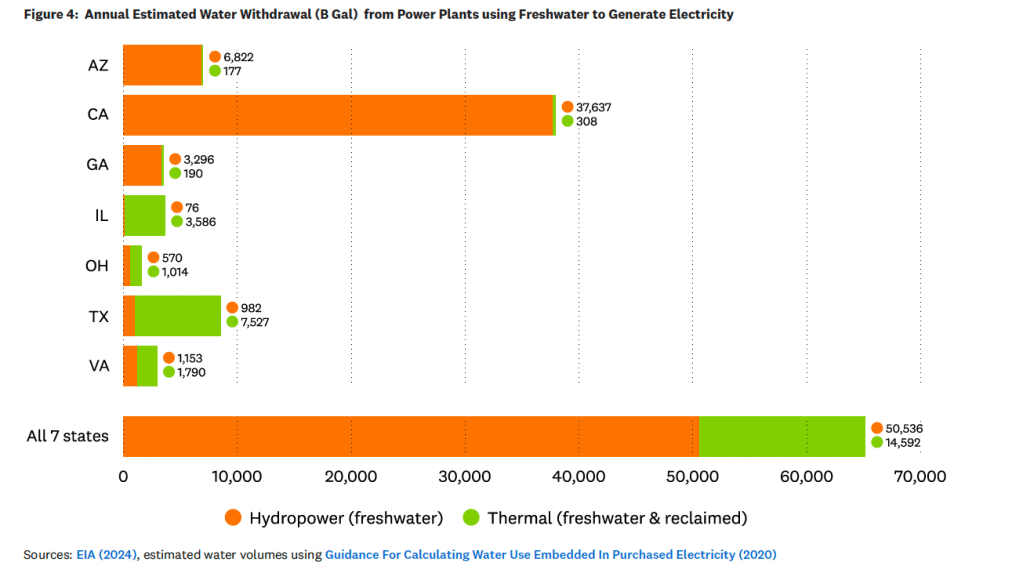
California tops the list for water withdrawals among the states analyzed, with nearly 1.4 trillion gallons attributed to its grid. This is largely due to the state’s significant reliance on hydroelectric power. While often viewed as "green" because it is low-carbon, hydroelectric generation is a massive water-intensive process, as it relies on the physical movement and evaporation-prone management of vast river systems.
Thermal Generation: The Midwest and Mid-Atlantic
In states like Ohio, Georgia, and Virginia, more than 90 percent of the indirect water use is linked to thermal generation—the combustion of natural gas and coal, or the operation of nuclear reactors. These plants operate by boiling water to turn turbines, a process that is fundamentally thirsty. The recent pivot by tech giants—including Amazon, Meta, Microsoft, and OpenAI—to invest in new natural gas capacity to meet the surging power demands of AI is particularly concerning to water researchers, as it locks in decades of water-intensive thermal dependency.
The Role of Renewables
Conversely, states like Texas demonstrate a more efficient water-to-power profile. Because Texas has aggressively integrated solar and wind power, its data centers exert less pressure on freshwater resources compared to their counterparts in states reliant on traditional, steam-based thermal plants. Wind and solar photovoltaics require virtually no water for electricity generation, marking them as the clear choice for sustainable, long-term infrastructure growth.
Official Responses and Industry Accountability
The lack of transparency remains the most significant hurdle to mitigating this crisis. As Shama Perveen, director of water research at Ceres and a co-author of the report, points out, the link between freshwater withdrawals and electricity procurement is a metric that almost no data center operator voluntarily discloses.
"This is the foundation for better understanding water risk," Perveen stated. "We need to work with power producers and peers in a precompetitive space to develop best practices that minimize impacts on local water resources, especially in areas that are already suffering from drought or chronic water stress."
The sentiment is echoed by industry analysts like Jonathan Koomey, who has spent decades researching the efficiency of digital infrastructure. "It’s a real problem the industry needs to figure out," Koomey said. "They are being confronted with numbers that are all over the place. People don’t have a clear way to measure this, and there aren’t clear standards. The industry is flying blind, and that is a recipe for disaster in regions where water is becoming a finite, contested resource."
Implications for the Future of Tech
The implications of this water dependency are profound, touching on geopolitics, corporate strategy, and environmental justice.
1. Locational Strategy
Data center operators can no longer choose locations based solely on tax incentives, connectivity, and electricity prices. Future development must factor in the "water stress" of a region. Placing massive, power-hungry facilities in drought-prone areas like Arizona or parts of the American Southwest is increasingly viewed as a long-term liability for both the company and the local community.
2. The Rise of "Water-Aware" Contracting
As the link between electricity procurement and water usage becomes common knowledge, we expect to see a shift toward "water-aware" power purchasing agreements (PPAs). Tech companies may begin to prioritize contracts with renewable energy providers not just for carbon reduction, but for their low water footprint.
3. Regulatory Pressures
If the industry fails to self-regulate, local and state governments will likely step in. We are already seeing the early stages of this, with municipal water boards in data-center-heavy regions questioning the long-term sustainability of allowing massive industrial expansion during periods of water scarcity. Mandatory disclosure of "indirect water usage" could become the next big regulatory hurdle for Big Tech.
4. Innovation in Cooling and Power
The pressure to reduce the water footprint will likely catalyze innovation in two areas:
- Advanced Cooling: Developing air-cooling systems that do not require water evaporation.
- Energy Efficiency: Reducing the sheer amount of power required for AI training, which would, by extension, reduce the water required by the grid to provide that power.
Conclusion: A Call for Transparency
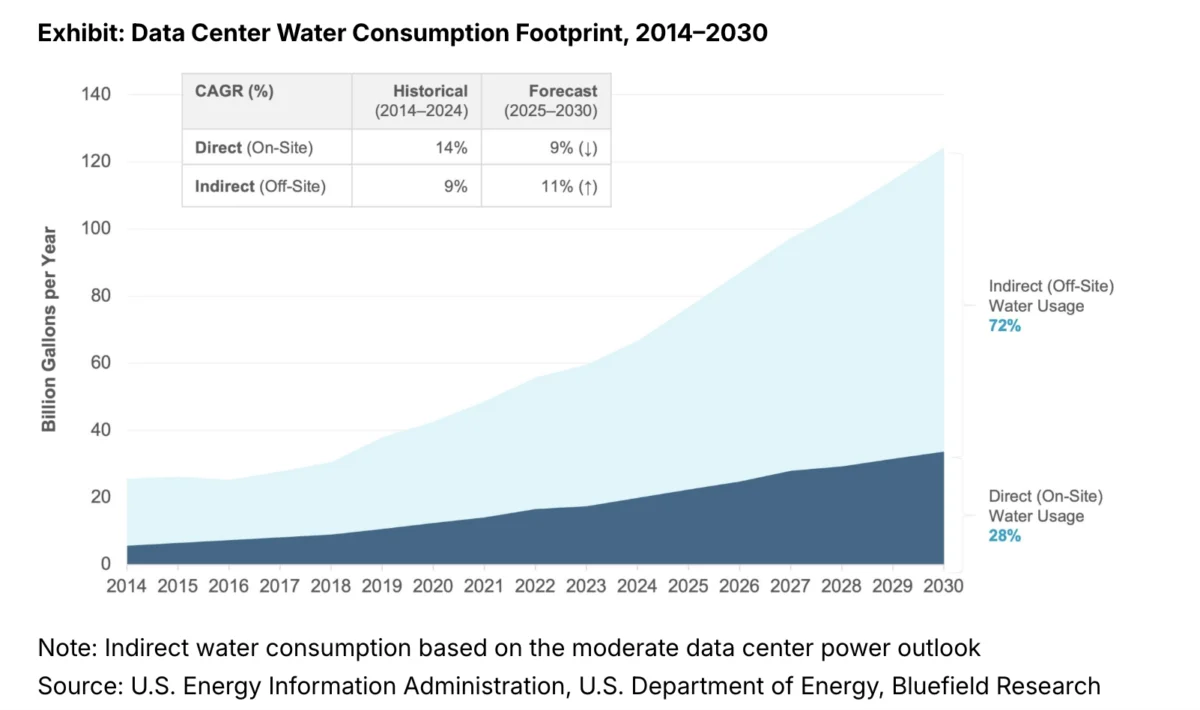
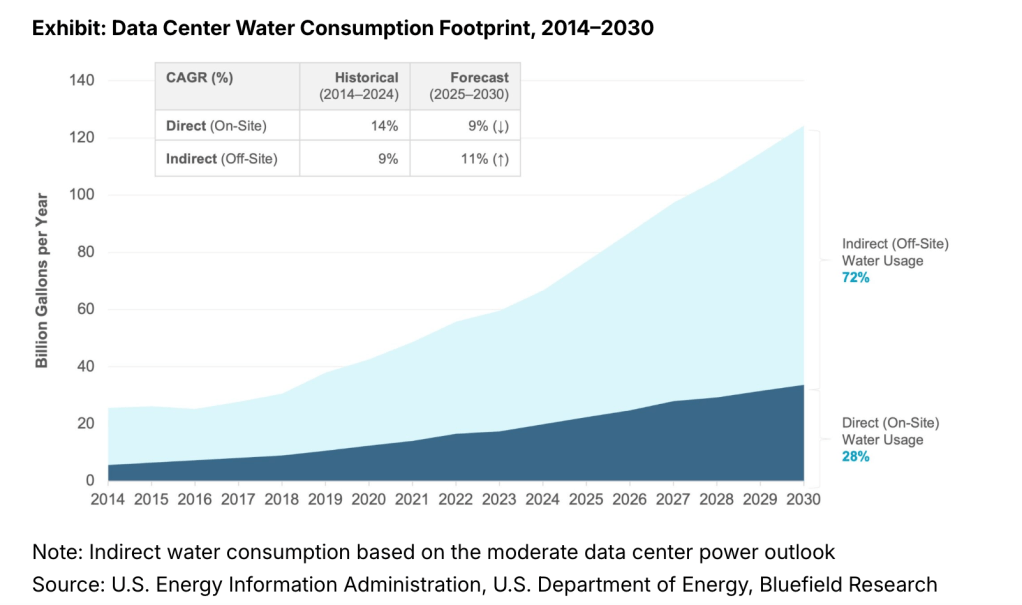
The digital transformation is essential, but it cannot come at the expense of the basic human right to water. The findings from Ceres and Bluefield Research—which predicts that the water needed for data center power generation will double annually and account for over 70 percent of data center water consumption by 2030—serve as a clarion call.
The industry is at a crossroads. It can continue to operate in the shadows, masking its true environmental cost, or it can lead the way in transparency and efficiency. For companies like Amazon, Microsoft, and Meta, the challenge is clear: if they want to build the future of AI, they must first ensure that the power fueling it does not drain the wells of the future. The transition to a water-conscious digital infrastructure is no longer an option—it is a necessity for the survival of the very communities that host these digital giants.