In the high-stakes world of semiconductor engineering, the "first-silicon success" metric has become a sobering benchmark. With industry-wide success rates currently languishing below 15%, the cost of failure has never been higher. As the industry pivots toward 3D integrated circuit (3D IC) architectures—characterized by billions of transistors, heterogeneous chiplets, and intricate memory hierarchies—the complexity of design has outpaced the capabilities of traditional verification tools.
While the semiconductor industry has made significant strides in automating RTL generation and verification coverage, a critical, resource-intensive hurdle remains: debugging. Accounting for roughly 50% of the entire verification effort, debugging is no longer just a task; it is the single largest productivity bottleneck in the chip development lifecycle.
The Anatomy of the Debug Crisis
To understand why debugging has become the industry’s "Achilles’ heel," one must first acknowledge the shift in scale. Modern 3D IC designs involve multiple clock domains, sophisticated hardware-software interactions, and complex packaging, all of which multiply the potential for obscure, transient failures.
The Complexity Gap
As design complexity scales, the relationship between a failure symptom and its root cause becomes increasingly nebulous. In previous generations, a bug might manifest in a localized block. Today, a failure in a 3D IC system may be the result of a race condition occurring across chiplet boundaries, thousands of clock cycles prior to the observed error.

Engineers are currently forced to perform manual "forensics," sifting through a mountain of disparate data: simulation logs, complex waveforms, assertions, design documentation, and commit histories. Because no single tool provides a holistic view, the hypothesis space grows exponentially. Engineers are left to manually connect the dots, a process that is not only slow but heavily reliant on the "tribal knowledge" of senior architects.
The "Needle in the Haystack" Problem
Consider a recent case study involving a bidirectional serialization interface. A complex failure occurred where a control signal and a data payload shared the same channel. A specific sequence—a reset triggered mid-transaction, combined with a data value that mimicked a start-code—caused the Subordinate to misinterpret the frame. This mismatch cascaded, leading to a system failure much later in the run. Such "impossible-to-spot" bugs, which require the alignment of multiple improbable events, are becoming the norm in high-density designs.
Chronology of the Debugging Evolution
The evolution of semiconductor debug has moved from manual inspection to automated script-based tools, and now, to the frontier of agentic AI.
- The Era of Manual Triage (1990s–2000s): Debugging was a deeply human endeavor. Engineers relied on logic analyzers and basic waveform viewers. The process was slow, linear, and limited by the human capacity to track state transitions.
- The Rise of Verification Automation (2010s): The industry introduced Universal Verification Methodology (UVM) and formal verification. While these tools improved coverage, they also generated an explosion of data, leading to "log fatigue" among engineers.
- The Agentic Shift (2024–Present): With the introduction of multi-agent AI systems, the focus has shifted from merely detecting bugs to orchestrating the entire root cause analysis (RCA) workflow. Instead of providing raw data, these systems provide a path to resolution.
Supporting Data: The Case for AI-Driven RCA
The economic argument for moving beyond manual debugging is supported by recent field data. For teams managing large-scale regressions, a single run can produce dozens of failures, each requiring deep, manual tracing.

The ChipAgents Case Study
The impact of autonomous RCA is best illustrated by a recent collaboration between ChipAgents and a firm specializing in 3D IC and Wafer-on-Wafer (WoW) technologies. Facing a memory controller issue with limited observability, the engineering team was stalled. Conventional methods required days of manual correlation across verification sources.
By deploying an agentic AI platform, the team achieved the following:
- Time-to-Resolution: Reduced from days to between 15 and 60 minutes.
- Accuracy: A 100% hit rate in identifying the underlying root cause.
- Project Impact: Avoided an estimated one to two weeks of project delays, proving that AI is not just a productivity tool but a critical schedule-recovery mechanism.
Token Efficiency and Cost-Performance
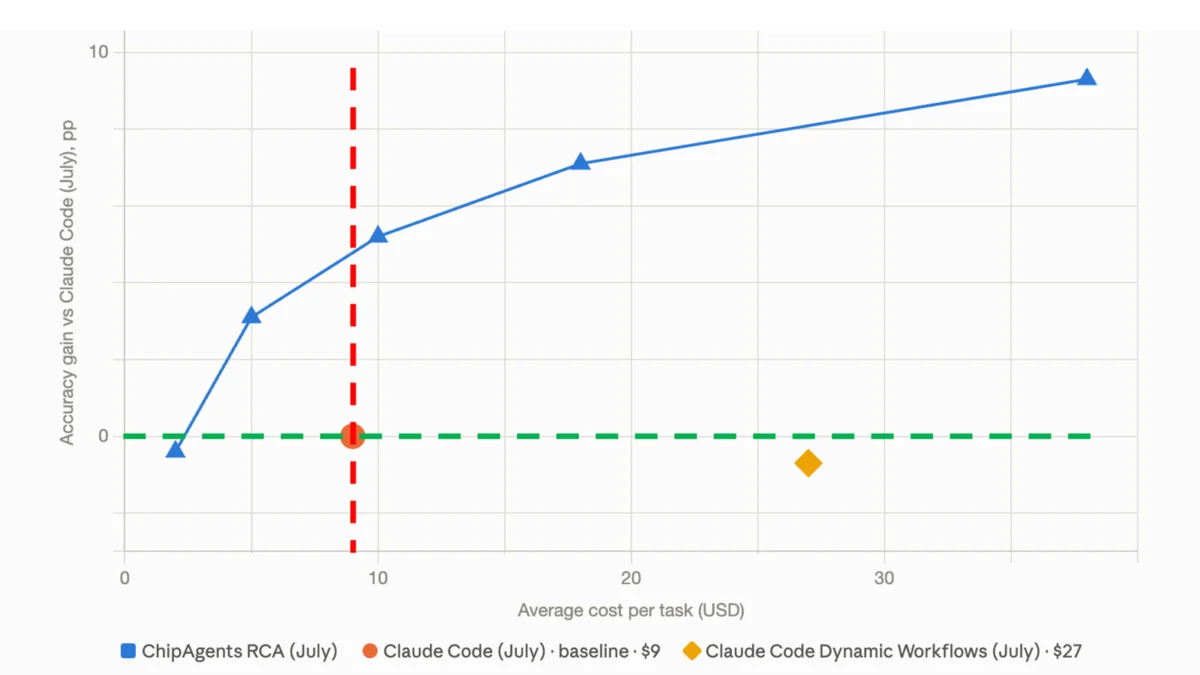
A common critique of Large Language Model (LLM) applications in engineering is the cost of "token consumption." However, new benchmarks suggest that domain-specific agents are drastically more efficient than general-purpose coding assistants. By constraining the agent’s operating environment to the specific context of hardware design—rather than general software coding—ChipAgents has demonstrated that they can achieve higher accuracy at a fraction of the cost of generic, large-scale AI models.
Official Industry Perspectives
The transition toward autonomous debugging is not merely a vendor-led trend; it is a necessity driven by market pressure. Leaders in the space, such as Zackary Glazewski of ChipAgents, argue that the industry is at an inflection point. "We are moving from a world where engineers spend 80% of their time finding the bug and 20% fixing it, to a world where AI performs the triage, allowing engineers to focus on validation and high-level architectural improvements," Glazewski noted in recent industry discourse.

Furthermore, the integration of these tools into CI/CD (Continuous Integration/Continuous Deployment) pipelines is considered the "holy grail" of semiconductor workflows. By resolving known issues automatically overnight, these platforms ensure that when an engineer starts their day, they are presented with a prioritized report rather than a backlog of unexplained simulation failures.
Implications for the Future of Silicon
The shift toward agentic AI in semiconductor engineering carries profound implications for the industry’s future:
1. Scaling Beyond Human Capacity
As we approach the era of trillion-transistor chips, the human brain’s ability to visualize state machines and timing paths will be insufficient. Agentic AI acts as an "extended cognition" layer, enabling the analysis of design hierarchies that are simply too large for a single team to monitor manually.
2. Redefining the Role of the Verification Engineer
The role of the verification engineer is shifting from "manual detective" to "system orchestrator." By offloading the tedious, iterative work of trace-back and log analysis to AI agents, engineers are freed to focus on the edge cases that define the robustness of a new design.

3. Accelerated Time-to-Market
In the semiconductor industry, time-to-market is the primary determinant of commercial success. By cutting root cause analysis time from days to minutes, companies can perform more design iterations, test more configurations, and ultimately reach the "first-silicon success" threshold significantly faster.
4. The Path to Autonomous Design
The ultimate goal of this technology is the autonomous design flow. While we are currently in the stage of autonomous debugging, the success of these systems suggests that we are laying the groundwork for a future where the design, verification, and debug cycles are linked in a continuous, self-correcting loop.
Conclusion
The semiconductor industry is currently undergoing a paradigm shift. As 3D IC architectures become the standard, the complexity of debugging threatens to throttle innovation. However, the emergence of multi-agent, domain-specific AI platforms offers a clear path forward. By transforming the debugging process from a manual, experience-dependent chore into an automated, data-driven workflow, these technologies are not just saving time—they are enabling the next generation of hardware to move from concept to silicon with unprecedented reliability and speed. The "Productivity Frontier" is no longer a distant goal; it is here, and it is being defined by the agents in the machine.