The integration of artificial intelligence into enterprise IT management is no longer a futuristic concept—it is a present-day reality. As organizations rush to deploy autonomous AI agents to manage device fleets, patch vulnerabilities, and streamline workflows, a critical oversight has emerged: the gap between AI capability and IT governance.
A new entrant in the device management space, Smplify, has emerged with a $1 million pre-seed funding round to tackle this specific challenge. By positioning itself as a "headless" management tool, Smplify aims to provide the guardrails necessary to ensure that AI-driven automation remains under the strict, auditable control of IT administrators.
The Main Facts: Defining the "Last-Mile" Control Plane
At the core of the current IT dilemma is the shift from "AI as an assistant" to "AI as an actor." Traditionally, IT management platforms functioned as interfaces where human administrators monitored dashboards and manually initiated changes. Today, AI agents are increasingly authorized to execute changes at machine speed.
Smplify, co-founded by COO Ben Greiner and industry veteran Preetham Gurram—whose resume includes foundational work at MobileIron, SOTI, and Apple—seeks to solve the "last-mile control" problem. Their platform is designed as a headless, API-first service, meaning it is not a standalone dashboard but a layer of governance that integrates directly into existing IT workflows.
"Device management still assumes a person is watching," Greiner explains. "Admins already automate with scripts and pipelines, and now AI agents are showing up that can act on a fleet at machine speed. Enterprises that win won’t be the ones with the smartest agents; they’ll be the ones that can say exactly what each agent is allowed to do and prove what it did."
Essentially, Smplify acts as a final checkpoint. An AI agent might identify a vulnerability and propose a patch, but the Smplify platform ensures that the action cannot be executed on the device fleet until it has been vetted, logged, and authorized against a predefined policy framework.
A Chronology of the Autonomous IT Shift
The trajectory toward autonomous IT management has been swift, marked by several key developments:
- The Era of Scripting (2010–2020): IT teams relied on manual scripting and rudimentary automation to manage growing fleets. The human was always the final "gatekeeper" of the execution.
- The Rise of Declarative Device Management (DDM): Apple’s introduction of DDM marked a turning point. Instead of pushing specific commands, admins began defining a "desired state," allowing devices to reconcile their own status.
- The AI Gold Rush (2023–Present): With the proliferation of LLMs and autonomous agents, organizations began experimenting with tools that can "self-heal" infrastructure, leading to the current crisis of governance.
- The Governance Correction (2025–2027): Industry analysts, including those at Gartner, are now predicting a massive "decommissioning" phase as companies realize that unmonitored AI agents are creating more technical debt and security risks than they are solving.
Smplify enters the market at this pivotal moment, aiming to bring the discipline of GitOps—version control, peer review, and audit logs—to the world of mobile and desktop device management.
Supporting Data: The Governance Gap
The urgency of this transition is backed by sobering statistics. According to the OneTrust 2026 AI-Ready Governance Report, while 87% of organizations are actively encouraging the adoption of AI agents, less than half (47%) have implemented the necessary governance and controls to manage them.
The risks are not merely theoretical. Gartner predicts that by 2027, 40% of enterprises will be forced to demote or decommission autonomous AI agents due to governance failures that only become apparent after a catastrophic incident occurs.
These incidents often stem from "hallucinations" or logical errors in the AI’s decision-making process. If an agent is given broad permissions—such as the ability to push software updates or modify system configurations—a single misinterpretation of a problem can result in a fleet-wide outage. As Fleet CEO Mike McNeil has noted, the "cost of recovery" is the primary risk factor. If an agent with root-level access makes a destructive change, the time and effort required to revert those changes can cripple an organization’s productivity.
Official Responses and Industry Perspectives
The challenge of "watching the watchmen" has captured the attention of major players in the MDM space.
The Jamf Approach
Jamf, a leader in the Apple device management market, has moved aggressively to address AI governance. Earlier this year, CEO Beth Tschida emphasized that the goal is not to block AI—which is effectively impossible—but to build a framework of visibility around it. Jamf launched an AI Governance suite in July, focusing on discovery, policy enforcement, and reporting to ensure that administrators remain informed about what AI tools are being used and how they are interacting with the fleet.
The Fleet Perspective
Mike McNeil of Fleet highlights that the danger is tied directly to the level of privilege granted to the agent. "I’d frame risk by two things: how much privilege the code runs with and how hard recovery is," McNeil stated. His focus is on preventing the "wipe thousands of laptops" scenario, where an agent with a privileged key executes a command that cannot be easily undone, leaving IT teams scrambling to manually re-image devices.
The Smplify Philosophy
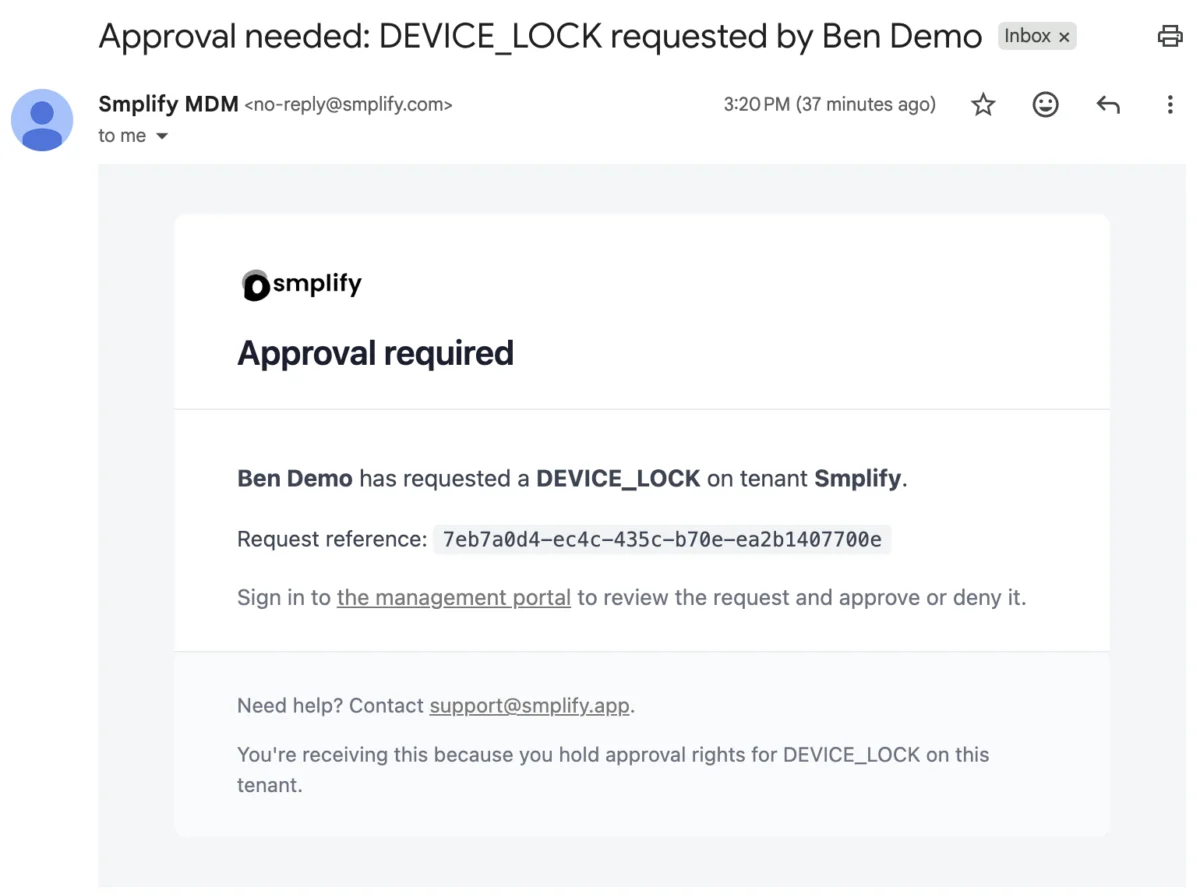
Greiner and Gurram argue that the solution lies in treating AI agents as untrusted entities until proven otherwise. By utilizing Apple’s DDM protocols, Smplify allows admins to define a "state of truth." The system then monitors the fleet to ensure it adheres to that truth. If an AI agent attempts to make a change that deviates from the desired state, Smplify intercepts the request. It creates a record of the intent, the source of the instruction, and holds the action until a human provides the go-ahead.
Implications: The Future of IT Management
The emergence of tools like Smplify, combined with the maturation of Apple’s Declarative Device Management, suggests a broader shift in how IT will function in the coming decade.
1. The Death of the "Wild West" Automation
We are moving away from an era where IT admins write "black box" scripts that run unchecked. The future of IT is "Intent-Based Management." Admins will define the policy (the intent), and the system will ensure the environment remains compliant. AI will be used to speed up the process of reaching that state, but it will no longer have the "keys to the kingdom."
2. Apple’s Privacy-First Influence
Apple’s increasing controls over Apple Intelligence, particularly its focus on on-device processing, play a significant role in this evolution. As businesses demand tighter control over which AI features are enabled on company-owned hardware, MDM vendors are being forced to provide more granular, policy-based toggles. Smplify’s alignment with this, particularly through its emphasis on local, API-first management, is a direct response to the enterprise need for privacy and control.
3. The Human-in-the-Loop Requirement
Despite the hype surrounding "fully autonomous" agents, the consensus among industry leaders is that human oversight is not going away—it is merely changing form. The role of the IT administrator is transitioning from a "doer" to a "governor." By approving the policies that the AI must follow, IT teams can achieve the efficiency of machine-speed management without the existential risk of automated failure.
4. The commoditization of Management
Finally, Smplify’s API-first model suggests a future where device management is no longer a siloed application. By allowing other software companies to embed device management capabilities directly into their own products, Smplify is setting the stage for a world where management features are a utility, rather than a destination.
Conclusion: A New Standard for Stability
The "AI-ready" organization of the future will be defined by its ability to balance speed with security. The "last-mile control plane" proposed by Smplify is a blueprint for this balance. As organizations continue to integrate autonomous agents, the ability to define, audit, and intercept machine-driven actions will become the most critical skill set for IT departments.
The era of "set it and forget it" automation is over. In its place is an era of "define, verify, and govern"—a necessary evolution to ensure that the promise of AI does not result in the chaos of an unmanaged enterprise.