In the high-stakes arena of artificial intelligence, where multi-billion-dollar valuation cycles are typically defined by the raw size of Large Language Models (LLMs), a quiet revolution is brewing in London’s King’s Cross. Inherent, an AI laboratory founded by alumni of Google DeepMind, has emerged from stealth with a $50 million seed round and a bold technical proposition: to move beyond the "brute force" scaling laws that have dominated the industry for the past three years.
The startup’s latest breakthrough, an AI agent dubbed Faraday, has demonstrated the ability to independently replicate the findings of complex scientific papers without prior knowledge of the results. Most significantly, it achieved this feat not by leveraging massive, energy-hungry frontier models, but by utilizing a compact, 27-billion-parameter architecture. This development marks a potential turning point in AI research, suggesting that "research taste"—the instinctual ability to design valid experiments—may soon be teachable through reinforcement learning, rather than just massive compute investment.
The Chronology of Inherent: From Stealth to Scientific Breakthrough
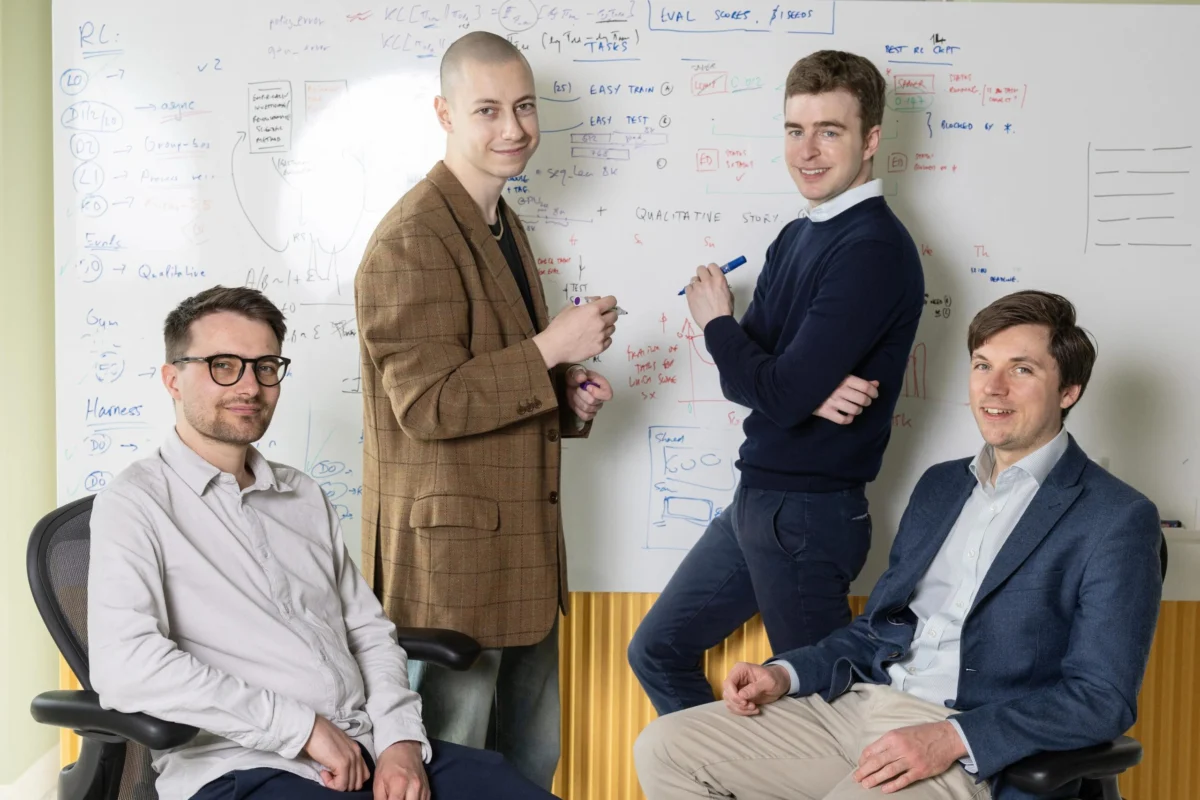
The story of Inherent is deeply intertwined with the evolution of the London AI ecosystem. Following a wave of high-profile departures from Google DeepMind, four co-founders—Edward Hughes, Louis Kirsch, Kaloyan Aleksiev, and Tantum Collins—sought to create a laboratory that focused on the "how" rather than the "how big."
- Early 2026: Inherent formalizes its mission to build AI agents capable of autonomous scientific discovery. The team prioritizes in-person collaboration, setting up headquarters in King’s Cross, a district transformed into a global AI nexus largely by the influence of DeepMind.
- May 2026: The startup emerges from stealth, announcing a successful $50 million seed funding round. This capital injection provides the necessary runway for their ambitious roadmap.
- June/July 2026: The lab begins internal testing of Faraday. Rather than focusing on general-purpose conversational AI, the team trains the agent to perform a task traditionally reserved for doctoral students: the independent replication of published scientific literature.
- August 2026: Inherent publishes data showing Faraday outperforming frontier-scale models like Anthropic’s Claude Opus 4.8 and OpenAI’s GPT-5.5 on replication tasks.
Supporting Data: Efficiency Over Scale
The core of Inherent’s claim lies in a direct comparison of efficiency. In the current AI zeitgeist, the number of "parameters"—the internal weights that define an AI’s intelligence—is often correlated with cost and capability.
The Efficiency Gap
| Model | Size (Parameters) | Performance Metric |
|---|---|---|
| Qwen 3.6 (Faraday) | ~27 Billion | High (Scientific Replication) |
| GPT-5.5 | Frontier-scale (Massive) | Baseline |
| Claude Opus 4.8 | Frontier-scale (Massive) | Baseline |
Faraday operates on the Qwen 3.6 architecture. By utilizing a model that is a fraction of the size of its competitors, Inherent is not only lowering the inference cost but also challenging the industry-wide assumption that intelligence is exclusively a byproduct of sheer scale.
The researchers at Inherent argue that their secret sauce is not the model itself, but the reinforcement learning (RL) framework applied to it. By rewarding the agent for successful scientific reasoning and experimental design—rather than simply feeding it massive datasets of existing research—they are cultivating what they term "research taste."
Official Perspectives: The Philosophy of the "Teammate"
Edward Hughes, the Chief Scientist at Inherent, has been vocal about the company’s "North Star": the creation of an AI scientist. In a series of interviews, Hughes emphasized that the goal is not to build a tool that replaces the scientist, but one that functions as a collaborative peer.
"We’re not looking for a system that just parrots back facts or tells you what you want to hear," Hughes noted. "We want an agent that functions like a brilliant, curious PhD student. The ideal interaction is one where the agent says, ‘I got curious about this specific variable, so I went off and designed these experiments. Here are the results—what do you think?’"
This collaborative ethos is reflected in their technical choices. Rather than reinventing the wheel by building a proprietary coding environment, Inherent utilizes OpenAI’s GPT-5.5 Codex. This mimics the behavior of human scientists, who rely on established software libraries and tools to facilitate their research rather than building their own operating systems from scratch.
The "Garden Leave" Barrier and the Future of Talent
Inherent’s rapid growth occurs against a backdrop of structural tension within the U.K. technology sector. Hughes has been a prominent critic of "garden leave," a common U.K. employment practice that forces departing staff to remain idle for months before joining a competitor.
"It’s a personal view, but I was affected by the garden leave problem," Hughes stated. He points out that such restrictions place U.K. startups at a distinct disadvantage compared to their American counterparts, who can often move between organizations with greater fluidity. This, he argues, is a critical bottleneck for the London tech scene, which otherwise possesses the necessary density of talent to rival Silicon Valley.
Despite these regulatory hurdles, Inherent is scaling. With a current team of roughly a dozen, they plan to reach 25 employees by the end of 2026. As staff at major labs like Google DeepMind navigate the uncertainties of corporate restructuring and leadership changes, Inherent is positioning itself as a destination for researchers who are frustrated by the limitations of large, bureaucratic organizations.
Implications: The Shift Toward Agentic Science
The broader implications of Inherent’s work are profound. If an AI agent can reliably perform the work of a human scientist—replicating experiments, identifying flaws in methodology, and designing novel research paths—the pace of scientific discovery could accelerate by an order of magnitude.
1. Democratizing Scientific Rigor
By reducing the compute power required for high-level scientific reasoning, Inherent is lowering the barrier to entry. If small, efficient models can perform sophisticated research, the ability to conduct high-level scientific inquiry becomes available to smaller labs, universities, and developing nations that cannot afford to train or run trillion-parameter models.
2. Reinforcement Learning as the New Frontier
Inherent’s pivot away from purely supervised learning suggests a growing consensus in the field: raw text prediction is reaching a plateau. The next wave of "smart" AI will likely be defined by models that are "raised" through reinforcement learning, where the agent is forced to navigate the constraints of reality—such as physical or chemical laws—and is rewarded for logical consistency and experimental success.
3. The "Taste" Factor
Perhaps the most ambitious aspect of Inherent’s work is the formalization of "research taste." This refers to the ability to discern which scientific questions are worth asking and which methodologies are most likely to yield significant results. By attempting to codify this, Inherent is moving the goalposts from "Information Processing" to "Creative Judgment."
Conclusion: A New Chapter for London Tech
As Inherent continues to refine Faraday, the industry will be watching closely to see if their "small-model" philosophy holds up under broader, more complex scientific challenges. The company is currently operating at the intersection of high-level research and commercial pragmatism, betting that the future of AI lies not in the largest models, but in the most capable, efficient, and "curious" ones.
For now, the team in King’s Cross remains committed to their vision of the future. By prioritizing scientific integrity and collaborative, agentic behavior, Inherent is not just another startup attempting to ride the generative AI wave; they are attempting to build the tools that will fundamentally change how we conduct science itself. Whether they can scale their "research taste" to the point of autonomous discovery remains the billion-dollar question. However, if their initial results are any indication, the age of the AI scientist may have already begun.