Main Facts: SpaceNews to Host Virtual Summit on the Evolution of In-Space Logistics
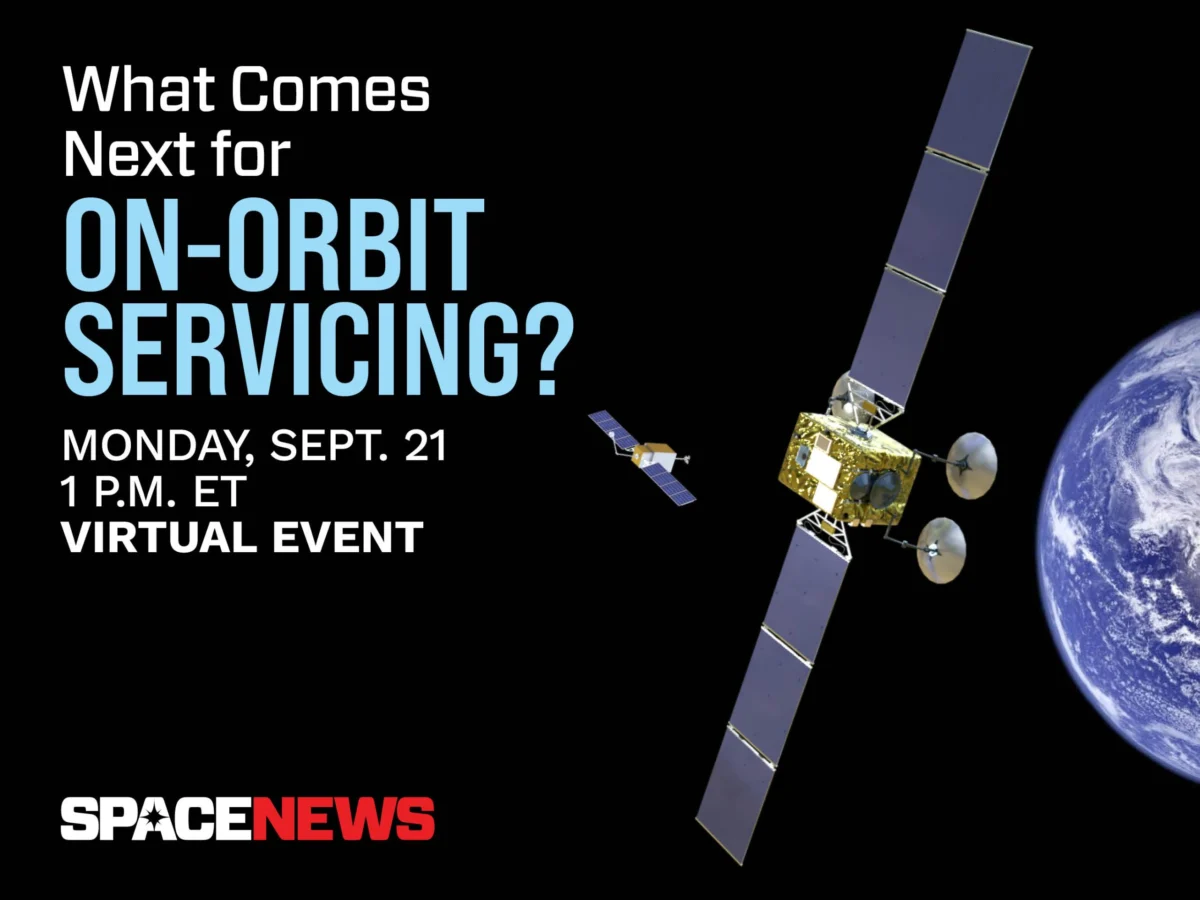
On Monday, September 21, 2026, from 1:00 p.m. to 1:45 p.m. ET, SpaceNews will host a virtual panel discussion titled "What Comes Next for On-Orbit Servicing?" The event arrives at a critical inflection point for the global space industry. Over the past decade, the concept of In-space Servicing, Assembly, and Manufacturing (ISAM) has transitioned from a series of high-risk, experimental demonstrations into a foundational pillar of the emerging orbital economy.
Today, commercial spacecraft are actively proving the viability of autonomous rendezvous, proximity operations, and docking (RPOD). Technologies designed for orbital transfer, active debris removal (ADR), life extension, and robotic manipulation are no longer theoretical; they are operational realities. However, as the technical baseline stabilizes, the industry faces a complex web of market, regulatory, and systemic challenges.
================================================================================
                           VIRTUAL EVENT DETAILS
================================================================================
Event     What Comes Next for On-Orbit Servicing?
Date:           Monday, September 21, 2026
Time:           1:00 p.m. to 1:45 p.m. Eastern Time (ET)
Format:         Virtual Panel Discussion (Recording available post-event)
Organizer:      SpaceNews
Key Themes:     Autonomous RPOD, Orbital Refueling, Active Debris Removal,
                Technical Interoperability, Defense & Commercial Dual-Use
================================================================================
The upcoming SpaceNews virtual summit will convene leading experts, policymakers, and commercial executives to address the critical questions determining the trajectory of this sector:
- Market Maturation: Which commercial use cases—such as satellite life extension, in-orbit refueling, or orbital cargo transport—will achieve self-sustaining profitability first?
- Technical Standardization: What universal standards and physical interfaces are required to ensure that servicing vehicles built by different companies can seamlessly and safely interact with diverse client satellites?
- Public-Private Partnerships: How should civil space agencies and military organizations structure contracts, grants, and regulatory frameworks to incentivize private capital investment?
- Dual-Use Dynamics: How can the international community balance the commercial utility of servicing technologies with the national security concerns inherent in systems capable of maneuvering close to sensitive military satellites?
The panel will explore these issues across three primary domains: supporting the transition to commercial low-Earth orbit (LEO) space stations, enabling sustainable infrastructure for deep-space and lunar exploration, and bolstering the resilience of national security assets in highly contested orbital regimes.
Chronology: The Evolution of In-Space Servicing
The path to a standardized on-orbit logistics ecosystem has been shaped by a shift from bespoke, government-led engineering triumphs to agile, commercially driven service offerings.
       [1993-2009]             [2020-2021]             [2024-2025]             [2026+]
  =====================   =====================   =====================   =====================
  Bespoke Gov Missions    First Commercial GEO    Non-Cooperative RPOD    Standardized Logistics
  - Hubble Servicing      Life Extension          - Astroscale ADRAS-J    - Universal ports
  - High-cost, manual     - MEV-1 & MEV-2 dock    - Inspections of        - Commercial fuel
    shuttle operations      with active Intelsat    space debris assets     depots & stations
The Era of Bespoke Government Operations (1993–2011)
For decades, on-orbit servicing was synonymous with highly complex, multi-billion-dollar government programs. The template was set by NASA’s Hubble Space Telescope servicing missions. Between 1993 and 2009, Space Shuttle crews conducted five human-assisted missions to repair, upgrade, and maintain the telescope. While highly successful, these operations relied on specialized astronauts, custom-designed tools, and a massive government infrastructure, rendering the model economically unviable for commercial satellite operators.
The Commercial Breakthrough in Geostationary Orbit (2020–2021)
The paradigm shifted from human-assisted servicing to robotic autonomy with Northrop Grumman’s Mission Extension Vehicles (MEV).
- February 2020: MEV-1 made history by docking with the active but fuel-depleted Intelsat 901 communications satellite in a graveyard orbit above geostationary orbit (GEO). This marked the first time two commercial spacecraft had docked autonomously. MEV-1 successfully pushed the satellite back into its operational orbit, extending its life by five years.
- April 2021: MEV-2 duplicated this feat by docking with Intelsat 10-02 directly in its active operational GEO slot, proving that proximity operations could be conducted safely without disrupting commercial telecommunications services.
The Rise of Active Debris Removal and Inspection (2024–2025)
As LEO became increasingly congested with mega-constellations, attention turned to active debris removal (ADR) and space situational awareness (SSA).
- 2024: Astroscale’s ADRAS-J (Active Debris Removal by Astroscale-Japan) mission demonstrated the ability to safely approach, characterize, and fly around an unprepared, non-cooperative upper-stage rocket body left in LEO.
- 2025: Companies like Orbit Fab advanced the concept of "gas stations in space," conducting flight tests of their Rapidly Attachable Fluid Transfer Interface (RAFTI) to establish a standardized port for in-orbit refueling. Simultaneously, the industry witnessed a transition from dedicated, single-purpose servicing vehicles to multi-mission orbital transfer vehicles (OTVs) designed to deploy payloads and perform secondary logistics missions.
Supporting Data: The Economics of the Orbital Logistics Market
The transition from "disposable" satellites to circular orbital infrastructure is driven by compelling macroeconomic factors. According to industry market research, the global market for ISAM and on-orbit servicing is projected to exceed $10 billion by 2032, driven by a compound annual growth rate (CAGR) of over 15%.
Projected Global ISAM & On-Orbit Servicing Market Growth (2024-2032)

  Market Size ($ Billions)
   12 +-------------------------------------------------------------------------+
      |                                                                         |
   10 +------------------------------------------------------------------*------+
      |                                                           *             |
    8 +----------------------------------------------------*--------------------+
      |                                             *                           |
    6 +--------------------------------------*----------------------------------+
      |                               *                                         |
    4 +------------------------*------------------------------------------------+
      |                 *                                                       |
    2 +----------*--------------------------------------------------------------+
      |   *                                                                     |
    0 +---+------+------+------+------+------+------+------+------+------+------+
         2024   2025   2026   2027   2028   2029   2030   2031   2032   (Projected)
The Cost-Benefit Analysis of Life Extension
For a commercial operator in GEO, a standard telecommunications satellite represents a capital expenditure of $200 million to $400 million, including launch and insurance costs. Historically, when these spacecraft exhausted their onboard chemical propellant—typically after 15 years—they were retired to a graveyard orbit despite having perfectly functional transponders and electronics.
By utilizing life-extension services (such as those offered by Northrop Grumman’s SpaceLogistics or emerging robotic refuelers), operators can extend the operational life of a high-revenue-generating asset for a fraction of the cost of building and launching a replacement satellite. This preserves capital expenditure and allows operators to delay expensive replacement launches until next-generation technologies mature.
The Rising Threat of Space Debris
The operational environment in LEO is increasingly precarious. According to data from the European Space Agency (ESA) and the U.S. Space Surveillance Network:
- Tracked Objects: Over 35,000 artificial objects are actively tracked in orbit, of which only about 9,000 are operational satellites.
- Untracked Debris: There are an estimated 1 million pieces of debris between 1 cm and 10 cm in size, capable of catastrophic damage upon impact due to hypervelocity orbital speeds (approx. 7.8 km/s in LEO).
- Launch Volume: With multiple commercial entities deploying mega-constellations, the number of active satellites in orbit is projected to surpass 50,000 by 2030.
This dramatic increase in orbital density makes active debris removal and autonomous collision avoidance essential to preserving orbital usability.
Official Responses and Policy Frameworks
Governments and international bodies are actively shaping the regulatory and technical standards of the ISAM sector to ensure safety, minimize debris creation, and manage geopolitical tensions.
The Push for Industry Standards: CONFERS
The Consortium for Execution of Rendezvous and Servicing (CONFERS), an industry-led initiative backed by DARPA and private stakeholders, has been instrumental in establishing voluntary consensus standards. CONFERS has published fundamental guiding principles for commercial servicing, including:

- Sharing operational data to prevent accidental collisions.
- Operating at safe stand-off distances during proximity maneuvers.
- Utilizing standardized, non-proprietary physical interfaces for docking and refueling.
NASA’s Strategic Pivot
NASA has historically pioneered servicing technologies, but its strategy has undergone a significant transformation. Following technical delays, cost overruns, and the eventual cancellation/restructuring of the flagship OSAM-1 (On-Orbit Servicing, Assembly, and Manufacturing 1) mission, the agency has shifted toward a commercial-first procurement model.
Instead of building proprietary, government-owned servicing fleets, NASA is increasingly acting as an anchor customer for commercial services. This aligns with NASA’s broader transition to commercial partners for LEO operations, exemplified by the Commercial LEO Destinations (CLD) program, which aims to replace the International Space Station (ISS) with commercially operated outposts by 2030.
The U.S. Space Force and "Dynamic Space Operations"
The military utility of on-orbit servicing is a primary driver of government investment. The U.S. Space Force (USSF) and the Defense Advanced Research Projects Agency (DARPA) are actively funding programs to enable what they term Dynamic Space Operations (DSO).
Historically, military satellites were designed to be "positional"—meaning they remained in static orbits to conserve fuel. Under the DSO paradigm, the Space Force envisions a fleet of highly maneuverable satellites that can change orbits to evade threats, inspect suspicious objects, and be refueled or upgraded in real-time.
Major General Stephen Purdy, formerly of Space Systems Command, highlighted this shift in a recent military space symposium:
"We must move away from the era of ‘disposable’ national security satellites. The ability to maneuver without regret—knowing we can refuel, repair, and upgrade our assets on orbit—is vital to maintaining space superiority in a contested environment."
Future Implications: Toward a Circular Space Economy
The realization of a functioning in-orbit logistics ecosystem will fundamentally rewrite the rules of space architecture, national security, and exploration.
+-------------------------------------------------------------------------------+
|                       THE CIRCULAR SPACE ECONOMY                              |
+-------------------------------------------------------------------------------+
|                                                                               |
|   [1. Launch] ----------> [2. Operate] ----------> [3. Refuel & Upgrade]      |
|        ^                                                    |                 |
|        |                                                    v                 |
|   [5. Manufacture] <----- [4. Recycle & Reclaim] <--- [Debris Removal]        |
|                                                                               |
+-------------------------------------------------------------------------------+
The Transition to a Circular Space Economy
For the first 70 years of the space age, humanity operated under a linear "take-make-waste" model. Satellites were launched, used until they failed or ran out of fuel, and then abandoned. A mature servicing and logistics ecosystem enables a circular space economy.
In this future, old satellites will not be abandoned; they will be harvested for parts, melted down for raw materials, or refueled to serve new missions. Robotic assembly platforms will build structures in space that are too large or delicate to fit inside a traditional rocket fairing, such as massive solar power satellites or deep-space radio telescopes.
Supporting Deep Space and Lunar Exploration
The technologies perfected in Earth orbit are directly applicable to NASA’s Artemis program and the long-term goal of human missions to Mars. The Lunar Gateway, a planned space station in orbit around the Moon, will rely heavily on autonomous docking, refueling, and robotic maintenance.
Furthermore, the transfer of cryogenic propellants (such as liquid oxygen and liquid hydrogen) in orbit is a critical path item for SpaceX’s Starship and Blue Origin’s Blue Moon landers, both of which require multiple refueling launches in LEO before departing for the Moon.
Geopolitical and Security Risks
While the benefits of on-orbit servicing are vast, the dual-use nature of these technologies introduces significant geopolitical friction. A robotic servicer capable of approaching, docking with, and repairing a friendly satellite possesses the inherent capability to approach, disable, or de-orbit an adversary’s satellite.
As commercial and military RPOD operations become more common, the risk of misattribution, accidental collision, or perceived aggression rises. Establishing clear international norms of behavior, transparent communication protocols, and robust space domain awareness will be essential to preventing on-orbit logistics from becoming a flashpoint for conflict.
The upcoming SpaceNews virtual event on September 21, 2026, will serve as a crucial forum for navigating these technical, economic, and geopolitical realities, shaping the policies and partnerships that will define the next decade in orbit.