SALT LAKE CITY, Utah — At the 2026 Small Satellite Conference, the global aerospace community gathered against a backdrop of unprecedented orbital density and geopolitical tension. Amidst the bustling exhibition halls and technical sessions, the core narrative of the conference emerged: space propulsion is no longer a secondary payload consideration, but the defining factor for orbital survivability, mission flexibility, and national security.
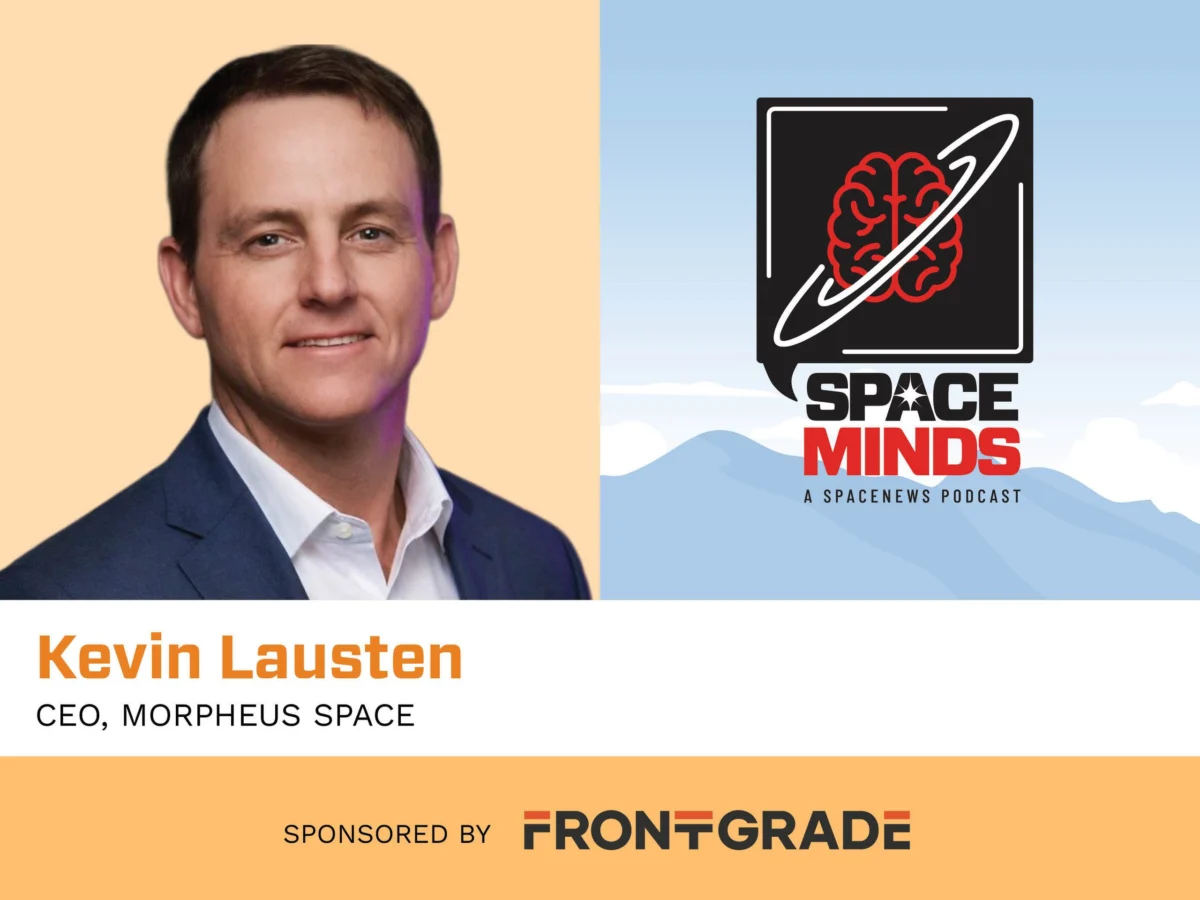
In a featured episode of the Space Minds podcast by SpaceNews, host Mike Gruss sat down with Kevin Lausten, CEO of Morpheus Space, to dissect this pivotal moment in space systems engineering. Their discussion illuminated how the convergence of orbital congestion, the demand for national technological sovereignty, and the rise of autonomous manufacturing are fundamentally reshaping the satellite propulsion sector.
1. Main Facts: The Centrality of Propulsion in Modern Space Operations
The modern space economy is undergoing a structural shift. Historically, small satellites—often referred to as CubeSats or SmallSats—were deployed as passive, secondary payloads. These spacecraft drifted along their insertion orbits, largely at the mercy of natural orbital decay and atmospheric drag.
Today, that paradigm is obsolete. According to industry leaders at the 2026 Small Satellite Conference, several factors have elevated propulsion to a critical mission requirement:
- Active Collision Avoidance: With thousands of active satellites and hundreds of thousands of pieces of trackable debris in Low Earth Orbit (LEO), the ability to actively maneuver is essential to prevent catastrophic collisions.
- Orbital Adaptation: Commercial operators and military commanders require the flexibility to alter orbits dynamically to respond to changing market demands, natural disasters, or adversarial threats.
- Regulatory Compliance: International regulatory bodies, including the U.S. Federal Communications Commission (FCC), have tightened post-mission disposal rules, making reliable de-orbit propulsion systems non-negotiable for licensing.
- Autonomous Operations: The sheer scale of planned mega-constellations makes manual, human-in-the-loop maneuvering impossible. Propulsion systems must now integrate directly with onboard autonomous flight software.
Morpheus Space, under the leadership of Kevin Lausten, has positioned itself at the intersection of these trends. The company specializes in highly integrated, modular electric propulsion systems that leverage advanced software to automate maneuver planning and execution, reducing the operational burden on satellite operators.
2. Chronology: The Evolution of Small Satellite Propulsion
The journey of small satellite propulsion from an experimental luxury to an operational necessity has occurred over three distinct phases.
+---------------------------------------------------------------------------------+
|                                 CHRONOLOGY                                      |
+---------------------------------------------------------------------------------+
| PRE-2015: The Experimental Era                                                  |
| - SmallSats are primarily passive educational tools.                            |
| - Lack of miniature propulsion limits missions to short lifetimes in low LEO.   |
+---------------------------------------------------------------------------------+
| 2015–2022: The Constellation Boom & Debris Wake-Up Call                          |
| - Launch of SpaceX Starlink and OneWeb demonstrates the need for active LEO     |
|   management.                                                                   |
| - Miniaturized cold gas and early electric propulsion systems emerge.           |
+---------------------------------------------------------------------------------+
| 2022–2025: Regulatory Hardening & Geopolitical Realignment                      |
| - FCC institutes the "5-Year Rule" for post-mission satellite de-orbiting.      |
| - Geopolitical conflict highlights vulnerability of shared orbital regimes.     |
+---------------------------------------------------------------------------------+
| 2026: The Autonomous & Sovereign Era                                            |
| - Propulsion becomes software-defined, modular, and mass-manufactured.          |
| - Western nations mandate domestic supply chains for critical components.       |
+---------------------------------------------------------------------------------+
The Experimental Era (Pre-2015)
In the early days of the CubeSat revolution, propulsion was virtually non-existent. Satellites were deployed from dispensers on launch vehicles and left to drift. Mission lifetimes were short, typically ranging from a few weeks to several months, and payload capabilities were highly constrained by weight and power limitations.
The Constellation Boom and Debris Wake-Up Call (2015–2022)
The mid-2010s saw the birth of commercial mega-constellations. As companies began launching hundreds, and eventually thousands, of satellites to build global broadband and Earth observation networks, the risk of orbital collisions skyrocketed. Operators realized that passive satellites were a liability. This era saw the rapid development of miniaturized electric propulsion (EP) systems, such as Hall-effect thrusters and gridded ion engines, adapted for smaller form factors.
Regulatory Hardening and Geopolitical Realignment (2022–2025)
In late 2022, the FCC adopted a new rule requiring satellite operators to de-orbit their spacecraft within five years of completing their missions, replacing the previous 25-year guideline. Concurrently, escalating geopolitical tensions on Earth bled into the space domain. Space agencies and defense departments began demanding "dynamic space operations" (DSO)—the ability for satellites to actively maneuver to avoid threat interception or to perform inspection missions.
The Autonomous and Sovereign Era (2026)
By the time of the 2026 Small Satellite Conference, the industry had transitioned to software-defined, autonomous propulsion systems. Thrusters are no longer standalone hardware components; they are integrated nodes within autonomous space traffic management (STM) networks, capable of making split-second maneuver decisions without ground intervention.
3. Supporting Data: The Quantitative Reality of LEO Congestion
The urgency surrounding the propulsion market is driven by stark statistical realities. The volume of objects in LEO has grown exponentially, transforming space traffic management from a theoretical problem into a daily operational crisis.
| Metric / Parameter | 2020 Value | 2026 Value (Projected/Current) | % Increase |
|---|---|---|---|
| Active Satellites in Orbit | ~3,300 | ~11,500+ | ~248% |
| Tracked Debris Objects (>10 cm) | ~25,000 | ~36,500+ | ~46% |
| Daily Conjunction Alerts (Average) | ~2,000 | ~12,000+ | ~500% |
| Global SmallSat Propulsion Market | $180 Million | $850 Million | ~372% |
The Operational Cost of Congestion
The data highlights a critical challenge for constellation operators. In 2026, a typical LEO operator managing a fleet of 100 satellites must process hundreds of conjunction data messages (CDMs) daily from the U.S. Space Force’s 18th Space Defense Squadron.
Without autonomous onboard propulsion, analyzing these alerts and executing avoidance maneuvers manually would require an unsustainable army of ground controllers. Furthermore, each maneuver consumes precious propellant, directly shortening the operational lifetime of the satellite unless highly efficient electric propulsion systems are utilized.
4. Official Responses and Industry Perspectives
The conversations at the 2026 Small Satellite Conference reflected a mature industry addressing complex geopolitical and manufacturing challenges. Kevin Lausten’s insights during the Space Minds podcast highlighted three pillars of the modern propulsion sector: sovereignty, autonomy, and scalable manufacturing.

Kevin Lausten on Sovereignty and the Global Supply Chain
In his interview with Mike Gruss, Lausten emphasized that "sovereignty" has become a dominant purchasing criterion for both government and commercial clients.
"Sovereignty in the modern space market is about supply chain security and national resilience," Lausten noted. "Governments are no longer willing to rely on critical components, like propulsion, that are manufactured in politically unstable regions or by potential adversaries. Having a localized, sovereign supply chain is now a prerequisite for securing defense contracts in the U.S. and Europe."
This shift has forced propulsion manufacturers to onshore their production facilities and source raw materials—such as propellants and high-grade electronics—from allied nations.
The Role of Autonomy in Production and Operations
Lausten also discussed how Morpheus Space is leveraging artificial intelligence and automation to scale production. Historically, space hardware was hand-assembled by highly specialized technicians, a process that limited production volumes and drove up costs.
To meet the demands of mega-constellation operators who require hundreds of thrusters per year, Morpheus Space has transitioned to automated robotic assembly lines.
"We are treating propulsion manufacturing more like the automotive industry," Lausten explained. "By standardizing our core architectures and using autonomous assembly, we can scale production rapidly while maintaining the rigorous quality control standards required for spaceflight."
Supporting Perspectives: The Infrastructure Layer
The emphasis on modularity and rapid deployment was echoed by other industry players, including Frontgrade Technologies, the sponsor of the Space Minds episode. Frontgrade, which has supported every U.S. crewed space mission since Apollo 11, highlighted the importance of modular microelectronics and motion control systems in enabling these advanced propulsion architectures.
By providing radiation-hardened, scalable processing units, component manufacturers enable propulsion systems to run complex autonomous flight software directly onboard the spacecraft, bypassing the latency associated with ground-to-space communications.
5. Implications: The Future of Orbital Mobility
The maturation of the propulsion industry carries profound implications for the future of space exploration, national security, and the commercial utilization of LEO.
              +--------------------------------------------------+
              |   Widespread Autonomous Propulsion Adoption       |
              +--------------------------------------------------+
                                       |
        +------------------------------+------------------------------+
        |                                                             |
        v                                                             v
+----------------------------------+                        +----------------------------------+
| Dynamic Space Operations (DSO)   |                        | Automated Space Traffic          |
| - Satellites change orbits to    |                        | Management                       |
|   evade threats or reposition.   |                        | - AI-driven peer-to-peer         |
| - Refueling and servicing        |                        |   coordination prevents          |
|   become routine.                |                        |   collisions without ground help.|
+----------------------------------+                        +----------------------------------+
The Transition to Dynamic Space Operations (DSO)
With reliable, high-efficiency propulsion, the space sector is moving away from static orbital architectures. The U.S. Space Force and allied military space commands are actively developing concepts for Dynamic Space Operations. In this paradigm, satellites are not fixed targets; they can maneuver to evade interceptors, reposition to cover emerging conflict zones, or rendezvous with servicing vehicles to refuel and extend their operational lives.
Preventing the Kessler Syndrome
The widespread adoption of active propulsion and autonomous collision avoidance is the primary defense against the Kessler Syndrome—a theoretical scenario where the density of objects in LEO is high enough that a single collision triggers a cascade of subsequent collisions, rendering certain orbits unusable for generations. Autonomous propulsion ensures that even as the number of satellites grows to tens of thousands, the probability of catastrophic collisions remains low.
Geopolitical Market Bifurcation
The insistence on sovereign supply chains is accelerating the bifurcation of the global space market into two distinct ecosystems: one led by the United States and its Western allies, and the other led by China and its partners. Propulsion companies will increasingly have to choose which market they serve, as security clearances and export control regulations (such as ITAR and EAR) become more stringent.
Conclusion: A Dynamic Frontier
The insights from the 2026 Small Satellite Conference and the Space Minds podcast make it clear that the future of space is dynamic. As space becomes more congested and contested, the ability to move, adapt, and survive is paramount. Through technological innovation, autonomous manufacturing, and a commitment to sovereign supply chains, propulsion pioneers like Morpheus Space are not just building thrusters—they are building the foundational infrastructure for the next era of humanity’s expansion into the cosmos.