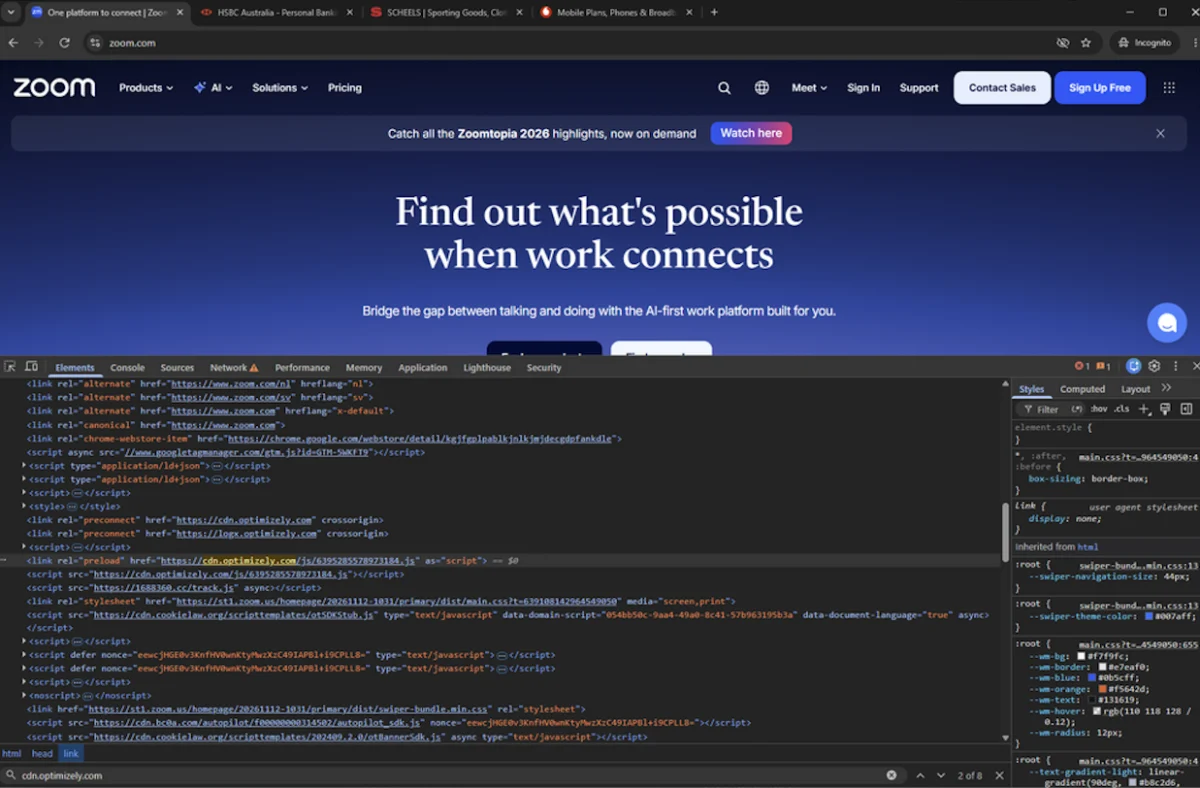
In an era where the modern web is built upon a precarious "house of cards" comprised of third-party dependencies, a single point of failure can trigger a cascading catastrophe. This week, the digital ecosystem was reminded of this fragility when a security vulnerability within Optimizely—a premier platform for digital experience optimization and A/B testing—was weaponized to deliver malicious payloads to the visitors of at least 178 high-profile web destinations.
The incident, which unfolded over a 24-hour period beginning on November 16, 2026, saw household names such as the BBC, CNN, Equifax, Ledger, and Zoom unwittingly serve data-stealing malware to millions of unsuspecting users. The attack underscores a harrowing reality: even the most sophisticated global enterprises are susceptible to supply chain attacks that bypass their internal security perimeters entirely.
The Anatomy of the Attack: A Chronology of Compromise
The breach began when unauthorized actors identified and exploited a vulnerability in the Optimizely Experimentation platform. By gaining the ability to inject custom JavaScript directly into customer projects, the attackers turned a tool designed to enhance user experience into a delivery mechanism for malicious code.
November 16: The Deployment
The malicious campaign commenced in the early hours of November 16. Security researchers at Report URI, led by Scott Helme, observed that the injected JavaScript was not a static threat; it was a dynamic, evolving payload. Throughout the day, the attackers rebuilt and updated the malicious code 26 times, constantly refining its capability to evade detection and maximize data exfiltration.
The Payload: A Multi-Stage Threat
The malware delivered via this supply chain attack was comprehensive. Once a user navigated to an affected site, the script executed immediately, requiring no user interaction. The toolkit functioned as a "Swiss Army knife" for cybercriminals:
- Data Theft: It harvested session cookies, saved payment card information, and captured screenshots of the user’s browser activity.
- Cryptocurrency Hijacking: The script actively monitored for crypto-wallet addresses, swapping legitimate payment destinations for those controlled by the attackers.
- Zero-Click Exploits: Perhaps most alarmingly, the payload included custom exploit kits—dubbed "DarkSword" and "Coruna"—specifically designed to target vulnerabilities in legacy Apple iOS devices. By chaining together six distinct security flaws, these kits could seize full, elevated control of an outdated iPhone or iPad, allowing the attacker to persist on the device long after the user navigated away from the compromised website.
Supporting Data: The Failure of Modern Defense
The breadth of this incident highlights a systemic failure in how websites manage third-party code. According to the 2025 Web Almanac, the median homepage now loads at least 22 distinct JavaScript files. Each of these represents a potential "backdoor" into a site’s environment.
The Content Security Policy (CSP) Void
The most effective defense against this type of attack is a robust Content Security Policy (CSP)—a security layer that allows site administrators to define exactly which domains are permitted to execute code on their pages. If properly implemented, a CSP would have blocked the unauthorized, malicious JavaScript from the Optimizely-hosted domain.
However, the data collected by Report URI paints a grim picture of current web hygiene:
- 68 websites impacted had no CSP implemented at all.
- 50 websites had an overly permissive CSP that failed to block the specific malicious domain used by the attackers.
- Only 24 websites (15%) had a policy strong enough to fully mitigate the threat.
Zach Edwards, a researcher at Infoblox and co-founder of the ad-tracking service DecryptAds, notes that the problem is exacerbated by the "fire-and-forget" nature of marketing scripts. "Because Optimizely is used for A/B testing, these snippets are embedded at the very top of the page and designed to fire before any consent dialog," Edwards explained. "This meant the attack was instantaneous. It didn’t matter if a user opted out of tracking or clicked ‘deny’ on a cookie banner; the code was already running."
Official Responses and Remediation
Optimizely responded to the crisis within hours, releasing a statement confirming that an unauthorized party had gained access to a vulnerable path within their infrastructure.

"We acted swiftly to contain the incident and have fully remediated the identified vulnerability," the company stated. Their response included:
- Access Restriction: Immediate blocking of the vulnerable path within their platform.
- Code Purge: Systematic removal of all injected malicious scripts from affected customer projects.
- Credential Reset: Termination of all active user sessions and the revocation of API tokens to prevent further unauthorized access.
- Enhanced Infrastructure Security: Implementation of additional safeguards within their Cloudflare delivery network to detect and block similar injections in the future.
On November 18, Optimizely published a detailed incident report, providing transparency into the technical nature of the vulnerability. While the company has engaged third-party forensic experts for a comprehensive investigation, the reputational damage and the lingering questions regarding how such an injection was possible remain at the forefront of the industry conversation.
Implications: The Age of JavaScript Supply Chain Attacks
The Optimizely incident serves as a wake-up call for web operators and security professionals alike. We have entered an era where "trusted" code is a dangerous assumption.
The "Wild West" of Web Dependencies
Scott Helme of Report URI describes the current state of the web as a "Wild West" where organizations blindly trust the third-party providers they integrate. "Organizations are running all this code, but they don’t know what it’s doing," Helme remarked. "Once an attacker gains the ability to run code on your site, they can script anything. With the rise of generative AI, the barrier to writing highly sophisticated, polymorphic malware has vanished. It is no longer a question of ‘if’ an attacker can craft a payload, but ‘what’ they want to steal."
The Future of Defense: Why CSPs Matter
For website operators, the path forward is clear but arduous. Implementing a strict CSP is the gold standard for security, yet it is notoriously difficult to configure without breaking site functionality. As marketing departments demand more data and more interactive content, the pressure to keep scripts unrestricted remains high.
However, as this incident proves, the cost of an overly permissive policy is no longer just a minor privacy concern—it is a full-scale compromise of the user’s device.
The Role of the End-User
For the average internet user, the defense landscape has shifted. Ten years ago, the focus was on local antivirus software. Today, that is insufficient. Modern ad-blocking and script-blocking extensions (such as NoScript or privacy-focused ad-blockers) have become the de facto firewalls of the modern web. By stripping away unnecessary third-party scripts, users effectively reduce the "attack surface" of their browser, shielding themselves from the ripple effects of supply chain breaches like this one.
Conclusion: A Turning Point for Web Security
The Optimizely breach resulted in an estimated $7,500 in cryptocurrency theft and an undisclosed number of compromised payment records—a figure that could have been significantly higher had the attackers been more aggressive. It stands as a stark warning: the convenience of third-party integration cannot continue to outweigh the necessity of rigorous security controls.
As the industry moves forward, the focus must shift from blind integration to "Zero Trust" web development. Until organizations treat third-party JavaScript with the same suspicion as an email attachment from an unknown sender, the next large-scale supply chain attack is not a matter of if, but when. The "trusted" web, it seems, is a luxury we can no longer afford to take for granted.