The global satellite-to-phone market is rapidly transitioning from nascent trials to a full-blown commercial battleground, signaling a new era of revenue opportunities for mobile operators and a titanic clash between industry giants. By 2026, the direct-to-device (D2D) satellite connectivity sector is set to ignite, with SpaceX’s Starlink, AST SpaceMobile, and Amazon Leo leading a charge to redefine mobile coverage and tap into billions of dollars in untapped revenue.
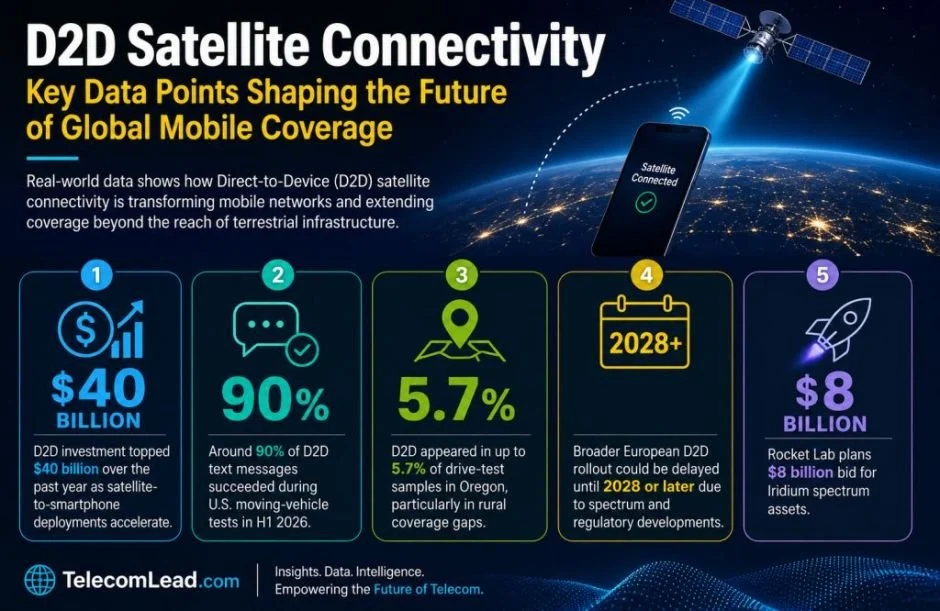
Unlike traditional satellite broadband that requires specialized equipment, D2D technology offers a revolutionary proposition: enabling ordinary smartphones to connect directly to satellites when terrestrial cellular networks falter. This breakthrough promises to eliminate dead zones and extend connectivity to the most remote corners of the globe, fundamentally altering the landscape of telecommunications.
The Imminent Boom: Market Projections and Investment Surge
The financial forecasts for the D2D satellite market paint a picture of exponential growth. Industry analysts predict a meteoric rise in both user adoption and revenue. Omdia, a leading market research firm, projects that by 2030, satellite D2D services will boast a staggering 411 million monthly active users, generating an annual revenue of $11.99 billion. This translates to an average annual growth rate of a remarkable 80.1 percent for users and 49.4 percent for revenue between 2026 and 2030.
Further underscoring the market’s potential, Gartner estimates the low-Earth-orbit (LEO) satellite connectivity opportunity for D2D services to be worth a colossal $20.2 billion. Meanwhile, GSMA Intelligence, the research arm of the global mobile industry association, anticipates that D2D could unlock over $30 billion in incremental connectivity revenue for telecom operators by 2035. These figures highlight not just a technological advancement, but a seismic shift in how connectivity will be delivered and monetized.
The burgeoning competition is increasingly being shaped by strategic partnerships between satellite providers and established mobile network operators. This collaborative approach is crucial for scaling services and ensuring widespread adoption. SpaceX’s Starlink, already possessing the largest operational satellite-to-mobile network, is aggressively pursuing these alliances. AST SpaceMobile boasts an impressive network of agreements with over 60 operators, collectively covering more than 3 billion subscribers. Amazon, with its ambitious Project Kuiper initiative rebranded as Amazon Leo, has significantly bolstered its position through the planned acquisition of Globalstar and a critical agreement to support Apple’s satellite services.
A Snapshot of the Key Players
The race to dominate the satellite-to-phone market is a high-stakes affair, with each major contender leveraging unique strengths and strategic maneuvers.
Starlink Leads the Charge with an Expanding Constellation
SpaceX’s Starlink has established a significant early deployment advantage, driven by its unparalleled ability to rapidly manufacture and launch satellites. Its direct-to-mobile constellation has already reached approximately 650 LEO satellites, making it the largest such network in operation. This extensive constellation is designed to support data, voice, video, and messaging services, with plans to extend its reach to over 1.7 billion people through strategic mobile operator partnerships.
According to GSMA Intelligence, as of May 2026, Starlink was already powering services for an impressive 7.4 million monthly unique devices across roughly 30 countries, utilizing its 650 D2D satellites. This rapid adoption is facilitated by a growing roster of high-profile partners, including T-Mobile US, Optus, Telstra, Rogers Communications, KDDI, One NZ, Globe Telecom, Salt, Entel, and Kyivstar.
The evolving nature of satellite roaming is exemplified by Japan’s market. KDDI, a key Starlink partner, expanded international satellite roaming for its au Starlink Direct customers to include Canada in June 2026, with further planned availability in the Philippines and New Zealand, in addition to existing US connectivity. This demonstrates the seamless integration of satellite services into existing mobile offerings.
Starlink’s strategic approach, as detailed on its website, focuses on integrating satellite connectivity directly with existing mobile networks. This model allows operators to retain crucial aspects of their business, including billing, spectrum ownership, and customer relationships, while SpaceX provides the essential satellite coverage layer. Mobile operators can then monetize this service through various avenues, such as premium tariffs, add-on packages, enhanced roaming capabilities, emergency services, and specialized enterprise IoT plans.
However, it’s important to note that satellite connectivity currently primarily serves as a coverage enhancement. GSMA Intelligence data from May 2026 indicated that T-Mobile’s T-Satellite traffic represented a mere 0.0002 percent of the operator’s total US network usage, underscoring its current role as a complementary service rather than a replacement for terrestrial networks.
AST SpaceMobile: Building a Global Operator Network
AST SpaceMobile is emerging as Starlink’s most direct and formidable competitor in terms of telecom distribution. By August 2026, the company had secured agreements with an extensive network of over 60 mobile network operators, collectively representing more than 3 billion subscribers. This vast network includes industry heavyweights such as AT&T, Verizon, Vodafone, and Saudi Telecom Company (stc).
AST has inked a significant agreement to provide SpaceMobile connectivity to AT&T customers across the continental United States and Hawaii. Furthermore, a definitive commercial agreement has been finalized with Verizon for direct-to-cellular services slated to commence in 2026.
In a strategic move in October 2025, AST signed a 10-year commercial agreement with stc, covering Saudi Arabia and other key markets. Vodafone is also a crucial partner, facilitating the distribution of SpaceMobile services to operators throughout Europe, the UK, and select additional regions.
The company’s financial performance is beginning to reflect its accelerating commercialization efforts. AST generated $31.5 million in revenue during the second quarter of 2026, primarily from gateway deliveries and US government milestones. The full-year revenue is projected to reach between $150 million and $200 million, a substantial increase from the $70.9 million recorded in 2025.
The revenue backlog has surged to approximately $1.30 billion, encompassing both commercial contracts and US government awards, with government awards alone exceeding $125 million. Financially, AST reported robust liquidity, with over $3.7 billion in pro forma cash, cash equivalents, and restricted cash as of June 30, 2026. This was further bolstered by a $1.15 billion capital raise through convertible senior notes in July.
Infrastructure expansion is also progressing at an impressive pace. In August 2026, nearly 50 gateways were in various stages of completion, installation, and planning. AST is targeting the deployment of 45-60 satellites by the end of 2026, with launches scheduled approximately every one to two months. The successful launch of BlueBird 11, 12, and 13 on August 5 further solidifies this deployment trajectory.
Amazon Leo: A New Entrant with Massive Ambitions
Amazon Leo, formerly known as Project Kuiper, has rapidly emerged as a significant contender in the direct-to-phone race. In a landmark announcement in April 2026, Amazon revealed its agreement to acquire Globalstar, a move that would grant it access to Globalstar’s existing satellite constellation, ground infrastructure, and crucial mobile satellite service spectrum. This acquisition is anticipated to be finalized in 2027, pending regulatory approvals.
Amazon has also secured a pivotal distribution channel through its partnership with Apple. Amazon Leo will be instrumental in supporting satellite services for compatible iPhone and Apple Watch models, encompassing essential features such as emergency messaging, general communications, and roadside assistance.
Amazon’s long-term vision for Amazon Leo extends far beyond these initial applications. In July 2026, Amazon Leo submitted a filing to the FCC seeking approval for a dedicated D2D constellation comprising up to 5,105 satellites. The planned deployment of this ambitious constellation is slated to commence in 2028, with the capacity to support voice, messaging, data, and emergency services directly to compatible mobile devices.
Parallel to its D2D ambitions, Amazon’s broader broadband satellite constellation is undergoing rapid expansion. In March 2026, the company announced the successful launch of over 200 satellites, with an additional 200-plus units stacked and ready for launch. Amazon planned for more than 20 missions during its second year of deployment and has invested over $200 million in infrastructure at Cape Canaveral. By the time of its Q1 results announcement, Amazon had completed its tenth Leo launch, placing more than 250 satellites in orbit. The company’s comprehensive broadband network is designed to accommodate over 3,000 satellites, supported by more than 80 contracted launches from leading launch providers including Arianespace, Blue Origin, SpaceX, and United Launch Alliance.
Strategic Partnerships: Vodafone’s Dual Role
Vodafone is playing a multifaceted role in the evolving satellite-to-phone landscape, demonstrating the complex interplay of partnerships. In March 2026, Vodafone and Amazon Leo expanded their collaboration, with Vodafone intending to leverage the LEO network for satellite backhaul to connect additional 4G and 5G mobile sites across Europe and Africa. This is particularly beneficial in regions where terrestrial backhaul solutions are challenging or prohibitively expensive.
Beyond its partnership with Amazon Leo for backhaul, Vodafone is also actively involved with AST SpaceMobile for direct-to-device connectivity. This dual engagement highlights a strategic approach where operators may utilize multiple satellite networks for different service applications. Amazon also has existing satellite relationships with entities like Australia’s National Broadband Network, DirecTV, and Herotel, further expanding its reach and potential integration points.
The Road Ahead: A Market Transformed
The trajectory of the satellite-to-phone market is clear: a period of unprecedented growth and widespread adoption. Omdia’s projections of 411 million monthly active users and $11.99 billion in annual service revenue by 2030 underscore this optimistic outlook. A crucial trend emerging is the overwhelming preference for services compatible with standard cellular devices. By 2030, over 95 percent of global D2D monthly active users are expected to utilize cellular-standard devices, favoring seamless integration with conventional 4G and 5G smartphones over dedicated satellite phones.
Deloitte estimates that spending on D2D satellite capacity could reach between $6 billion and $8 billion in 2026 alone. By the end of the same year, it is anticipated that more than 1,000 D2D-capable satellites could be operational. The broader LEO satellite industry is also poised for significant expansion, potentially exceeding 15 million subscribers in 2026 and generating approximately $15 billion in annual revenue.
The geographic opportunity is immense. GSMA Intelligence points out that terrestrial mobile networks still fail to cover approximately 62 percent of the Earth’s landmass. This vast underserved territory represents a prime market for satellite-to-phone services.
Who Will Reign Supreme in the Satellite-to-Phone Race?
Determining a clear winner in this rapidly evolving race is premature, but current standings offer valuable insights.
SpaceX’s Starlink currently holds the lead in terms of deployment, boasting approximately 650 D2D satellites, servicing 7.4 million monthly unique devices, and operating in around 30 countries. Its ability to rapidly launch satellites gives it a significant operational advantage.
AST SpaceMobile leads in potential operator reach, with over 60 operator partners serving more than 3 billion subscribers. Its accelerating commercialization, evidenced by an expected $150 million-$200 million revenue in 2026, a $1.30 billion backlog, and planned satellite deployments, positions it as a strong contender.
Amazon Leo represents the long-term wildcard. Its ambitious proposal for a 5,105-satellite D2D constellation, coupled with the planned acquisition of Globalstar, its strategic partnership with Apple, a vision for over 3,000 broadband satellites, and more than 80 contracted launches, could dramatically reshape the competitive landscape from 2028 onwards.
For telecom operators, the satellite-to-phone market presents a compelling opportunity to generate substantial additional revenue without the prohibitive cost of constructing thousands of low-utilization rural cell sites. GSMA Intelligence estimates that this could translate to an incremental average revenue per user (ARPU) of roughly $4-$5 per person per month among addressable users, leading to more than $30 billion in incremental connectivity revenue by 2035.
Ultimately, the satellite-to-phone contest is evolving beyond a mere technological race between Starlink, AST SpaceMobile, and Amazon Leo. It is a high-stakes competition to secure control over the next frontier of global mobile coverage and to capture billions of dollars in telecom revenue from locations that terrestrial networks have historically been unable to economically reach. The sky, it seems, is no longer the limit, but the new expansive territory for mobile connectivity.